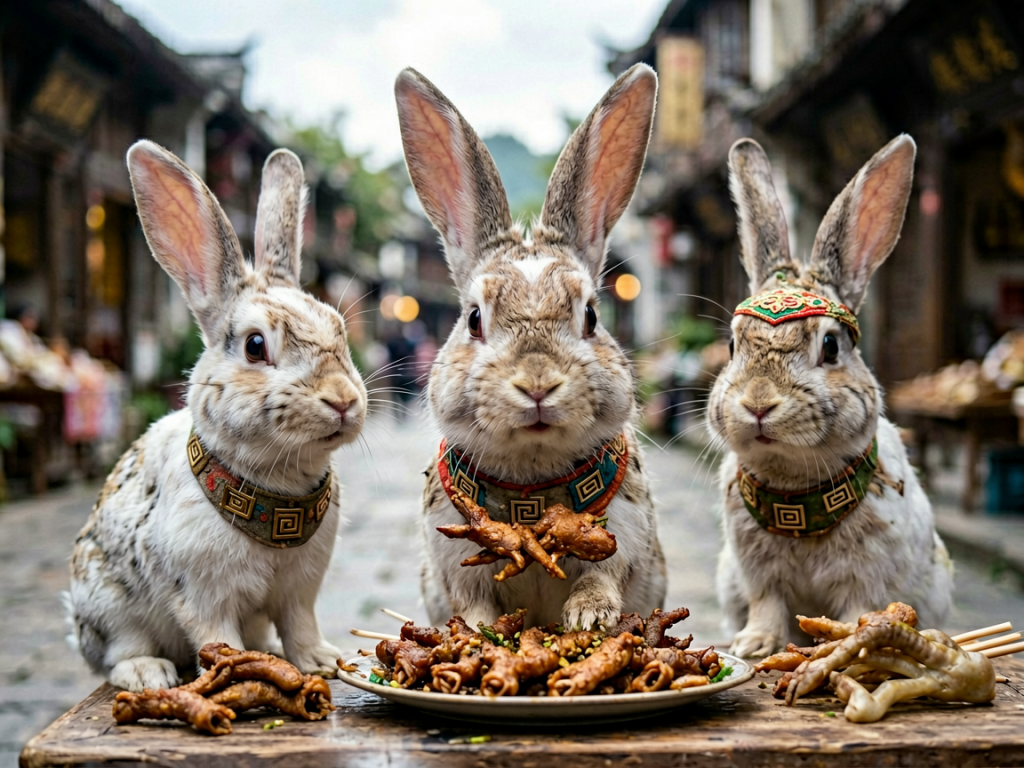
So, you think you’re brave with food? You’ve tried stinky tofu in Changsha. You’ve dared to eat durian in Guangzhou. You even looked a spider in the eye before deep-frying it in Yunnan.
Huge respect. But let’s get one thing straight. None of that prepares you for the street stalls of Chengdu.
I’m talking about the things that look like they fell off the body. The ears. The eyes. The feet. The necks. When I first moved here eight years ago, I thought I had seen it all. Then my boss took me to a night market near Tianfu Square.
He pointed at a steaming plastic bin and said, “Try this.”
Inside was a rabbit head. Glazed in red chili oil, staring up at me with glassy, dead eyes. I wanted to run. Instead, I sat down. And honestly? It changed how I see Chinese street food forever.
Sichuan people don’t just eat for sustenance. They eat for the thrill. The texture. The challenge. Today, I’m going to walk you through the holy trinity of Sichuan snacking: rabbit heads, duck necks, and chicken feet. Trust me, once you try these, you’ll never look at a wing drumstick the same way again.
The Rabbit Head: Why Eat the Whole Face?
Let’s address the elephant in the room–or rather, the lagomorph in the bag.
Eating a rabbit head feels primal. It’s intense. But here’s the secret nobody tells you: there’s very little meat on a rabbit head. You aren’t eating it for calories. You’re eating it for the cheek muscles and the jaw.
The cheek meat is tender. Sweet, even. But the real prize is the flavor absorption. These heads are boiled in a broth of star anise, cinnamon, Sichuan peppercorns, and enough dried chilies to set your soul on fire.
I remember my first time. I picked it up with both hands, like a toddler with a drumstick. I pulled the jaw apart. The cartilage snapped audibly. It was satisfying in a weird, ASMR kind of way.
You suck the meat right off the bone. You chew the cheeks until they dissolve. Then, you hit the spicy oil. It coats your tongue and makes your nose run. That’s the point. The spice isn’t a bug; it’s a feature.
If you’re squeamish, look away. Focus on the flavor. My friend Lao Li calls it “playing with your food.” He eats them faster than I can blink. He says the eyes are the best part–gelatinous and rich. I’ll stick to the cheeks, thanks.
Pro tip: Don’t try to eat the whole thing in one bite. You’ll choke. Or you’ll lose a tooth. Take it slow. Tear the face apart piece by piece. It’s almost meditative. Almost.
Duck Necks: The Art of the Long Chew
If rabbit heads are the intense date of Sichuan snacks, duck necks are the long-term relationship. They require patience. They require effort. And they reward you with hours of savory entertainment.
I live three blocks from a stall called “Wei Wei Duck.” The owner, Auntie Wei, has been selling these since 1998. Her duck necks are darker than night. Glossy. Sticky.
The meat on a duck neck is lean. Very lean. There’s no fat to hide behind. So, the marinade does all the heavy lifting. It penetrates deep into the small muscles wrapping around the vertebrae.
When I first ate one, I struggled. I couldn’t get past the windpipe. Auntie Wei watched me, shook her head, and demonstrated. She twisted the neck, pulled the skin back, and showed me how to slide the meat off the bone in one long strip.
It felt like magic. And it tasted like umami bomb.
Sichuan duck necks come in two main styles: dry-spiced and wet-braised. The dry version is dusted with chili powder and cumin. It’s crunchy and smoky. The wet version is stewed in soy and star anise until the meat is soft and falling off.
I’m a wet-verse guy myself. There’s something comforting about the warm, savory broth soaking into every fiber. I usually buy five or six at a time. I’ll walk home with them in a plastic bag, gnawing on one like a dog. People stare. I don’t care.
It’s cheap, too. Two RMB each. That’s less than forty cents. You can’t even buy a bottle of water for that price in some tourist traps. Yet here I am, spending my hard-earned yuan on poultry anatomy.
Is it weird? Yes. Is it addictive? Absolutely. Once you master the twist-and-pull technique, you’ll find yourself seeking out duck necks wherever you go in China. It’s the ultimate bar snack.
Chicken Feet: Texture Over Taste
Now, let’s talk about chicken feet. Or *zhao jiao* as the locals call them.
Westerners have a love-hate relationship with chicken feet. We see them and think, “That’s a foot. Why would anyone eat a foot?”
Sichuan people look at you like you’re crazy. To us, a chicken foot is pure texture heaven. It’s all collagen. All gelatin. Melt-in-your-mouth goodness.
The taste comes entirely from the sauce. In Chengdu, the classic preparation is *hongyou paofeng*. Red oil frog feet? No, wait, that’s different. Red oil chicken feet.
The feet are blanched, then cooled in ice water to tighten the skin. After that, they’re tossed in a mixture of sesame oil, chili oil, garlic, ginger, vinegar, and cilantro.
Imagine biting into a tender, slippery nub. The skin gives way instantly. The meat is minimal, but the flavor is intense. Garlic bites you back. Vinegar tangs your palate. Chili warms your throat.
I tried making these at home once. Big mistake. My kitchen smelled like a Chinese restaurant for three days. And the texture was rubbery because I didn’t cool them in ice water fast enough.
Auntie Wei at the market always reminds customers to shake the bag well before opening. The oil settles at the bottom. You want that concentrated pool of red gold at the end.
It’s messy. Your fingers will be stained orange. You’ll need napkins. Lots of them. But the payoff is worth the cleanup.
What surprised me most was how social they are. You don’t eat chicken feet alone. You eat them while drinking beer with friends. You pick at them, complain about work, laugh about nothing. They’re conversation starters. Literally. You have to keep your mouth busy.
Why This Matters: More Than Just Snacks
You might be wondering, “Why is this culture so obsessed with animal parts?”
It’s not just about being weird. It’s about resourcefulness. Historically, food was scarce. Throwing away parts meant wasting precious protein. Sichuan cuisine turned waste into delicacies.
But it’s also about the sensory experience. Western dining often prioritizes presentation. We want clean plates. Neat cuts. In Sichuan, the mess is part of the fun. Getting your hands dirty connects you to the food.
There’s a philosophy here. Embrace the unknown. Challenge your boundaries. Find joy in the unusual.
When I bring foreign friends to these night markets, their faces go through five stages of grief. Denial. Anger. Bargaining. Depression. Acceptance.
Stage four is where most quit. Stage five is where they order seconds.
I’ve seen tough guys from Texas cry over the spiciness of a duck neck. I’ve seen delicate fashion bloggers devour rabbit heads like popcorn. Food breaks down barriers. It forces vulnerability.
And that’s beautiful. You can’t pretend to be sophisticated when you’re holding a chicken foot in your sweaty hand, trying to figure out which joint to twist.
Your Turn: Don’t Be Afraid
So, are you ready to try? Maybe start with the duck necks. They’re the least intimidating. Just follow Auntie Wei’s twisting method.
Then, move up to the chicken feet. Enjoy the cold, garlicky crunch.
And finally, tackle the rabbit head. For courage. For flavor. For the story.
You’ll regret it if you don’t. Not because you’ll get sick, but because you’ll miss out on one of the most vibrant, chaotic, delicious aspects of Chinese life.
Sichuan street food isn’t just fuel. It’s theater. It’s community. It’s art.
I still remember the first rabbit head I ate. It was midnight. The air was humid. The neon lights reflected in the puddles. My friends were laughing. The chili oil was burning my lips, but I couldn’t stop smiling.
That’s the magic. Come for the spice. Stay for the experience. And maybe, just maybe, fall in love with the things that used to scare you.
See you at the night market. Bring a napkin.