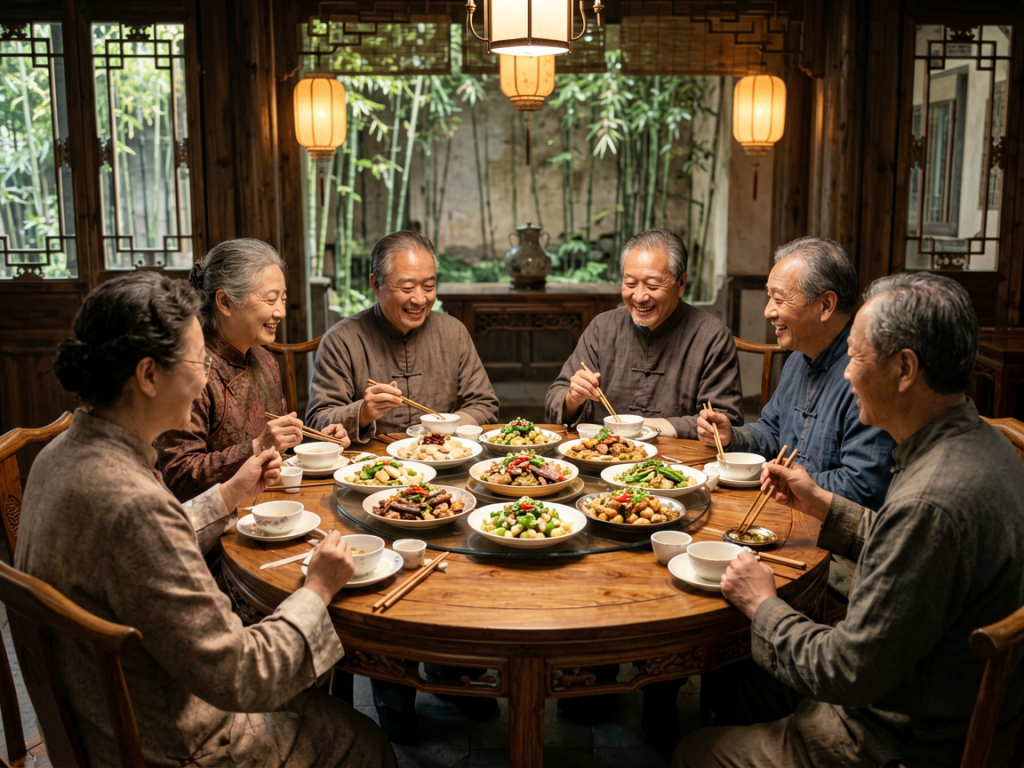
I remember my first time sitting down for a formal dinner in Chengdu. I arrived early, expecting a standard rectangular setup like I’d seen in so many Western movies. Instead, the host pointed to a massive, circular wooden table dominating the center of the private room. There was no head of the table. No left or right side. Just a perfect, unbroken circle.
At first, I was confused. Then, a bit annoyed. I’m used to having my own designated space, my own plate, my own corner. Sitting at a round table felt chaotic. Who is the guest of honor? Where do I sit? Is it polite to reach across?
I didn’t know then that this geometry wasn’t a design flaw. It was the entire point. In China, the round table isn’t just furniture. It’s a social contract. It’s a physical manifestation of unity, equality, and the messy, beautiful chaos of communal living.
The Lazy Susan Changes Everything
You can’t talk about the round table without talking about the Lazy Susan. That spinning glass or bamboo platform in the center is arguably the most important piece of technology in Chinese dining. And no, it doesn’t have a single standardized name in English. Some call it a turntable, others a rotating tray.
When I first saw it, I thought it was a gimmick. But after eight years of eating out in China, I’ve learned that it’s actually genius. It solves the biggest problem of communal dining: access.
Imagine a square table with four dishes in the middle. If you’re sitting on the opposite side, you’re stuck. You have to stand up, lean over, maybe knock into someone’s elbow to get to the Kung Pao chicken. It’s awkward. It breaks the flow of conversation. It creates friction.
With a round table and a spinner, distance becomes irrelevant. The food comes to you. Or rather, the opportunity to take the food rotates to you. It forces a pause in the action. You have to watch the dish approach. You have to decide when to stop it. This small mechanic creates a rhythm to the meal that rectangular tables simply can’t match.
I love how it slows people down. You aren’t just shoveling food into your mouth. You’re participating in a collective movement. It’s dance-like, really. And it ensures that everyone gets an equal shot at the best bites, provided they pay attention.
Democracy in Dinnerware
In Western dining, the seating arrangement is often a strict hierarchy. The host sits at the head. The VIP sits to the right. The junior colleague sits at the foot or far ends. The table tells you exactly where you stand in the social pecking order. It’s subtle, but it’s there.
The round table rejects this. By its very shape, it eliminates the “head.” Everyone is equidistant from the center. Everyone is equidistant from each other.
This doesn’t mean there are no rules. There are. But they’re different. For example, the seat facing the entrance is traditionally reserved for the eldest or the most honored guest. But once you’re seated, the geometry levels the playing field.
I’ve hosted dinners in Beijing where we had twelve people around a table meant for ten. It was cramped. We were shoulder to shoulder. But nobody felt excluded. The proximity forced interaction. You couldn’t ignore the person next to you. You couldn’t hide in the corners.
This is crucial in Chinese culture, which places a huge emphasis on *guanxi*–relationships. The round table is a relationship-building machine. It removes barriers. It physically brings people together in a way that a long, narrow table never could.
To be fair, it’s not always comfortable. My knees are often touching the person across from me. My elbow brushes against my neighbor’s. But that’s the trade-off. Intimacy costs a little personal space. And in China, intimacy is the goal.
The Art of the Shared Plate
Let’s talk about the food itself. In the West, we often order individual portions. I get a steak. You get a burger. We eat what’s in front of us. It’s clean. It’s efficient. But it’s also isolated.
Chinese families order family-style. We share everything. The round table is designed for this. It maximizes surface area in the center, allowing for more dishes to be placed within arm’s reach of everyone.
I’ll never forget a hotpot night in Xi’an. We had a pot of boiling broth in the very center, surrounded by plates of raw beef, lotus root, mushrooms, and tofu. The table was full. Overflowing, almost. But because it was round, everyone could reach the ingredients equally.
We cooked the meat together. We passed the dipping sauces around. We clinked glasses over the center. The food became a focal point of shared experience, not just individual consumption.
There’s a saying in China: “Dumplings look like ingots.” They symbolize wealth. But the act of making them together, or eating them from a shared bowl, symbolizes prosperity through community. If you eat alone, you survive. If you eat together, you thrive.
I used to prefer individual plates. It felt safer. Hygienic, even. But I’ve come to appreciate the trust involved in communal eating. You’re trusting that the person pouring the tea for you will pour enough. You’re trusting that the person taking the last dumpling will leave you a smile and a story.
It’s vulnerable, in a way. And that vulnerability builds bonds. Stronger ones than sitting across from someone at a silent, rectangular table ever could.
Circular Time and Circular Life
There’s a deeper philosophical layer here too. Chinese culture is deeply influenced by Taoism and Confucianism, both of which value cycles over linear progress.
A circle has no beginning and no end. It represents continuity. Rebirth. The eternal return. When we sit around a round table, we are participating in a ritual that mirrors the universe itself. It’s cyclical. It’s inclusive.
In contrast, a rectangle has four corners. Four distinct points. It implies direction. Start and finish. A round table implies that the conversation continues. The friendship endures. The family stays together.
I’ve noticed this in how toasts work. In a rectangular setting, you might toast the person next to you, then the one across. It’s sequential. On a round table, a toast often starts at the center or the honored guest and moves outward, or everyone raises their glass simultaneously. It’s a moment of collective unity.
Once, during the Lunar New Year reunion dinner, my host family insisted we all raise our glasses at the exact same second. Not one by one. All at once. The clinking of glasses was deafening. The joy was palpable. It felt like a wave of energy that hit every person in the room simultaneously.
That’s the power of the geometry. It synchronizes us. It reminds us that we are part of a whole, not just isolated individuals.
Modern Adaptations and Global Influence
Now, don’t think this is some ancient tradition frozen in time. The round table is evolving. In modern high-end restaurants in Shanghai, you’ll see round tables made of sleek marble or integrated with digital menus. The Lazy Susans are now motorized, controlled by buttons on the table surface.
But the core principle remains. Even as China modernizes rapidly, the desire for communal dining persists. People are moving into smaller apartments. Space is getting tighter. Yet, when they gather for important meals, they prioritize the round table.
I’ve even seen Chinese restaurants in New York and London adapting. They replace the long communal benches with round tables. They bring the Lazy Susan to American diners who are used to splitting the bill and going separate ways. It changes the vibe of the meal entirely. It forces a slower, more connected experience.
Some Westerners complain about the lack of privacy. They say it’s noisy. They miss their own designated spot. But those who stick with it often report that they enjoy the meal more. The anxiety of “where do I sit?” vanishes. The focus shifts back to the food and the company.
It’s easier than you’d expect to adapt. You just have to let go of the need for control. Let the table spin. Let the food move. Trust the process.
The Heart of the Home
If you visit a traditional Chinese home, the living room is often arranged around a coffee table. But the dining room? That’s sacred ground. The table is the heart of the home.
I’ve been invited into countless homes in China. In every single one, the round table was the centerpiece. It was where birthdays were celebrated. Where business deals were whispered over tea. Where arguments were resolved and friendships were cemented.
It’s not just about eating. It’s about existing together. In a world that’s increasingly digital and fragmented, there’s something grounding about sitting in a circle, passing dishes, and looking each other in the eye.
I’m no sociologist. I’m just a traveler who loves good food and great stories. But I’ve learned that the shape of your table shapes your relationships. A square table separates. A round table connects.
So next time you’re invited to a Chinese banquet, or even just a family dinner, look at the table. Notice the curve. Notice the spinner. Notice how everyone fits.
Don’t try to find the head of the table. There isn’t one. Just sit down. Spin the dish your way. And enjoy the meal.
Trust me, it’s better than any alternative. And honestly, it might just change how you think about dining forever.