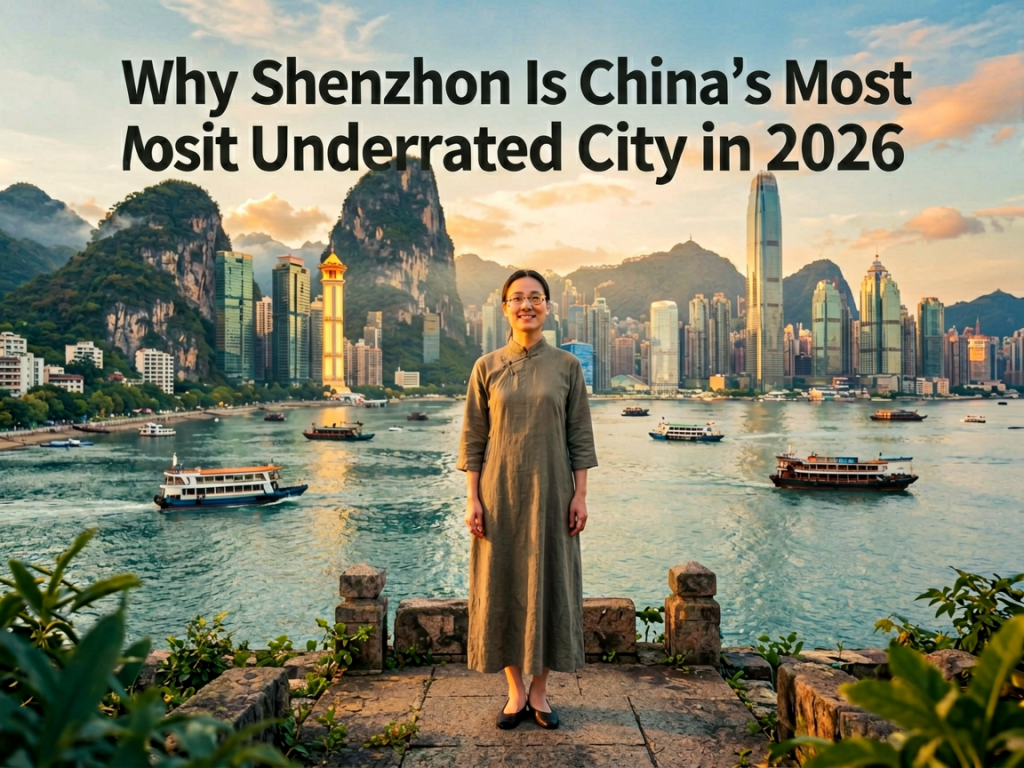
I’ll be honest, I used to hate Shenzhen.
When I first moved here eight years ago, I couldn’t stand it. It felt too loud, too fast, and entirely lacking in soul. The air smelled like diesel and ambition. There were no old temples hiding behind skyscrapers. There were no tea houses where grandfathers argued over Go for hours. There was just… building.
But then something shifted. Maybe it was the humidity finally breaking in October. Or maybe it was realizing that while everyone else was looking at Beijing for history or Shanghai for luxury, the actual heartbeat of contemporary China was thumping right here in the Greater Bay Area.
Now, standing on the coast in 2026, I wouldn’t trade this place for anything. Shenzhen isn’t just a city anymore. It’s a mood. It’s a promise. And frankly, it’s the most underrated destination in China right now.
The City That Refuses to Sleep
You’ve heard the stories. Everyone talks about Shenzhen as the Silicon Valley of hardware. And sure, that’s true. But you’re missing the point if you only think about code and circuits.
I remember walking through Huaqiangbei late one night last year. You know the place? It’s a labyrinth of electronics markets that stretches for blocks. Most tourists skip it because it looks like chaos. I stopped skipping it three years ago.
I was there trying to find a specific drone part for a friend’s startup. The market was alive. Not just busy, but electric. Vendors shouted over each other in Cantonese, Mandarin, and broken English. Stacks of PCBs reached the ceiling. Cables hung like vines in a jungle.
What struck me wasn’t the technology. It was the speed. In Beijing, you wait for approval. In Shanghai, you wait for style. In Shenzhen, you wait for nothing. You want a prototype? Make it tonight. You need a casing? Print it by morning. You want to launch next week? Go for it.
This hustle culture isn’t toxic here. It’s liberating. It feels like the future is a material you can touch. I watched a young woman solder a circuit board while simultaneously video-calling an investor in Berlin. She didn’t look stressed. She looked focused. That’s the vibe. That’s the energy that keeps me coming back.
Coastlines You Won’t Find Elsewhere
Here’s the thing about Shenzhen that surprises people. It’s not just concrete and glass. It’s also one of the most beautiful coastal cities in Asia.
We spent last Sunday at Dameisha Beach. I know, I know. Dameisha gets crowded. But go early. Like, 6 AM early. The sun hits the water in a way that makes you forget you’re in a megacity.
The coastline here is wilder than you’d expect. I love taking my bike along the Shenzhen Bay Park trail. It winds for miles, hugging the shore. On one side, you have the lush greenery of parks and hills. On the other, the sparkling skyline of Hong Kong across the water.
It’s a unique view. You can see the colonial architecture of Kowloon mixing with the brutalist modernism of Futian. It’s a visual metaphor for the city itself. Tradition and innovation, side by side, never quite touching but always present.
I stopped at a small stall near the pier. A local guy was grilling squid over charcoal. He handed me a skewer for 15 yuan. It was smoky, salty, and perfect. I ate it while watching the sunset turn the bay purple. No fancy restaurant. No reservations. Just good food and a great view.
This is what Shenzhen does best. It doesn’t force you into a box. Want to hike? There are hills. Want to surf? Dapeng Peninsula is ready. Want to sit on the beach and do nothing? The city allows that too, even if just for an hour.
The Food Scene Is Finally Maturing
I’m no expert on fine dining, but I do know good food. And for years, the narrative was that Shenzhen had none. Just fast food and cheap noodles.
To be fair, the cheap noodles were amazing. I still dream about the beef noodle soup from that little shop near my old apartment in Nanshan. But 2026 is different.
The culinary landscape here has exploded. Not just in terms of variety, but in depth. Chefs who previously worked in Guangzhou or Chengdu have settled here. They bring their techniques. They bring their patience.
Last month, I tried a new dim sum spot in Shekou. It wasn’t the typical tourist trap. It was run by a third-generation chef who insisted on making every dumpling by hand. He showed me how he pleated the skin. It took him ten seconds. I tried one. It was delicate, rich, and perfectly balanced.
It cost about 80 yuan for a basket. Reasonable? Yes. Worth it? Absolutely.
And it’s not just Cantonese. Because Shenzhen is a city of migrants, you get everything. Great Sichuan hotpot in the north of the city. Authentic Thai curries in the south. Even some decent coffee. Don’t laugh. The coffee scene here is serious. Roasters source beans directly from Yunnan and Ethiopia. The brews are clean, bright, and strong.
I met a barista at a small café in OCT-LOFT. We talked for an hour about extraction times and bean origins. He told me that Shenzhenians drink coffee faster than anyone else in China. They treat it like fuel. I prefer to treat it like a moment. But I respect both approaches.
Why It Matters Now
So why should you care about Shenzhen in 2026? Why not just stick to the usual suspects?
Because Shenzhen is showing us what’s next. It’s not just about technology. It’s about how technology integrates into daily life.
Pay with your face? Done. Take a bus with your phone? Easy. Order groceries to arrive in 30 minutes? Standard. It’s seamless. It’s invisible. It just works.
But beyond the tech, there’s a sense of possibility that you can’t find elsewhere. In Beijing, you feel the weight of history. In Shanghai, you feel the pressure of status. In Shenzhen, you feel the pull of potential.
I’ve seen startups die here. I’ve seen companies rise overnight. It’s ruthless. But it’s also fair. If you have an idea, you can test it. If it fails, you try again. No one cares where you’re from. They only care what you can build.
This meritocracy is refreshing. It’s exhausting, yes. But it’s honest. I love that about this city. It doesn’t pretend to be anything other than what it is. A machine for creating the future.
A Personal Take
I still miss the quiet sometimes. I miss the old alleyways that got torn down for malls. I miss the feeling of being alone in a crowd.
But then I walk out onto the balcony of my apartment in Nanshan. I watch the lights flicker on across the bay. I hear the distant hum of traffic. I smell the salt from the sea.
And I realize that this noise is life. It’s the sound of millions of people trying to make something of themselves.
Shenzhen isn’t perfect. The weather is humid. The crowds are dense. The pace is relentless. But it’s real. It’s unfiltered. It’s the most alive city I’ve ever known.
If you’re looking for peace, go to Hangzhou. If you’re looking for romance, go to Paris. But if you want to see what tomorrow looks like, come here. Bring your curiosity. Leave your preconceptions.
You might not fall in love with it immediately. I didn’t. But you’ll respect it. And eventually, you’ll understand why it’s built the modern world around us.
Trust me. Give it a week. Rent a bike. Get lost in the markets. Eat street food until you’re stuffed. Talk to the locals. You’ll see it. You’ll feel it. And you’ll probably start planning your own next move.
That’s the Shenzhen effect. It stays with you long after you leave.