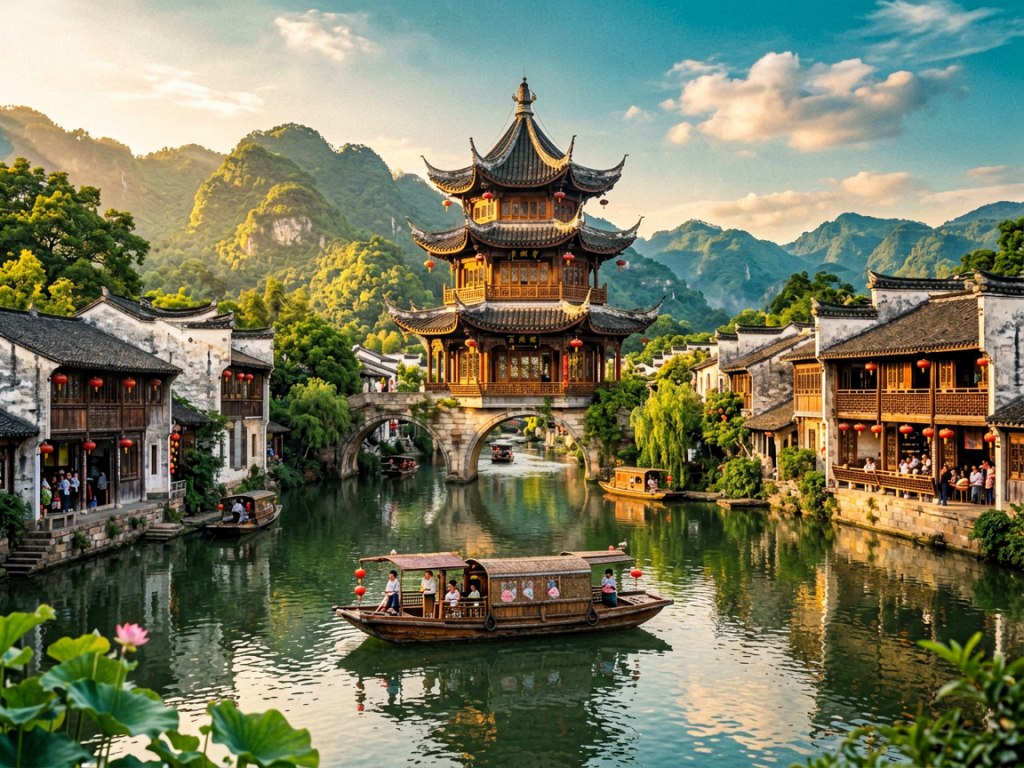
The City That Doesn’t Feel Like a Tourist Trap
I’ll be honest, I was skeptical when my friend in Beijing told me to skip Xiamen and head north to Quanzhou. She said Quanzhou had everything Xiamen did, but without the crowds, the inflated prices, and that stiff, polished feel of a place trying too hard to be perfect.
We’ve all been there. You arrive in a famous Chinese city expecting magic, only to find endless souvenir shops selling identical keychains and restaurants where the staff speaks barely a word of English. It’s exhausting. I’ve lived in China for eight years, and trust me, I’ve seen it all.
But Quanzhou? It hit different. The moment we stepped off the high-speed train, the air smelled like roasted peanuts and sea salt, not exhaust fumes and overpriced coffee. There were no tour buses blocking the sidewalks. Just locals rushing to work, old men playing chess in the shade, and a general sense of calm that I haven’t found in many other major cities here.
It’s a UNESCO World Heritage site, sure. But it doesn’t scream “look at me.” It whispers. And that’s exactly why I fell in love with it.
A Crossroads Where Worlds Collided
Here’s the thing about Quanzhou: it wasn’t always just a quiet coastal city. Back in the Song and Yuan dynasties, it was the largest port in the world. I’m talking bigger than Venice, bigger than Guangzhou. Ships from Arabia, Persia, India, and Southeast Asia docked right here.
Walking through the streets, you can still feel that global energy. It’s not just Chinese history; it’s a mosaic of cultures that refused to stay in their own lanes. You’ve got Buddhist temples sitting just blocks away from mosques, which are next door to Taoist shrines. And then you have the remnants of Hindu carvings scattered around, left by traders who came for the spices and stayed for the stories.
I spent an afternoon wandering the Kaiyuan Temple complex. It’s massive, obviously, with those twin pagodas that define the skyline. But what struck me wasn’t just the architecture. It was the sheer diversity of the inscriptions and statues inside. You see Sanskrit verses carved alongside Confucian proverbs. It’s wild to think that people from totally different worlds once shared tea in these exact same courtyards.
To be fair, some of these sites require a bit of historical context to fully appreciate. If you go in blind, you might just see old stones. But once you understand that this was the starting point of the Maritime Silk Road, every weathered brick tells a story of adventure, trade, and curiosity.
Eating Like a Local (And It’s Cheap)
Let’s talk about food, because this is where Quanzhou truly shines. I’ve eaten my way through Chengdu, Xi’an, and Guangzhou, but the snack culture here is on another level. And it’s affordable. Really affordable.
You can eat like a king in Quanzhou for less than ten dollars a day. I mean that literally. I had a breakfast of mianxian hu (wheat gluten soup) that cost me two yuan. It’s weirdly comforting, like chewing on edible noodles made from starch. It sounds strange, but it’s delicious if you let it be.
My favorite discovery, though, was the Lu Wei (braised meat) stalls. They’re everywhere. You walk up to a window, point at whatever looks good–duck necks, tofu puffs, pork intestines–and they toss it in a dark, aromatic sauce. It’s spicy, salty, and savory all at once.
I remember sitting on a plastic stool outside a stall near the West Street entrance, eating braised beef tendon while watching the sunset hit the ancient city walls. A local uncle next to me nodded at my stack of empty skewers and smiled. He didn’t speak much English, and my Mandarin is still broken, but we communicated perfectly over food.
That’s the vibe here. People aren’t performing for tourists. They’re living their lives, and if you’re polite and hungry enough, they’ll welcome you in. Try the shaxian snacks, but skip the touristy versions. Find the hole-in-the-wall spots where the chairs are wobbly and the menu is handwritten. You’ll thank me later.
The Pace of Life is Your Friend
In a country that moves at breakneck speed, Quanzhou feels like it paused time. I know, that’s a cliché. But hear me out. In Beijing or Shanghai, you’re constantly rushing. Subways are packed. Cafes are full of people typing furiously on laptops. The pressure is palpable.
Quanzhou operates on “Guanxi” time, which is basically whatever time works for you. The mornings are slow. You’ll see grandmas walking their dogs at a leisurely pace. You’ll see young people drinking bubble tea without checking their phones every thirty seconds.
We spent a whole day just walking along the waterfront. There’s a long promenade that runs parallel to the coast, and it’s lined with trees and benches. Locals come out in the evening to dance, play instruments, and fly kites. It’s peaceful. It’s genuine.
I met a guy named Old Chen who claimed he’d been fishing in the same spot for thirty years. He showed me how to tie a simple knot and watched me fail spectacularly. He laughed, not in a mean way, but in that warm, wheezy laugh that makes you feel like part of the family. We talked about his grandson studying abroad and his worries about the changing tides.
Stories like that don’t happen in the big metropolises. You have to slow down to catch them. And Quanzhou encourages you to do exactly that.
Hidden Gems Beyond the Main Sites
Most travelers stick to West Street and the Kaiyuan Temple. That’s fine, I guess. But if you want the real Quanzhou, you need to wander. Get lost on purpose.
Head towards the Qingjing Mosque. It’s tiny, unassuming, and built in Arab style centuries ago. It’s right in the middle of a busy commercial area, yet it feels like a sanctuary. The white stone contrasts beautifully with the neon signs buzzing above it. It’s a powerful reminder of how these different layers of history coexist.
Then there’s the Guanlu Village area. It’s a bit further out, but worth the taxi fare. You’ll find traditional Minnan architecture with those distinctive curved roofs and red brick walls. It’s photogenic, yes, but also incredibly livable. There are small workshops where artisans still make the famous clay teapots and embroidered shoes.
I bought a pair of handmade cloth shoes from a woman who insisted I try them on before buying. She measured my foot with her eyes, stitched a few adjustments right then and there, and charged me half price because I complimented her embroidery. That’s not customer service. That’s human connection.
Don’t miss the temples dedicated to Mazu, the goddess of the sea. Every fishing village seems to have one. They’re colorful, incense-heavy, and full of energy. The rituals can be intense, with firecrackers and dancing lions, but watching from the sidelines gives you a front-row seat to a tradition that’s kept safe for thousands of years.
Why It Stays Under the Radar
So why hasn’t everyone flocked here yet? Partly because it lacks the “Instagrammable” branding of other cities. It’s not pretty in the curated, influencer-friendly way. It’s messy, loud, and real. The streets are narrow. The sidewalks can be uneven. The AC in some older buildings rattles like a dying engine.
But that imperfection is its charm. It’s not trying to sell you a fantasy. It’s offering you reality. And in a world of filtered experiences, reality is refreshing.
Also, the infrastructure isn’t as polished as Shanghai’s. You won’t find as many western-style hotels or coffee chains. But that pushes you toward local guesthouses and street food, which is exactly where the magic happens. I stayed in a family-run b&b where the owner taught me how to brew tieguanyin tea properly. It was the highlight of my trip.
If you’re looking for luxury, go to Sanya or Shenzhen. If you want history, go to Beijing. But if you want a city that feels alive, unpretentious, and deeply rooted in its past while comfortably existing in the present, Quanzhou is your spot.
Final Thoughts From a Long-Term Expat
I’ve moved around China quite a bit. I’ve chased trends and tried to find the “next big thing.” But Quanzhou stuck with me. Not because it changed anything fundamental about my life, but because it reminded me why I travel in the first place.
It’s not about checking boxes. It’s about feeling the pulse of a place. It’s about tasting the food, hearing the dialect, and watching the sun set over a harbor that’s seen empires rise and fall.
Quanzhou doesn’t need UNESCO status to be special. It’s special because of the people who live here, the history they carry, and the peace they offer to visitors willing to look beyond the surface. I could be wrong, but I doubt anyone will regret taking the extra hour to get here.
Just promise me one thing. When you go, put your phone down. Talk to the vendors. Ask the locals where *they* eat. Let the city surprise you. You won’t be disappointed.