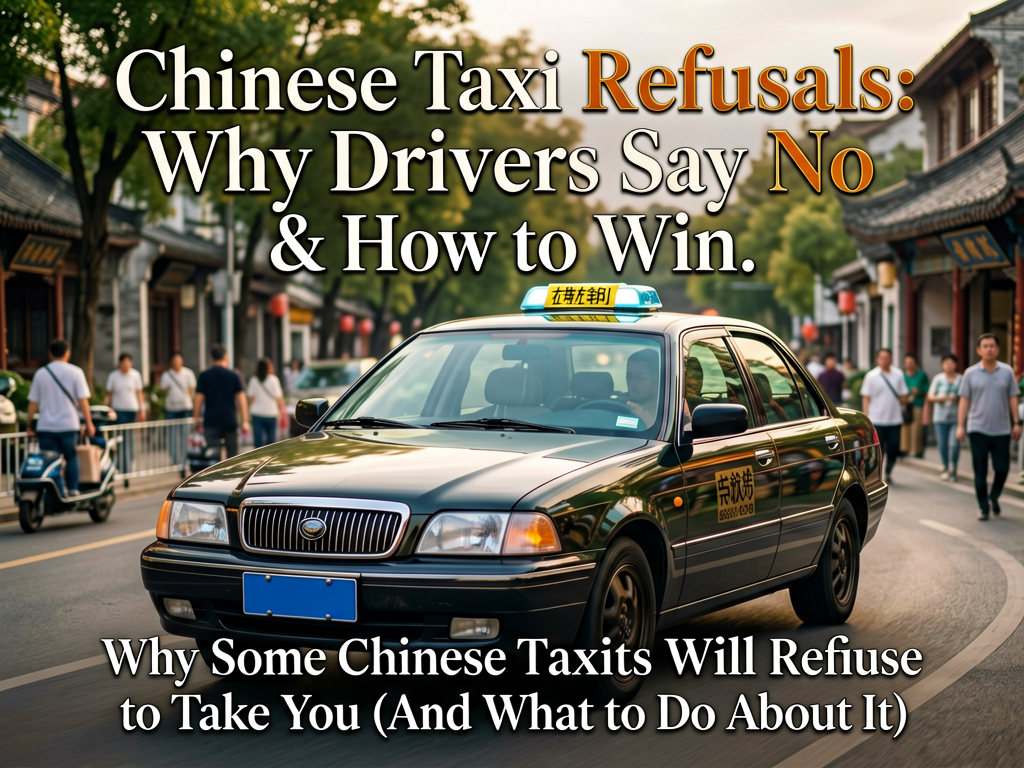
The Time I Was Left Standing in the Rain
I’ll never forget the first time a Beijing taxi driver refused to take me. It was raining cats and dogs, the kind of sudden summer downpour that turns streets into rivers.
I stood there with my umbrella tilting wildly, watching him wave his hand dismissively through the open window. He just shook his head, rolled up the glass, and drove off.
I felt foolish, angry, and completely stranded. Here I was, a seasoned traveler who had mastered chopsticks and survived the Great Wall, defeated by a guy in a Toyota Crown.
If you’ve ever traveled in China, you’ve probably seen this happen. Or maybe you’ve been the one standing on the curb, wondering why everyone else got a ride except you.
It’s not personal. Well, mostly it isn’t. But understanding the why is crucial if you want to keep your sanity while getting around.
The Real Reasons They Say No
Let’s be honest for a second. Most Western guides will tell you it’s because drivers want to skip short trips or avoid traffic jams.
That’s true, but it’s only half the story. The real reason is usually far more mundane and, frankly, a bit exhausting for them.
Taxi drivers in major Chinese cities work insane hours. We’re talking ten to twelve hours a day, six days a week. Their income depends entirely on the meter ticking over.
If a tourist gets in and doesn’t know where they’re going, or speaks zero Mandarin, the driver loses money. Every minute you spend figuring out an address is a minute they aren’t earning fare from someone who knows exactly where to go.
I remember trying to hail a cab in Shanghai near the Bund. I pointed vaguely towards a hotel and said something garbled in Chinese.
The driver looked at me, sighed, and pointed to his GPS. He wanted me to show him the destination on my phone before he’d even think about opening the door.
It’s not rudeness. It’s efficiency. They have a quota, and they need to hit it. When they can’t verify the trip is profitable or smooth, they opt out.
The Tourist Premium Problem
Another huge factor is the fear of being scammed or stuck with a non-paying passenger.
We’ve all heard the stories. The driver takes the long route. The meter breaks. You end up paying double the fare because you have no proof of the standard price.
Drivers are aware of these stereotypes. And while most are honest, some are tired of dealing with tourists who argue over every yuan.
I’ve seen drivers literally close their doors when they see a group of backpackers looking confused. They know the drill. It’s not worth the headache unless they’re sure you’re easy to handle.
Also, consider the payment aspect. Cash is becoming obsolete in China, but not dead yet. If you’re pulling out a wad of crumpled bills, a driver might worry about change or fake notes.
They prefer electronic payments. It’s faster, cleaner, and leaves a digital trail. If you’re holding cash, you’re already starting the interaction on the back foot.
I learned this the hard way in Xi’an. I had exact change, but the driver just stared at me until I pulled out my phone to scan his QR code.
Even then, he seemed happier once he saw the notification pop up. Instant payment equals instant peace of mind for him.
How to Actually Get a Ride
So, what do you do? Do you just wander the streets hoping for luck? Nope.
The single biggest game-changer is having the Didi app installed. This is China’s Uber, and it’s ubiquitous.
You type in your destination in English. You don’t need to speak Mandarin. The app calculates the fare upfront. The driver sees the route and the price before they accept.
This removes all the uncertainty. The driver knows exactly where he’s going and how much he’ll make. You know you won’t be ripped off.
I use Didi almost exclusively now. It’s saved me so many times. I once needed to get to a remote temple in Hangzhou after dark.
A regular taxi would have looked at the map and laughed. Didi matched me with a driver within three minutes. The whole process was seamless.
Just make sure you have a Chinese SIM card or a roaming plan that works for the app verification. It’s usually tied to your phone number.
If you don’t have the app, or if you’re in a rural area where Didi is scarce, you need another strategy.
The Art of the Hail
Street hailing still works, but you have to play the game right. Stand at a main intersection, not tucked away in an alley.
Have your destination written down in Chinese characters. Show it to the driver immediately. Don’t wait until you’re in the car.
I keep a small card in my wallet with key phrases and addresses. “Please take me to this hotel.” Simple. Clear.
If the driver shakes his head, don’t argue. Smile, nod, and move on. There’s always another car coming.
Timing matters too. Rush hour is brutal. Drivers are stuck in traffic, burning fuel and making no money. They are less likely to take a short trip during these times.
Early morning or late evening can be easier, though finding a cab late at night outside major hotels can still be a battle.
I once waited twenty minutes in Chengdu just because the weather was cold. Drivers weren’t venturing out far from their hubs.
Be patient. It’s part of the experience. But don’t waste an hour. If it’s taking too long, switch tactics.
When All Else Fails
There are times when neither taxis nor Didi will work. Maybe you’re at a train station during a holiday surge.
In those cases, look for official taxi queues. Ignore the guys waving you down off the street. They might be unlicensed and expensive.
Official queues have order. You wait, you get a number, you get a car. It’s slower, but it’s safer.
I learned this lesson in Guangzhou during the Canton Fair. The streets were packed. Regular cabs vanished into thin air.
The official line moved slowly, but I eventually got home. The unlicensed guys outside were charging triple the normal rate.
Don’t take the bait. Your safety and wallet are worth the extra thirty minutes of waiting.
Also, consider walking. China is incredibly walkable in many cities. If you’re in the city center, sometimes just walking two blocks to a different corner yields results.
Cars circulate different areas. One street might be empty, while the next block is full of them.
It’s a bit of a scavenger hunt, but it’s often more reliable than standing still and hoping.
A Note on Respect and Context
Finally, let’s talk about attitude. These drivers are working humans, not robots.
Being rude or aggressive rarely helps. In fact, it makes things worse. A polite smile and a clear destination go a long way.
If you’re struggling with language, gestures help. Pointing at a map on your phone is universally understood.
I’ve found that showing respect for their time and effort builds goodwill. Even if they can’t take you right now, a friendly demeanor might mean they wave you down later when they’re free.
China is changing fast. Technology is bridging gaps that used seem insurmountable. The friction of daily life is smoothing out, but not disappearing.
You’ll still face hurdles. You’ll still get rejected. But each rejection teaches you something about the rhythm of the city.
Next time a driver passes you by, don’t take it personally. Just check your phone, update your address, and try again.
You’ll get there. And when you do, that first sip of hot tea in the back seat will taste sweeter than ever.