I still remember the first time I stepped off the high-speed train in Beijing. The air hit me like a cold, dry slap. It smelled of coal smoke, exhaust, and something ancient, like dust from the Forbidden City itself. I was shivering in a thin jacket, completely unprepared for the sheer scale of the place.
Two years later, I found myself in Shanghai. The humidity wrapped around me like a wet blanket. The sky was choked with skyscrapers that pierced the clouds, and the streets buzzed with a neon-soaked energy that felt straight out of a cyberpunk movie. One city felt like history pressing down on your shoulders. The other felt like the future rushing past you at a hundred miles an hour.
If you’re planning your first trip to China, this choice is going to keep you up at night. You’re probably scrolling through Instagram, looking at the Great Wall on one side and the Bund on the other, trying to decide where your soul belongs. I get it. I’ve lived in both cities for eight years now. I’ve made mistakes, missed trains, and eaten way too much dumpling.
So, let’s cut through the noise. Here’s the thing about Beijing versus Shanghai. It’s not just about geography. It’s about vibe. It’s about what kind of traveler you are right now. Are you looking for grandeur and gravity? Or do you want polish and pulse?
The Weight of History in Beijing
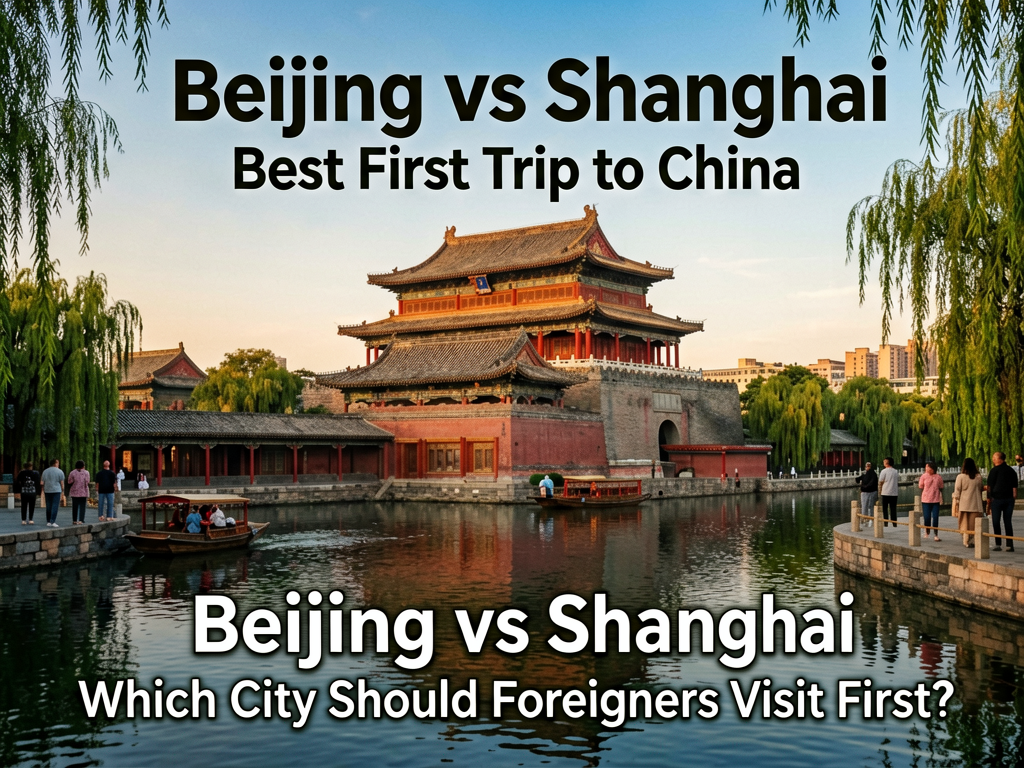
Beijing doesn’t just have history; it wears it on its sleeve. And then some. When you walk through the Forbidden City, you aren’t just looking at old buildings. You’re walking in the footsteps of emperors who ruled half the known world. The scale is intimidating. To be fair, it’s almost too big to comprehend in a single week.
I remember taking my first taxi ride there. The driver pointed out the window at a massive, gray wall that stretched for miles. “That,” he said, “is where they kept the bad guys.” I looked around. The traffic was gridlocked, the pedestrians were weaving through cars like they were playing a high-stakes game of chicken, and the air was thick with tension. But then we turned a corner, and suddenly, everything changed.
We were in the Hutongs. These narrow alleyways tucked between traditional courtyard homes feel like a different planet. I stopped at a tiny stall for a jianbing, a savory crepe. The vendor shouted over the noise, flipping eggs with a flourish that defied physics. I ate it standing up, watching a group of old men practice tai chi in perfect synchronization. Their movements were slow, deliberate, and utterly serene amidst the chaos.
This is the magic of Beijing. It’s chaotic, yes. But it’s a grounded chaos. It feels real. It feels lived-in. You aren’t just observing history here; you’re bumping into it. Every corner has a story. Every temple has a legend. If you love museums, the National Museum of China will blow your mind. I spent four hours there just looking at bronze vessels and calligraphy, feeling small in the best possible way.
But don’t let the romance fool you. Beijing winters are brutal. I learned this the hard way. I showed up in November thinking a scarf would suffice. It didn’t. The wind cuts through you. And the pollution? Well, it varies. Some days the sky is a piercing blue. Other days, you need a mask just to breathe comfortably. It’s part of the experience, really. It adds to the grit.
Also, the language barrier is harder here. Sure, you can order food anywhere. But if you want to chat with locals, you’re mostly talking to older generations who might not speak English. Young people do, but they’re often busy hustling. In Beijing, respect for hierarchy and tradition runs deep. You feel it in the way people queue, in the way they address elders, in the way they bow slightly when apologizing. It’s a culture of depth.
The Pulse of Modernity in Shanghai
Then there’s Shanghai. If Beijing is an emperor, Shanghai is a CEO. It’s fast, efficient, and relentlessly forward-looking. Walking down Nanjing Road feels like walking into the future. The lights are brighter, the shops are fancier, and the pace is faster. I’m no expert on fashion, but even I noticed that people dress differently here. There’s an edge to it. A confidence.
I spent a rainy afternoon in the Former French Concession. This area is all tree-lined streets, historic villas, and boutique cafes. It’s surprisingly quiet compared to the rest of the city. I sat at an outdoor table, sipping an overpriced latte, watching the rain drizzle down on the cobblestones. A couple walked by, sharing an umbrella, looking perfectly at ease. It felt European, yet distinctly Chinese.
Shanghai is easier for foreigners, especially on day one. Almost everyone speaks English. The signs are bilingual. The subway system is clean, efficient, and has apps that actually work without a Chinese phone number. I remember trying to figure out the metro in Beijing for the first time. I got lost three times. In Shanghai, I navigated it like a local within an hour. That ease of access matters when you’re jet-lagged and hungry.
Food-wise, Shanghai leans sweet and salty. The xiaolongbao, those steaming soup dumplings, are a rite of passage. I went to a crowded spot in Yu Garden. The line was out the door. When I finally got a plate, I followed the rules: bite a hole, sip the broth, eat the rest. It was hot, messy, and delicious. Better than most alternatives I’ve had back home, hands down.
But Shanghai isn’t just about food and coffee. It’s about art and innovation. The West Bund is a gallery district that rivals SoHo in New York. I saw an installation that used AI to predict your mood based on your heartbeat. Weird? Yes. Cool? Absolutely. The city is pushing boundaries. It wants to show the world that China isn’t just about silk and dragons anymore. It’s about tech, design, and global connection.
However, don’t get too comfortable. Shanghai can feel superficial if you’re looking for soul. Sometimes the glitz gets in the way. You see the shiny surface, but you miss the cracks underneath. I’ve met expats who lived there for ten years and still didn’t feel like they truly understood the city’s heart. It’s a city of masks, in a way. Everyone is performing, projecting an image of success and modernity.
Which Vibe Suits Your Soul?
So, how do you choose? It really depends on what you’re craving. If you’re the type of person who reads books about dynasties and dreams of standing atop a Great Wall watchtower, Beijing is your calling. You need to feel the weight of centuries. You need to see the scale of power. Beijing demands your attention. It forces you to slow down and look at the details, even when the world is screaming around you.
On the other hand, if you’re more interested in street art, underground music scenes, and trying the latest fusion cuisine, head to Shanghai. You’ll find a creative energy here that’s infectious. It’s easier to make friends, easier to get around, and easier to relax. You can spend a weekend just wandering the parks and cafes without worrying about missing a major historical site.
I’ll be honest, I leaned toward Beijing when I first arrived in China. I wanted the “authentic” experience. I thought Shanghai was too fake. I was wrong. Shanghai has its own authenticity, just a different kind. It’s the authenticity of ambition. Of people trying to build something new from the ashes of the past. Beijing is about preserving. Shanghai is about creating.
There’s also the practical side. Beijing is inland. It’s far from the coast. If you want to combine your trip with a beach getaway, you’re out of luck. Shanghai is near Hangzhou and Suzhou. You can take a short train ride and find yourself in classical gardens and water towns that look like paintings. The infrastructure for tourism is just better in the east. Flights are more frequent. Hotels are more varied.
But let’s talk about the people. In Beijing, people are direct. Blunt, even. If you ask them a question, they’ll give you an answer. Sometimes too honest. In Shanghai, people are polite, reserved, and careful. They value harmony. This can be frustrating for Americans who are used to blurt-ing things out. But it’s also charming. You learn to read between the lines. You learn patience.
My Personal Verdict
If I had to pick just one for a first-time visitor, I’d send you to Beijing. I know, I know. I just spent a paragraph praising Shanghai’s efficiency. But hear me out. Beijing gives you the context for everything else. Once you understand the history, the politics, and the sheer magnitude of China, Shanghai makes more sense. Shanghai is the face China shows to the world today. Beijing is the backbone.
I remember sitting on a bench near Jingshan Park after climbing the hill. I looked out over the Forbidden City. The sun was setting, casting long shadows over the red walls. It was silent. Just the wind in the trees and the distant hum of the city. In that moment, I felt connected to something huge. Something timeless. That feeling doesn’t happen in Shanghai. Not in the same way.
Shanghai will excite you. Beijing will move you. For a first trip, moving is more important than exciting. You want to leave China with a story that sticks. You want to tell your friends that you stood where emperors once stood. You want to eat street food that tastes like charcoal and memory.
That said, don’t limit yourself to one. If you have two weeks, do both. Take the high-speed train from Beijing to Shanghai. It’s a smooth, forty-hour ride. Watch the landscape change from arid plains to lush rice paddies to urban sprawl. It’s a journey in itself. By the time you arrive, you’ll have a complete picture. You’ll see the tension between tradition and modernity. You’ll see how China holds both in its hands.
Just remember to pack layers. And good shoes. You’re going to walk more than you think. Whether you’re climbing the Great Wall or strolling the Bund, your feet will thank you. And maybe, just maybe, you’ll find that you don’t need to choose forever. You can love both. You can love the past and the future. You can love the grit and the gloss.
China is big. It’s complex. It’s overwhelming. But it’s also beautiful. Whichever city you pick, you’re in for a treat. Just don’t expect it to be easy. That’s not the point. The point is to feel alive. To see something that challenges you. To come home with a fuller heart and a longer suitcase. Safe travels, friends. Go see what awaits you.