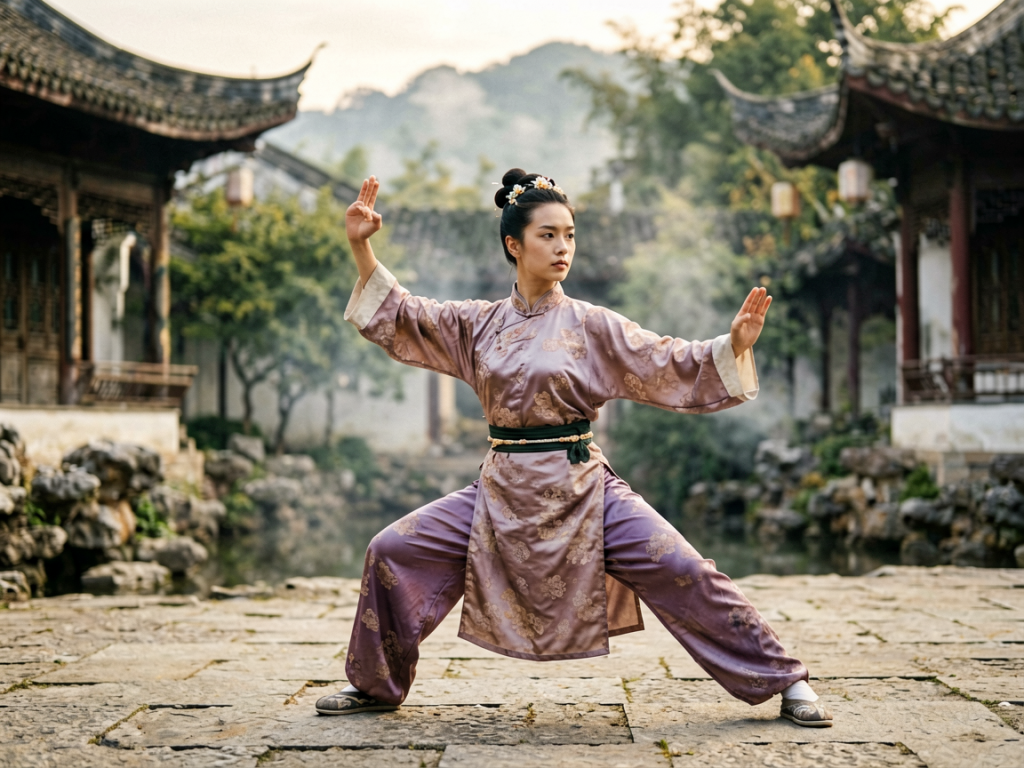
The Phantom Women of Shaolin
I’ll be honest with you. When I first started traveling through Henan province a few years ago, I went to Shaolin Temple expecting the usual spectacle. You know the drill. Young monks flipping over each other in perfect unison, sweating under the hot sun while tourists cheer from the sidelines. It’s performative, sure, but it’s also beautiful.
But then I noticed something odd. There weren’t many women there. Not as practitioners, and certainly not as masters. The lineup was almost entirely male. I asked my guide, a guy named Wei who’d been running tours since the nineties, where all the female monks were. He just shrugged and laughed.
“It’s complicated,” he said. “History doesn’t like to keep records of them.”
That stuck with me. We talk a lot about Chinese martial arts in the West. We obsess over Bruce Lee, Jet Li, Donnie Yen. These guys are icons. They’re the faces of Wing Chun, Tai Chi, and Wushu. But ask anyone who these legends trained with, and the list of famous female counterparts shrinks to almost nothing.
Why is that? Is it biology? Strength? Or is it something deeper, something woven into the fabric of Chinese society for thousands of years? I spent months digging into this. I read old texts. I talked to elders in Beijing. I even tried to find historical records of famous female fighters. What I found wasn’t just a gap in the record. It was a wall.
Confucius Cast a Long Shadow
To understand the silence, you have to look at Confucius. Seriously. The man’s influence is everywhere in China, even today. One of his core tenets is the separation of roles. Men belong in the public sphere. Women belong in the private sphere.
Martial arts, especially in the early days, were largely about military service, clan defense, and public display. Think about it. If you’re a woman in ancient China, your value was tied to your virtue, your obedience, and your ability to maintain the household. Picking up a staff? That’s not virtuous. It’s disruptive.
I remember talking to Professor Lin at Peking University about this. She’s a historian specializing in gender studies. We sat in her office, surrounded by stacks of dusty books. She told me that while there were plenty of women who knew how to fight–mostly out of necessity–they were rarely recognized as *masters*.
“A master teaches,” she explained. “And teaching is a public act. In traditional Confucian society, a woman teaching men or even other women was seen as inappropriate. So, the knowledge died with them.”
It’s heartbreaking when you think about it. Imagine a woman who’s spent forty years mastering Bagua Zhang, only to have her students disown her because she’s a woman. Or worse, her teachings are attributed to her husband or father after she passes. That’s not just erasure. That’s theft.
But here’s the twist. This isn’t just an ancient problem. It’s still happening, just in subtler ways. The media loves a male hero. It’s safer. It fits the narrative. A female hero? That disrupts the status quo. And status quos are hard to break.
The Legend of Hua Mulang (and Why It’s Not Enough)
Okay, you might be thinking. What about Mulan? Everyone knows Mulan. She joined the army in place of her father, fought bravely, and came home. Sound familiar?
Yeah, me too. But here’s the thing about Mulan. She’s a legend, not a history lesson. And even in the legend, her martial prowess is often overshadowed by her disguise. She wins because she’s clever, not necessarily because she’s the strongest fighter in the regiment.
Plus, Mulan goes back to being a daughter and a wife at the end. She doesn’t become a general. She doesn’t start a school. She returns to the private sphere. It’s a happy ending, sure, but it reinforces the idea that fighting is a temporary deviation for a woman, not a lifelong path.
I met a woman in Yangshuo named Li Na who trains in Chen-style Tai Chi. She’s tough. Really tough. I watched her break a wooden board with her palm during a demonstration. It sounded like a gunshot.
“When people ask me why I teach, I tell them it’s not about fighting,” she told me later, sipping tea in her courtyard. “It’s about reclaiming space. Every time I step onto the mat, I’m saying I belong here.”
She’s right. For women like Li Na, martial arts isn’t just exercise. It’s resistance. It’s a way to push back against a history that said they didn’t belong in the dojo.
The Modern Revolution
Thankfully, things are changing. Fast. I’ve been living in China for eight years now, and the shift is palpable. Gyms in Shanghai, Shenzhen, and Chengdu are seeing more women than ever before. And they aren’t just doing yoga or pilates. They’re learning San Shou, Jiu-Jitsu, and traditional Kung Fu.
One of the biggest changes is the rise of female instructors. These aren’t just helpers. They’re heads of schools. They’re rewriting the curriculum. They’re proving that strength and femininity aren’t mutually exclusive.
Take Zhang Wei, a practitioner I followed in Nanjing. She’s a black belt in Taekwondo and a master of Qing Yi Gong. She runs a small academy on the outskirts of the city. Most of her students are young women who want to learn self-defense. But some are older women who just want to feel strong again.
“It’s funny,” Zhang told me. “Older students come in and apologize for being slow. They say they’re ‘too old’ or ‘too weak.’ I have to tell them, ‘No. You’re just waking up.’”
That phrase, “waking up,” really stuck with me. Because that’s what’s happening. Women are waking up to their own power. And they’re sharing it openly, without shame.
There’s also a growing online community. Social media platforms like Douyin (the Chinese version of TikTok) are filled with videos of women performing incredible feats of strength and agility. Hashtags like #FemaleKungFu and #WushuGirls are trending. These women are building their own legacy, right in front of our eyes.
They’re not hiding. They’re not disguising themselves as men. They’re wearing their hair long. They’re showing their curves. And they’re kicking butt.
Breaking the Glass Ceiling, One Kick at a Time
So, why were female kung fu masters invisible in history? Because the system was designed to keep them that way. Confucian values, patriarchal structures, and a lack of documentation created a perfect storm of silence.
But silence doesn’t mean absence. It means suppression. And now, the suppression is breaking.
I recently attended a tournament in Beijing. It was a regional Wushu championship. The air was thick with tension and the smell of liniment oil. I sat in the stands, watching the competitors. Then, the women’s division started.
It was electric. These women moved with a grace and ferocity that left me breathless. Their forms were precise, their strikes powerful. They didn’t ask for permission. They didn’t apologize for taking up space. They just fought.
After the event, I stayed behind to watch the practice sessions. An older master, a man named Chen, was correcting a young girl’s stance. He was gentle but firm. I asked him if he’d ever had a female student who surpassed his male ones.
He smiled. “In the past, yes,” he said. “But those stories were lost. Now, they are written. And they will not be forgotten.”
That’s the hope. That’s the change. We’re finally starting to see the women who shaped Chinese martial arts. Not as side characters. Not as legends. But as masters.
If you’re interested in learning Kung Fu, don’t just look for the male instructors. Look for the women. Ask them about their lineage. Listen to their stories. You’ll find a richer, deeper history than the one you’ve been told.
The next time you hear someone say there are no famous female Kung Fu masters, smile. You know the truth. They were always there. We just had to learn how to see them.
And trust me, once you start looking, you won’t be able to stop. The martial arts world is getting louder, stronger, and more diverse every day. And it’s about time.