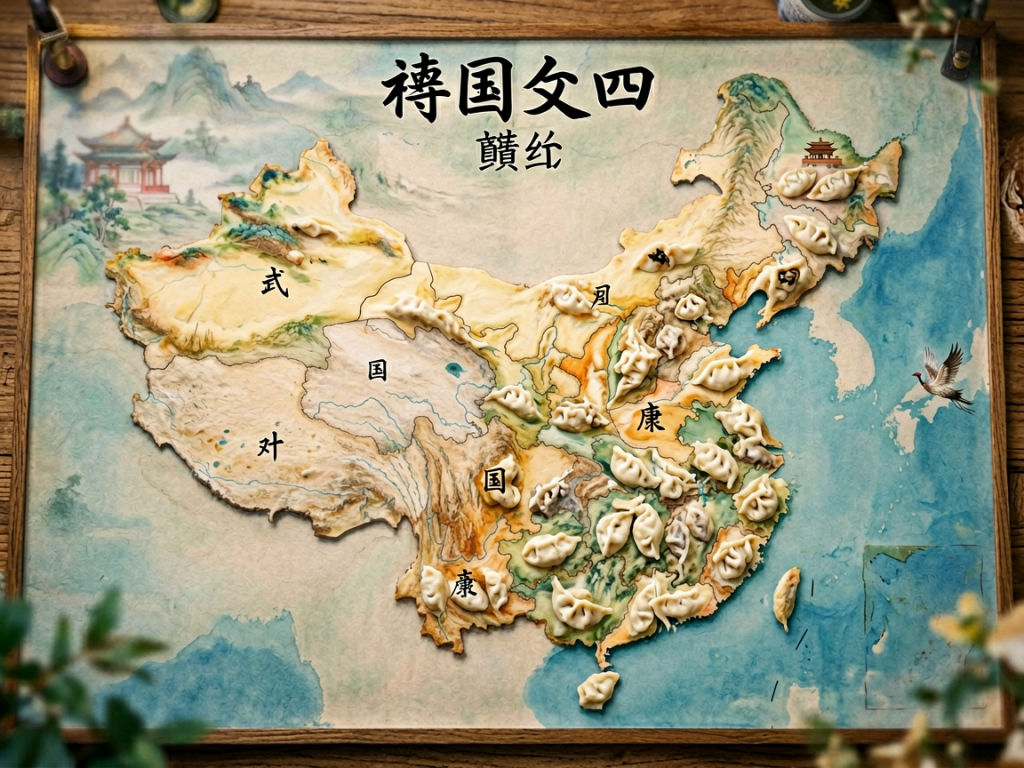
Look, if you’ve only ever eaten a steamed pork bun or a boiled dumpling from a chain restaurant back home, you’re missing out on half the fun.
I spent three months last winter just traveling north, eating my way through Shandong and Beijing. What started as a quest for warmth turned into an obsession. I realized that calling every filled dough pocket a “dumpling” is like calling every pastry a “cookie.” It’s technically true, but it’s incredibly lazy.
China’s geography is massive. Its history is fractured. And its food? It reflects both. Every province, every city, even every village down the street seems to have a claim to the throne of stuffed dough.
The shapes differ. The wrappers vary from paper-thin to chewy slabs. The fillings range from pure vegetable to whole lamb legs. I’m not exaggerating when I say there are over two hundred distinct regional varieties of what we broadly call dumplings in English.
Let’s break this down. You’ll never look at a steamer basket the same way again.
The North Loves Big, Bold, and Chewy
If you go to Beijing, you’re going to eat jiaozi. But not just any jiaozi. We’re talking hand-rolled wheat skins, thick enough to hold their own against the robust fillings inside.
I remember sitting in a cramped basement restaurant near Houhai with a local teacher named Li. He ordered the traditional mutton and cabbage dumplings. When they arrived, they were enormous. Each one looked like a golden ingot.
Li dipped his in black vinegar and chili oil, then took a bite that nearly broke his teeth. He laughed. “See?” he said. “If it doesn’t require effort to chew, it’s not worth eating.”
This is the Northern philosophy. Wheat is king here. The climate is colder, so people need hearty, carb-heavy meals. The dumplings are often boiled or pan-fried until the bottom is crispy. You want texture. You want substance.
In Shenyang, the capital of Liaoning province, the dumplings are even bigger. I’ve heard stories of locals making dumplings where a single piece weighs half a pound. That’s not a snack. That’s a meal replacement.
The filling tends to be simple. Pork and chive, beef and radish, or the classic egg and chive. There’s no fuss. Just quality ingredients and a wrapper made fresh that morning.
The East Plays with Soup and Thin Skins
Travel south to Jiangsu and Zhejiang, and the rules change. Suddenly, you’re dealing with delicate, translucent wrappers. The focus shifts from heartiness to refinement.
I’ll never forget my first time trying Tangyuan in Hangzhou. These aren’t exactly dumplings in the savory sense, but they fit the broader category of stuffed dough balls. They’re glutinous rice flour spheres, usually filled with black sesame paste or red bean.
But the real star of the Eastern region is the Xiaolongbao, or soup dumpling. If you haven’t had one, you haven’t lived. The trick is the gelatinized broth inside the skin. It turns into hot, savory soup when steamed.
Eating one is a minefield. I watched a tourist in Shanghai try to bite straight into a Xiaolongbao. He got splashed with boiling pork stock. He wasn’t happy. I wasn’t laughing as hard as I should have been.
The correct technique? Lift it gently with chopsticks. Place it on a spoon. Bite a tiny hole at the top. Sip the broth. Then dunk the rest in ginger vinegar and eat it. It’s ritualistic. It’s precise. It’s delicious.
Shanghai’s Xiao Long Bao uses wheat flour wrappers that are thin but strong. In contrast, Nanjing’s duck blood vermicelli soup might seem unrelated, but the city also has its own style of dumplings, often smaller and served in light broths.
Sichuan and the Spice Factor
Now, let’s talk heat. Sichuanese dumplings, or Jiaozi, are a different beast entirely. Here, the wrapper might be standard wheat, but the soul of the dish is in the dipping sauce.
I tried making Sichuan dumplings at a cooking class in Chengdu. The instructor, a stern woman in her fifties, insisted that the chili oil must be made from twice-broiled peppercorns and seven different spices. She wasn’t joking.
The fillings are bold, too. Pickled vegetables, beef with cumin, or even shrimp with spicy chili paste. The combination of the numbing sensation of Sichuan peppercorns in the sauce and the tender meat inside is addictive.
What surprised me was how many vegetarian options there were. You’d think heavy spice would overwhelm delicate flavors, but Sichuan cooks use herbs like cilantro and mint to balance the heat. It’s complex. It’s layered. It’s not just “spicy.”
The Northwest and the Steppe Influence
Go west, to Shaanxi, Gansu, and Xinjiang, and you enter the realm of the nomad. The wheat is coarse, the meat is lamb or beef, and the cooking methods are rustic.
In Xi’an, the home of the Terracotta Warriors, you’ll find Biangbiang noodles, which are wide and flat. But they also have Dumplings, specifically the Pan-Fried variety known as Guotie.
These are heavier, crustier versions of their northern cousins. The dough is often thicker, designed to soak up the savory juices of the meat without falling apart. I ate them in a street stall in the Muslim Quarter of Xi’an. The air smelled of cumin and roasting meat.
Further west, in Xinjiang, the influence of Central Asia becomes undeniable. Here, you’re looking for Manti. These are small, triangular dumplings, often steamed and topped with yogurt and garlic sauce rather than soy vinegar.
The filling is usually spiced lamb with onions and carrots. It’s rich, aromatic, and completely different from anything you’ll find in Shanghai. It tastes like the Silk Road. It tastes like history.
Fujian and the Seafood Connection
Can’t forget the coast. Fujian province, known for its mountainous terrain and long coastline, produces dumplings that reflect its dual nature.
I visited Fuzhou and tried the Min-style dumplings. The wrappers here are often made with a mix of wheat and sweet potato starch, giving them a unique chewiness. They’re translucent and bounce slightly when you touch them.
The fillings? Seafood. Shrimp, squid, clams, and fish paste. I had a dumpling filled with minced lobster and wood ear mushrooms. It was sweet, briny, and umami-rich all at once.
What’s fascinating is how Fujianese cooks treat the wrapper as part of the flavor profile, not just a vessel. The starch blend changes the mouthfeel entirely compared to the dense wheat dough of the north.
Why This Diversity Matters
You might wonder why this matters. Why does it matter that a dumpling in Beijing differs from one in Guangzhou?
Because food is identity. In a country as vast and diverse as China, regional pride is fierce. A person from Guangdong will tell you that their Har Gow (shrimp dumplings) are superior to anyone else’s. A person from Lanzhou will swear by their beef noodle dumplings.
It’s not just about taste. It’s about climate, agriculture, history, and trade routes. The wheat belt in the north supports hearty dumplings. The rice paddies in the south support sticky, delicate ones. The coastal regions use what they catch. The western plains use what they raise.
When you eat a regional dumpling, you’re tasting the landscape of that place. You’re tasting the local way of life.
How to Explore Without Getting Lost
So, how do you start this journey? Don’t try to memorize every type. Start with your own preferences.
If you like crunch, seek out pan-fried dumplings. If you like broth, go for soup dumplings or boiled varieties with complex sauces. If you prefer simple, stick to the northern hand-rolled styles.
And don’t be afraid to ask. I’ve found that Chinese locals love sharing their regional specialties. If you see a shop with a long line, join it. Ask the person next to you what they recommend.
You might end up in a hole-in-the-wall place serving something you’ve never heard of. Maybe it’s a zongzi variant, maybe it’s a type of steamed cake filled with bean paste. Either way, it’ll likely be the best thing you eat all week.
I’m still learning. I’m eight years into living here, and I still get confused by some of the dialect-specific terms for dumplings. But that’s the beauty of it. There’s always something new to discover.
Next time you sit down to a meal in China, look past the generic menu. Find the regional specialty. Order it. Eat it slowly. And let it change your understanding of what a dumpling can be.
Trust me, your palate will thank you.