Look, I’ve been living in China for eight years now. I’ve eaten mapo tofu until I questioned my life choices and hiked mountains where the air was so thin I forgot my own name. But nothing, and I mean nothing, prepared me for the mud.
You’re probably thinking, “Mud? Why would anyone pay for a flight just to look at dirt?” Trust me, you’re not alone. I had the same skepticism. I’m a writer, not a photographer. My idea of adventure usually involves finding a decent cup of coffee in a city that only knows instant noodles.
But then I went to Xiapu. And honestly? It changed how I see light, water, and patience.
If you’ve ever seen those viral photos of wooden stilts rising out of a shimmering, orange-tinted sea at dawn, you’ve seen Xiapu. It’s on the coast of Fujian province, about three hours north of Fuzhou. It’s not a beach resort. It’s an intertidal mudflat ecosystem that looks like a painting come to life.
Here’s the thing about this place. It’s not just pretty. It’s alive in a way that’s almost aggressive. The tides dictate everything. The fishermen know the rhythm better than they know their own family members. And the photographers? They treat the tide chart like a holy scripture.
The Tide That Dictates Life
I’ll be honest, I didn’t understand the mechanics at first. I thought, “Hey, it’s low tide, let’s walk around.” Big mistake. You don’t just walk here. You navigate. Or rather, the locals navigate for you.
Xiapu’s mudflats are famous for their aquaculture. You’ll see endless rows of bamboo poles sticking out of the wet earth. These aren’t for decoration. They hold up nets, rafts, and cages for mussels, oysters, and sea cucumbers. It’s a floating city built on sludge.
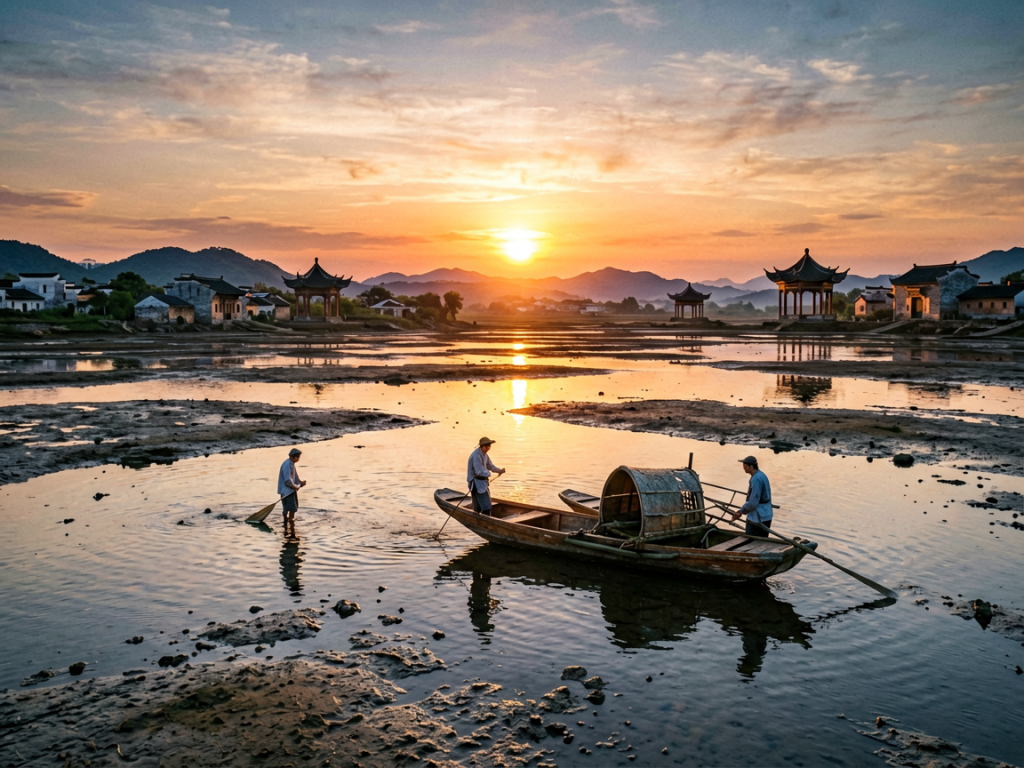
The local fishermen, mostly older men with weather-beaten faces and straw hats, operate small wooden boats. They know exactly where the channels are. Step off the path, and you’ll sink up to your knees in thick, sucking gray goo. I tried it once. I looked ridiculous. The fishermen just laughed.
That laugh stuck with me. It wasn’t mean. It was the kind of laugh that says, “Welcome to the real China, buddy. Out there, you’re the tourist. In here, you’re just another obstacle.”
To get the best shots, you need to time your visit with the spring tide. This happens twice a month, usually around the full and new moons. During these times, the water recedes further, exposing vast stretches of mud that become intricate patterns of channels and pools.
It’s like nature is drawing a map. And the sun? The sun is the painter.
Chasing the Golden Hour
We arrived in Xiapu on a Tuesday morning in late October. The air was crisp, carrying the salty, pungent smell of low tide. It’s an acquired scent. Think brine, decay, and seaweed. It hits you in the back of the throat.
Our goal was the sunrise at Shacheng. It’s a small village, but it’s the star of the show. We woke up at 3:30 AM. Yes, really. In China, we call this “chasing the light.”
I was groggy. My camera bag felt heavier than usual. But as we drove into the village, the darkness began to lift. The sky wasn’t black anymore. It was a deep, bruised purple.
The fishermen were already working. Canoes moved silently across the flat surface. They weren’t making noise. They knew that quiet is key. If you talk too loud, you scare the birds. If you scare the birds, you lose the shot.
And then, the sun started to peek over the horizon. It didn’t just rise. It ignited. The low-hanging mist caught the light and turned it into gold. The water reflected the sky perfectly, creating this surreal effect where you couldn’t tell where the mud ended and the air began.
I held my breath. My fingers fumbled with the lens cap. When I finally got the shutter clicking, I realized I wasn’t just taking pictures. I was trying to capture a feeling. That feeling of being small in a huge, ancient landscape.
One fisherman rowed past us. He stopped for a second, looked at my camera, and gave a thumbs up. He didn’t speak English. I didn’t speak his dialect. But in that moment, we shared a mutual respect for the beauty we were both witnessing.
That’s the magic of Xiapu. It’s not about the gear you carry. It’s about the patience you bring.
More Than Just Mud
People often ask if Xiapu is worth the trip compared to other spots in China. Let’s compare. Most tourist traps in China are crowded, commercialized, and fake. Think Zhangjiajie during holiday weeks. You stand in line for forty minutes to take a photo of a rock.
Xiapu is different. Yes, there are tourists. But there’s also labor. Real, hard, daily labor.
When the tide comes in, the scene changes completely. The stilts disappear underwater. The boats become the focus again. The fishermen haul in their harvest. You can see the glistening silver of fish, the dark green of seaweed, and the red shells of crabs.
I spent an afternoon watching them clean their catch. The sounds were rhythmic. Scraping, chopping, washing. It’s a symphony of survival. These people have lived off this land for generations. They don’t fight the environment. They work with it.
This philosophy is deeply rooted in Chinese culture. Taoism teaches harmony with nature. Nowhere is that more visible than in the mudflats of Xiapu.
You see, the mud isn’t empty space. It’s fertile. It’s rich in nutrients. It supports a complex web of life. From tiny shrimp to giant herons, everything relies on the ebb and flow of the tides.
I talked to a local guide named Lao Li. He’s been guiding photographers for ten years. He told me, “The mud remembers everything. Every footstep, every boat track. But the water washes it clean. Then the sun dries it. Then the cycle starts again.”
That quote stayed with me. It’s poetic, sure. But it’s also practical advice for traveling here. Don’t try to control the outcome. Let the environment lead. Bring your umbrella because the rain can start without warning. Bring good boots because the mud is deep. Bring patience because the light changes by the minute.
Practical Tips for Your Trip
Okay, let’s get down to business. If you’re serious about going, here’s what you need to know.
First, check the tide table. Seriously. Download an app or ask your hotel host. If you go at high tide, you’ll see water. A lot of it. You’ll miss the channels and the patterns. The best time is two hours before low tide and two hours after. That’s when the reflections are sharpest.
Second, hire a boat. Walking is possible, but it’s slow and dangerous if you’re not careful. A local boatman knows the safe paths. It costs about 200 to 300 RMB for a few hours. Worth every penny. Plus, you get to sit in the boat and let the man do the rowing. That’s luxury.
Third, bring a polarizing filter. The glare from the wet mud can be blinding. A polarizer cuts through the reflection and lets you see the colors underneath. It turns gray sludge into rich browns and oranges.
And fourth, dress warmly. Even in summer, mornings near the water are chilly. I saw photographers shivering in t-shirts. Don’t be that guy. Bring layers. A windbreaker is essential.
I should also mention the food. After a long shoot, you’ll be hungry. Head to a local noodle shop. Try the seafood noodles. They’re cheap, hot, and delicious. The broth is made from fish bones and kelp. It’s umami bomb.
I ate three bowls in one day. My doctor would be upset, but my soul was happy.
Why It’s Worth the Journey
So, why do photographers cross the world for this?
It’s not just for the Instagram likes. It’s for the experience of standing on the edge of the earth, where land meets sea, and time stands still.
In a world that moves faster every day, Xiapu offers a pause button. The tides don’t care about your schedule. The sun doesn’t wait for you. You have to adapt to them.
I left Xiapu with a memory card full of images, but more importantly, I left with a sense of calm. I sat on a bench in the village, watching the sun dip below the horizon. The sky turned pink, then orange, then deep blue.
A heron stood still on one leg nearby. It didn’t move. It just watched. And in that silence, I understood why people travel so far for this.
It’s not about the mud. It’s about the clarity. For a few hours, nothing else matters. Just the light, the water, and the breath in your lungs.
If you’re planning a trip to China, skip the crowded cities for a day. Go to the coast. Find the mud. Watch the tide.
You might not come back with the perfect shot. But you’ll come back with a story. And in my book, that’s the real treasure.
Just don’t forget your rubber boots.