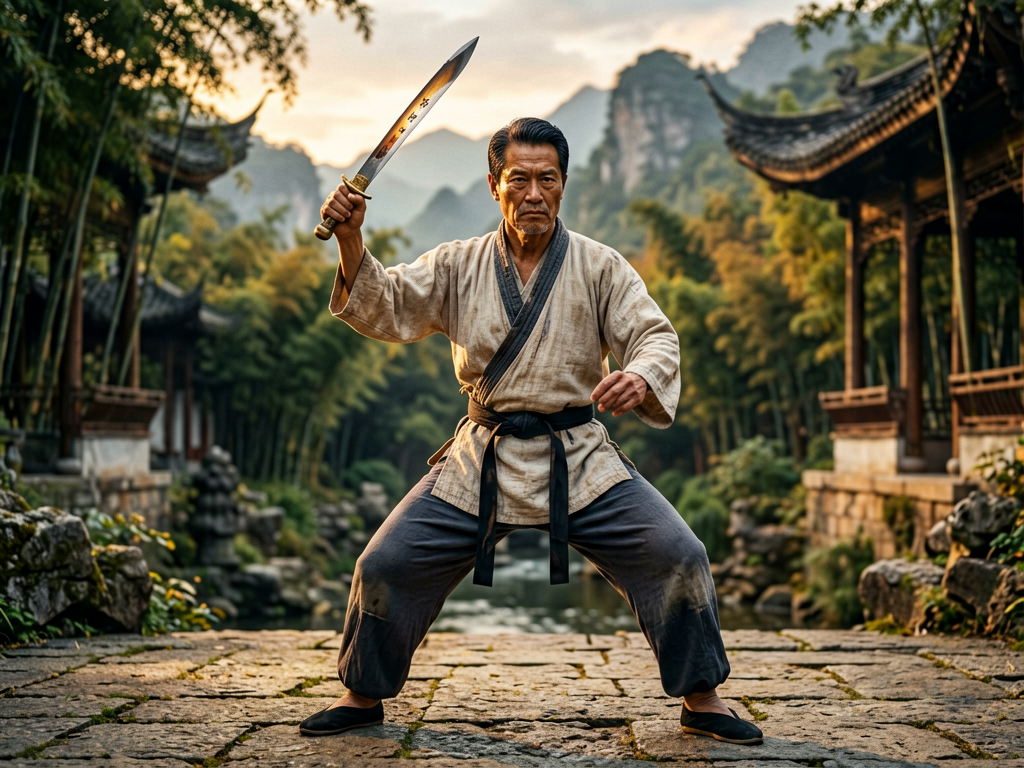
I still remember the smell of old sweat and floor polish in that cramped dojo in San Francisco. It was the late nineties, and my instructor, an old-school Karate master, was drilling us on kata. You know the type. Perfect form, stiff posture, eyes locked forward. He’d shout about discipline and tradition while we bounced on the balls of our feet, waiting for the chance to actually move.
It felt like dancing in chains. And that’s exactly why Bruce Lee’s philosophy hit me like a freight train when I finally encountered it years later. I wasn’t looking for a fight club secret. I was just trying to understand why so much of traditional martial arts felt so… performative. Then I read about Jeet Kune Do. The Intercepting Fist.
Honestly, it changed how I see movement entirely. It’s not just a fighting style. It’s a rebellion. A complete breakdown of the ego-driven structures that had kept martial arts stagnant for decades. Let’s talk about how one guy from Oakland looked at centuries of ritual and decided it was all bullshit.
The Absurdity of Traditional Forms
You have to understand the context here. In the sixties, martial arts in the West were heavily influenced by lineage and hierarchy. You started as a white belt. You stayed there for months. Maybe years. You learned a specific set of movements passed down from a master’s master. If you deviated, you were disrespectful. If you asked why a punch was thrown a certain way, you were told it was tradition.
Lee hated it. He saw these forms as decorative. As empty calories for the soul. He called them “non-artistic fancy jumping.” To him, a fight doesn’t happen in a dojang with an audience clapping. It happens in the dark, on a wet street, when someone wants to hurt you.
I remember watching footage of him training in his garage. No uniform. Just sweatpants and bare feet. He wasn’t practicing perfect stances. He was testing limits. He would punch a wooden dummy until his knuckles bled, not to honor the wood, but to understand impact. That’s the first rule he broke: efficiency over aesthetics.
Traditional styles often prioritize beauty in motion. Jeet Kune Do prioritizes speed. If a straight line is the shortest distance between two points, why circle your arm around to throw a punch? Lee argued that most martial artists were wasting energy on unnecessary movements. They were showing off. He wanted to strip it all back to the bone.
Water Doesn’t Have a Shape
This is probably the most famous part of his philosophy. “Be water, my friend.” People quote it constantly, often missing the point. It’s not about being flexible like yoga. It’s about being formless.
Picture water pouring into a cup. It becomes the cup. Pour it into a bottle, and it becomes the bottle. Pour it into a teapot, and it becomes the teapot. Water can flow, or it can crash. It can drip, or it can crush.
Most martial artists try to fit themselves into rigid boxes. Hard vs. soft. Internal vs. external. Linear vs. circular. Lee said that’s a trap. If you’re trained to counter a kick, you’re vulnerable to a punch. If you’re trained to grapple, you’re slow against distance strikes.
He advocated for adaptability. You don’t have a style. You have tools. You pick what works in the moment. I tried applying this mindset to my own workouts. Instead of sticking to a rigid regimen, I mixed up cardio, strength, and flexibility. The results were faster. My body stopped resisting change and started adapting to it.
That’s the core of Jeet Kune Do. It’s not a system. It’s a mirror. It reflects your own capabilities back at you. It asks you to discard what doesn’t work and keep what does. Simple, right? But trying to teach that to a generation obsessed with belts and titles? That was hard.
Stealing What Works
Here’s the thing that really upset the purists. Lee openly admitted he stole techniques. He studied Boxing. He studied Foil Fencing. He looked at Wrestling. He even watched movies. If he saw something effective, he took it.
Imagine a martial artist today saying, “I’m going to learn fencing footwork and apply it to Muay Thai.” The traditionalists would have a meltdown. But Lee didn’t care about purity. He cared about effectiveness. He realized that if Boxing punches were faster than traditional karate punches, you use Boxing punches.
I went to a seminar once where a guy tried to tell me that mixing styles diluted my heritage. I looked at his stiff stance and then at a street fighter I knew who could end a confrontation in three seconds. Who was diluting what? Tradition or reality?
Lee’s approach was pragmatic. He called it “using no way as way.” It sounds cryptic, but it just means don’t get attached to one method. Be like the wind. Fast, unpredictable, everywhere at once. He integrated the direct punch of Western boxing with the angles of fencing. He combined the grappling of Judo with the striking of Karate.
This wasn’t arrogance. It was observation. He watched fighters lose because they were too busy thinking about their “style.” He wanted fighters to think about the opponent. To react, not reactively prepare. To intercept. Hence, Jeet Kune Do.
The Death of the Ego
We’ve touched on efficiency, but the psychological aspect is where it gets really interesting. Martial arts are full of egos. The black belt who won’t spar with a beginner. The sensei who demands absolute obedience. Lee saw this toxicity. He thought it was dangerous.
He believed that a true martial artist should have no fixed ideas. If you hold onto your style like a religious text, you become blind. You miss openings. You hesitate. You fear losing your status more than you fear getting hit.
I saw this play out in my own life. Early on, I was terrified of looking stupid in class. So I held back. I didn’t ask questions. I stuck to what I knew, even when it wasn’t working. It wasn’t until I let go of that pride that I actually got better. That’s Lee’s lesson. Empty your mind. Be formless.
He encouraged students to question everything. Even his own teachings. He famously said, “Absorb what is useful, discard what is useless, add what is specifically your own.” He didn’t want followers. He wanted independent thinkers. He wanted people to create their own path, not walk in his shadow.
That’s why Jeet Kune Do doesn’t have a unified curriculum. There’s no belt test. There’s no final exam. Because life doesn’t have a final exam. It’s chaotic. It’s messy. Your fighting style should be too.
Why It Still Matters Today
So, why am I telling you this now? Why does a man who died in 1973 still matter to how we train today? Well, look at the MMA cage. Look at modern combat sports. Every top fighter uses a hybrid style. They box, they wrestle, they jiu-jitsu. They’ve all absorbed what Lee preached fifty years ago.
The UFC is basically Jeet Kune Do played out on a mat. The separation between disciplines has vanished. The “purity” debates are dead. Everyone realizes that if it works, you use it.
But it’s not just about fighting. It’s about how we live. We live in a world that loves labels. You’re this, you’re that. You belong to this group, you reject that one. Lee’s philosophy cuts through that noise. It asks you to define yourself by your actions, not your affiliations.
I find myself applying this to travel too. I don’t stick to one neighborhood in Beijing. I don’t eat only dumplings. I explore. I mix traditions. I find what resonates. It makes the experience richer. It keeps me sharp.
Jeet Kune Do broke the rules because the rules were holding people back. They were slowing progress. They were creating divisions where there should be unity. Lee saw that human potential was being wasted on dogma.
It’s a radical idea. That you are free to choose your own path. That you don’t need permission to improve. That you can dismantle the structures around you if they no longer serve you.
I’ll be honest, it’s scary at first. Throwing away your tradition feels like falling without a net. But once you catch yourself, you realize you’ve been flying the whole time. You’re not bound by the past. You’re present. You’re ready for whatever comes next.
That’s the gift Bruce Lee left us. Not a fighting style. But a mindset. One that values truth over tradition. Action over attitude. And life over death. Keep moving. Stay fluid. And never stop learning.