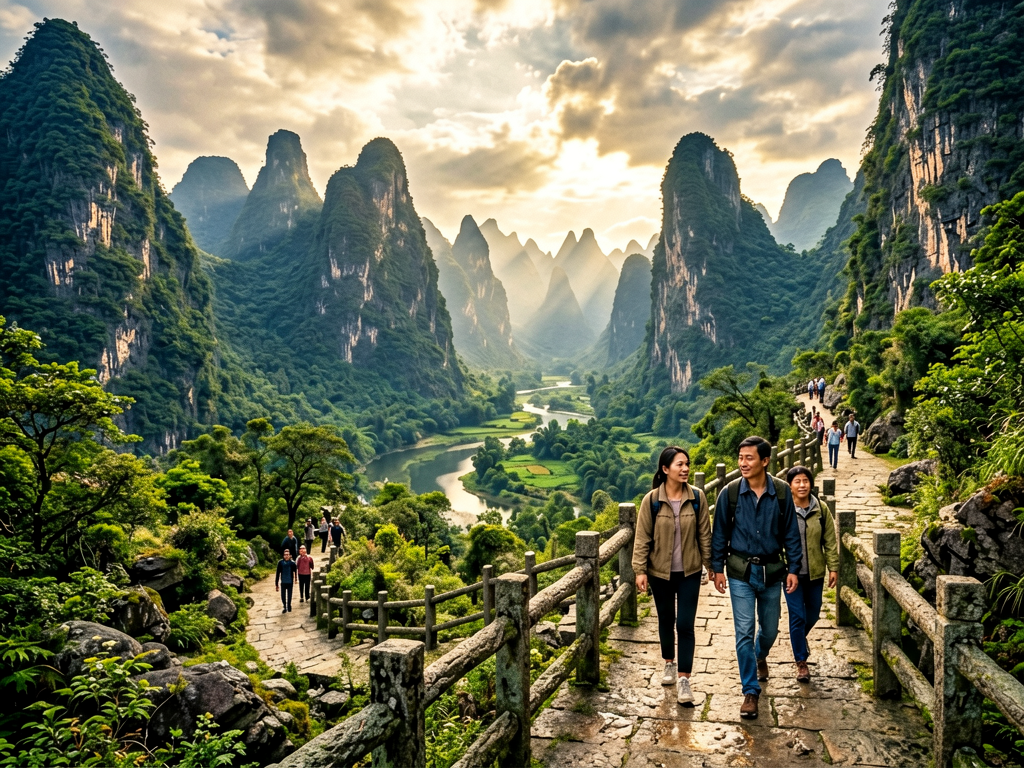
Look, I get it. Guilin is gorgeous. I’ve lived here for eight years, and I still get misty-eyed when the morning fog rolls off the Li River. But let’s be real for a second. If you show up in Guilin expecting solitude, you’re setting yourself up for disappointment.
The main drag, the bamboo rafts, the West Street chaos–it’s all packed. Tourists from every corner of the globe are shoving for the perfect selfie with Elephant Trunk Hill. And don’t even get me started on the group tours with the bright yellow umbrellas. It’s loud. It’s crowded. It’s exhausting.
I’ll be honest, I used to hate this part of China. I thought it was just a tourist trap. But then I stopped following the guidebooks. I started asking the grandpas playing chess in the park for directions to places they actually go. And that’s when everything changed.
There’s a whole other side to Guangxi province that doesn’t show up on Instagram. It’s quieter. It’s dirtier, in the best way. It smells like damp earth and wild ginger. And the views? They’re better than the postcard shots, I promise.
Here’s the thing about hiking in this region. You don’t need to be an Everest climber. Most of these trails are accessible, but they require a bit of curiosity. You have to be willing to take a slow bus, ask for help, and maybe get a little lost.
So, leave the bamboo raft behind. I’m taking you to five spots that the tour buses simply won’t go. These are the trails I’ve carved into my own personal map over the last few years. They’re rugged, they’re real, and they’re absolutely worth the sweat.
Yulong River’s Secret Upper Reaches
Everyone knows the Yulong River. Everyone rents a bamboo raft and floats down while a man beats a drum. It’s beautiful, sure. But it’s also a assembly line. You’re stuck on a raft, moving at the speed of a snail, waiting for the person in front of you to finish their photo.
Instead, try hiking the upper sections near Longsheng. Most people skip this because it’s not marked on the standard tourist maps. You’ll need to take a local minibus from the Guilin bus station. Ask for “Longsheng” or “Longji Rice Terraces,” but tell the driver you’re getting off near the village of Jinkeng, not the main viewing platform.
I remember my first time here. I was skeptical. The path looked more like a goat track than a hiking trail. But once I started walking, the crowds vanished. The air was cooler up there. The karst peaks seemed closer, sharper against the blue sky.
The trail winds through villages where the houses are still made of wood and stone. You’ll see women dyeing fabric with indigo leaves. It’s not a performance for tourists; it’s just their Tuesday afternoon. I bought a scarf from one of the ladies for twenty yuan. It was the best souvenir I ever got because I actually talked to her.
The hike itself takes about three hours. It’s not technical, but it’s steep. Bring good shoes. The mud gets slippery when it rains, which is often. But the payoff is a view of the terraces from the inside, not from a crowded viewing deck. You’re walking through the rice paddies. You can smell the wet soil. It’s intimate.
Sound interesting? It should. It’s peaceful. You can hear the water flowing in the irrigation channels. It’s a different kind of noise than the tour buses. It’s the sound of life here, not the sound of commerce.
The Clay Hills of Detian Border
Okay, this one is a bit of a trek. It’s not right in Guilin city. It’s over in Chongzuo, about three hours by high-speed train. But trust me, it’s worth the extra effort. And honestly, it’s where I go when I need to escape the city completely.
Most people go to Detian Waterfall. They take a boat ride, take a picture, and leave. It’s impressive, but it’s busy. I’m talking about the trails *around* the waterfall. The ones that wind through the karst mountains behind the main sightseeing area.
I found these paths by accident. I was trying to find a local noodle shop and got turned around. I ended up on a dirt path that led up a ridge. I was nervous at first. It wasn’t marked. There were no railings. But then I saw the view.
The mountains here are different. They’re reddish-brown clay mixed with limestone. They look like something from another planet. The light hits them in a way that makes them glow at sunset. It’s not the green and gray of standard Guilin scenery. It’s warmer. Older.
The hike is challenging. You’re climbing steep slopes with loose gravel. My knees have regretted it ever since, but my heart was full. I spent an hour just sitting on a rock, eating a steamed bun I’d bought from a village vendor. No one else was there. Just me, a goat, and the wind.
You’ll pass through small hamlets where the people are incredibly shy. They don’t speak much English. They don’t even have Wi-Fi. And that’s the point. You’re entering a world that moves at a different pace. It’s humbling.
Just be careful. The weather changes fast here. If you see dark clouds, turn back. The trails can become dangerous in rain. I’ve seen tourists try to hike these in summer storms and get stuck. It’s not worth the risk. Go in the morning. Clear skies are your best friend.
Longji Rice Terraces: Off the Beaten Path
I know, I know. Longji is famous. But most people stick to the main viewing platform. They take a cable car, snap a pic, and go home. They miss the soul of the place.
I spend my weekends here when I need to clear my head. But I don’t go to the touristy parts. I go to the villages further up, like Pingan or Jinkeng, but I hike the connecting trails between them. These are paths the locals use to carry harvest, not tourists carrying cameras.
The first time I did this, I was alone. It was early morning, around 6 AM. The mist was still clinging to the valleys. The rice paddies were mirrors, reflecting the sky. It was so quiet I could hear my own breathing.
The trail is well-worn but narrow. It hugs the side of the mountain. One wrong step and you’re sliding into the green below. It’s thrilling. It’s terrifying. It’s alive.
You’ll meet the Zhuang and Yao people here. They’re hardworking. Their hands are rough from years of farming. But they’re warm. If you smile, they’ll smile back. I’ve shared tea with elders who didn’t know a single word of English. We communicated through gestures and laughter. It was better than any conversation I’ve had in a boardroom.
Don’t rush this hike. It’s not a race. Stop at the water channels. Listen to the water. Watch the irrigation system. It’s an ancient engineering marvel that’s still working today. It’s a testament to human ingenuity and patience.
And the food? If you stop at a local homestay for lunch, you’ll eat dishes you’ve never heard of. Bamboo tube rice. Wild ferns. Fresh river fish. It’s cheap, too. Maybe thirty yuan for a feast. Compare that to the $50 meals in Guilin city. It’s a no-brainer.
Xingping Ancient Town’s Backhill
Xingping is another hotspot. It’s beautiful, but it’s packed. The 20 RMB view is crowded with photographers. I’m no fan of crowds, so I stopped going down to the river.
Instead, I started hiking the hills behind the town. There’s a trail that leads up to a small temple. It’s not marked on Google Maps. You have to ask a local. But it’s there.
The climb is moderate. It takes about an hour. But the view from the top is spectacular. You get the same karst peaks as from the river, but from above. You see the layout of the town. You see the river winding through the landscape like a green ribbon.
It’s much quieter up here. I’ve sat on the steps of that temple for hours. Just watching the clouds move. It’s meditative. It’s a reminder that nature is bigger than us. It’s bigger than our worries.
I’ve talked to hikers from all over the world here. We share stories. We compare notes. It’s a nice break from the isolation of modern life. We’re all just looking for a moment of peace.
And if you’re lucky, you’ll see the sunrise from up there. It’s pink and orange and purple. It paints the mountains in colors you can’t imagine. It’s worth waking up at 4 AM for. I’ve done it three times. I’d do it again tomorrow.
Yangshuo’s Cave Systems
Okay, this one’s a bit risky. I’m not recommending you go into caves without a guide. But there are hiking trails that lead to the entrances of small, unexplored caves. These are for adventurous types only.
I went once with a local friend. He’s a geology student. He knows the area well. We hiked for two hours through dense forest. The air was thick with humidity. The bugs were relentless.
But then we found it. A small opening in the rock. Inside, it was cool and dark. The walls were covered in crystals. They sparkled in the light of our flashlights. It was like walking into a jewel box.
It was eerie. It was beautiful. It was terrifying. I felt like Indiana Jones, but without the whip or the hat.
These trails are not for everyone. They’re rough. They’re dangerous. You need to be fit and prepared. But for those who seek adventure, it’s the ultimate thrill. It’s a chance to see the earth’s bones.
Just remember, don’t go alone. And don’t go if you’re claustrophobic. I’ve had friends who tried this and regretted it. It’s not a joke. The caves are deep. The drops are real.
But if you pull it off, you’ll have a story you’ll tell for the rest of your life. You’ll have seen a side of China that few outsiders ever witness. It’s exclusive. It’s raw. It’s yours.
Final Thoughts on Getting Lost
I could list more places. I have a whole notebook full of them. But I think you get the idea. The best parts of Guilin aren’t the famous spots. They’re the spaces in between. They’re the trails you find by asking questions. They’re the views you earn by climbing.
It’s about slowing down. It’s about engaging with the land. It’s about respecting the people who live here. If you approach hiking in this region with humility, it will reward you tenfold.
Don’t just look. Feel the dirt. Smell the rain. Talk to the locals. They’re not part of the scenery. They’re the heart of it.
So, pack your bag. Leave the guidebook at home. Take a local bus. Ask for directions. Get a little lost. You might just find yourself.
And if you do, take a picture. Not for Instagram. For yourself. So you remember how it felt. How the air tasted. How the silence sounded.
That’s the real souvenir. That’s the real Guilin. And it’s waiting for you, just off the beaten path.