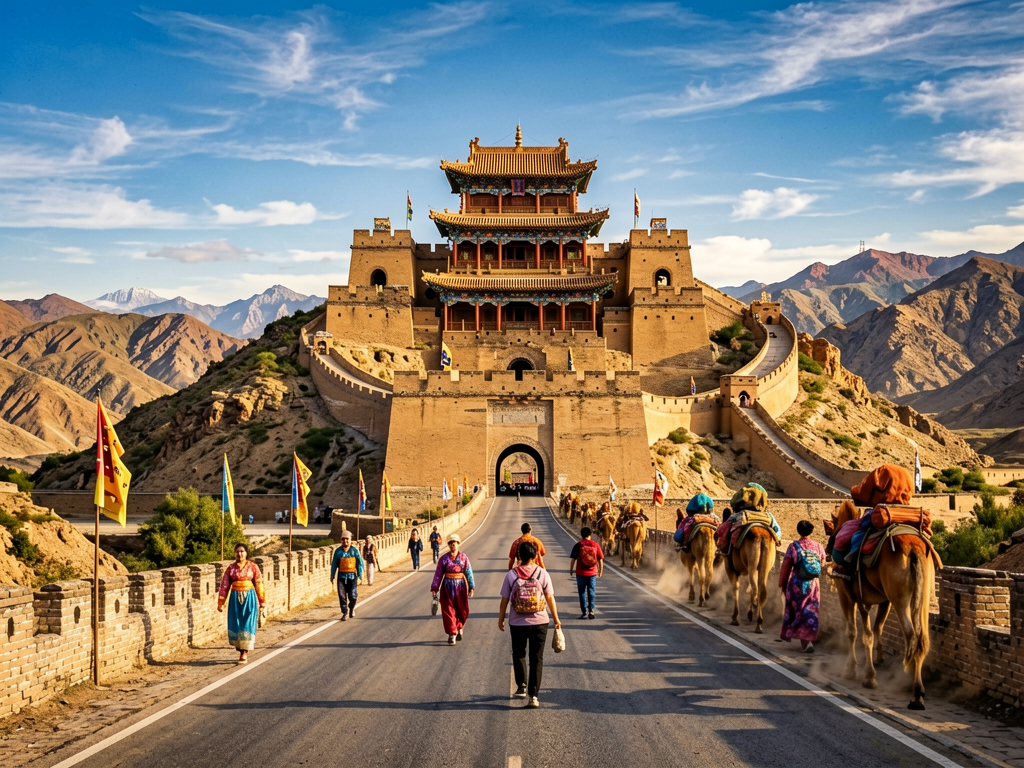
The Silk Road in China: 3 Cities You Can Still Visit
The ancient Silk Road network connected China to Central Asia and Europe for 1,500 years. Parts of it are still accessible to travelers — not as ruins, but as living cities that still show their Silk Road heritage.
Xi’an: The eastern terminus of the Silk Road. The Muslim Quarter is a direct legacy of the Arab and Persian merchants who settled here. The Great Mosque, built in 742 AD, blends Chinese and Islamic architecture. The Tang dynasty capital Chang’an was the most cosmopolitan city on earth — the Wild Goose Pagodas and the Tang Paradise theme park give you a sense of what that looked like.
Dunhuang: A oasis town in the Gobi Desert, home to the Mogao Caves — 492 cave temples carved into a cliff face, filled with Buddhist art spanning 1,000 years. The caves contain the world’s greatest collection of Buddhist manuscripts and murals. The Singing Sand Dunes and Crescent Moon Spring are surreal natural attractions right next to the caves.
Kashgar: The westernmost city in China, in Xinjiang. The Sunday Market (畜禽巴扎) is the largest livestock market in Central Asia — a chaotic, dusty, incredible spectacle. The Old City is a maze of winding alleys with traditional Uyghur architecture. Kashgar feels more like Central Asia than China. It’s culturally fascinating and politically sensitive — travel with awareness and respect for local rules.