Chinese Kung Fu: The Complete Beginner’s Encyclopedia
Chinese kung fu (功夫, gōngfu) is one of the world’s oldest and most diverse martial arts systems. With thousands of styles, a history spanning millennia, and a philosophy that goes far beyond fighting, it can be overwhelming for beginners. This guide covers the essentials you need to know.
What Is Kung Fu?
The term “kung fu” literally means “skill achieved through hard work” — it can apply to any skill, from cooking to calligraphy. But in English, it’s become synonymous with Chinese martial arts. In Chinese, the term “wushu” (武术) is more commonly used to refer to martial arts as a practice.
Chinese martial arts are divided into thousands of styles (门派, ménpài), traditionally categorized by: geography (northern vs. southern), philosophy (Buddhist Shaolin vs. Taoist Wudang), technique (external/hard vs. internal/soft), and imitation (animal styles like tiger, crane, monkey).
A Brief History
The earliest records of organized martial training in China date to the Shang dynasty (1600-1046 BC), when bronze weapons required structured practice. The Warring States period (475-221 BC) saw the development of unarmed combat systems alongside weapons training. The Shaolin Temple, founded in 495 AD, became the crucible of Chinese martial arts — Buddhist monks developed a systematic fighting style that blended physical conditioning with spiritual discipline.
The Ming dynasty (1368-1644) was the golden age of Chinese martial arts. General Qi Jiguang compiled the first comprehensive martial arts manual in the 1560s, documenting 16 different fighting styles. This period also saw the development of many “internal” styles, including Tai Chi.
The 20th century brought profound changes. The Boxer Rebellion (1900) saw martial artists fight against foreign powers with tragic results. The Cultural Revolution (1966-1976) suppressed traditional martial arts as “feudal.” But the reform period after 1978 revived them — and kung fu films, particularly Bruce Lee’s and later Jet Li’s, sparked a global craze that continues today.
Major Style Families
Shaolin (少林): The most famous. Over 1,500 years of continuous practice. Known for powerful, explosive movements, deep stances, and a vast repertoire of forms (over 700 recorded). Sub-styles include the Five Animal system (dragon, tiger, crane, leopard, snake) and numerous weapon forms.
Wudang (武当): Taoist internal arts emphasizing relaxation, flow, and internal energy. Includes Tai Chi, Baguazhang (eight trigrams palm), and Xingyiquan (form-intention fist). The movements are circular and continuous. Practitioners often start physical training later in life and continue into old age.
Wing Chun (咏春): A southern Chinese style designed for close-range combat. Emphasizes centerline theory, simultaneous attack-defense, and sensitivity training through Chi Sao (sticky hands). Bruce Lee trained in Wing Chun before developing Jeet Kune Do.
Northern Long Fist (北派长拳): Characterized by wide, extended movements, high kicks, and acrobatics. Northern styles tend to emphasize leg techniques and long-range fighting. Changquan, the most famous long fist style, is the basis for modern wushu performance.
Southern Fist (南拳): Southern Chinese styles (Guangdong, Fujian) emphasize strong arm techniques, low stances, and short, powerful movements. Hung Gar is the most famous — deep horse stances, iron-like blocks, and the tiger-crane set.
Animal Styles: Many traditional styles imitate animal movements. Tiger builds power and bone strength. Crane develops balance and precision. Leopard develops speed and explosive power. Snake develops internal energy and flexible strikes. Dragon develops spirit and circular movement. Most traditional schools teach a combination of animal forms.
Weapons
Chinese martial arts include 18+ traditional weapons, divided into categories. The “Four Major Weapons” are: staff (棍, gùn) — the foundation weapon, taught first; broadsword (刀, dāo) — a single-edged slashing weapon; straight sword (剑, jiàn) — a double-edged thrusting weapon, considered the gentleman’s weapon; and spear (枪, qiāng) — the most effective battlefield weapon in Chinese history. Beyond these are the less common weapons: rope dart, meteor hammer, chain whip, and the elusive “deer antler knives” — which you’ll mostly see in wushu performances.
The Philosophy
Kung fu is not about fighting. The ultimate goal is self-mastery — physical, mental, and spiritual. The training builds discipline, patience, and awareness. The forms (套路, tàolù) are the heart of practice — choreographed sequences that encode techniques, strategies, and principles. Each form is a library of fighting knowledge passed from teacher to student.
Confucian values appear in the emphasis on respect for the teacher (师父, shīfu) and the school hierarchy. Taoist philosophy appears in the concepts of qi (energy), wu wei (effortless action), and the balance of hard and soft. Buddhist influence appears in the emphasis on discipline, non-attachment, and compassion. A true master avoids violence when possible — kung fu’s greatest victory is the fight that never happens.
How to Start Training
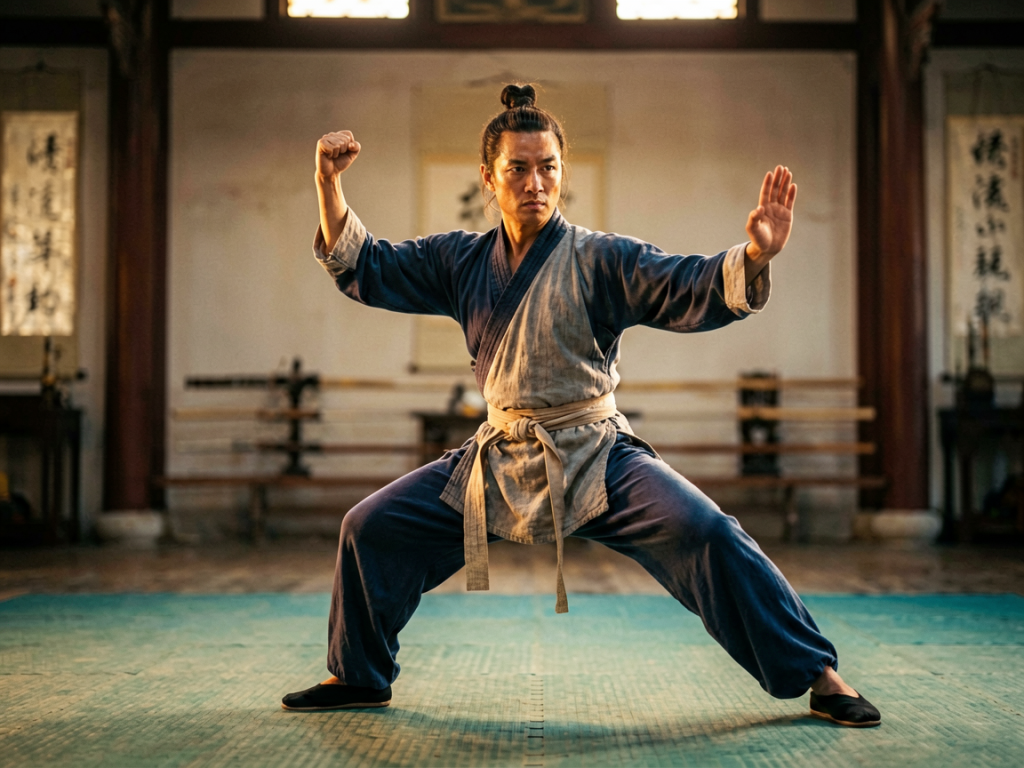
Find a qualified teacher. This is the hardest step. Look for someone who: was formally trained in a recognized lineage; emphasizes fundamentals (stances, basics) over forms; doesn’t promise mystical powers or fast results; and is willing to explain the why behind the movements. A good teacher will start you with basic stances (horse, bow, cat, crane) and fundamental movements. These are boring but essential. Without solid basics, advanced techniques are built on sand.
Supplement your training with conditioning: running, stretching, and bodyweight exercises. Kung fu requires flexibility, endurance, and leg strength. You’ll be surprised how hard holding a horse stance for two minutes can be. Train for 3-6 months with basics before expecting to learn forms. Consistency matters more than intensity — 20 minutes daily beats 3 hours once a week.
And above all: be patient. Real kung fu skill takes years to develop. The people who persist past the first year are the ones who truly benefit. The training changes you slowly — better balance, better posture, better focus, more confidence. By the time you notice the changes, you’ll understand why people dedicate their lives to this practice.