Terracotta Warriors: Everything You Need to Know
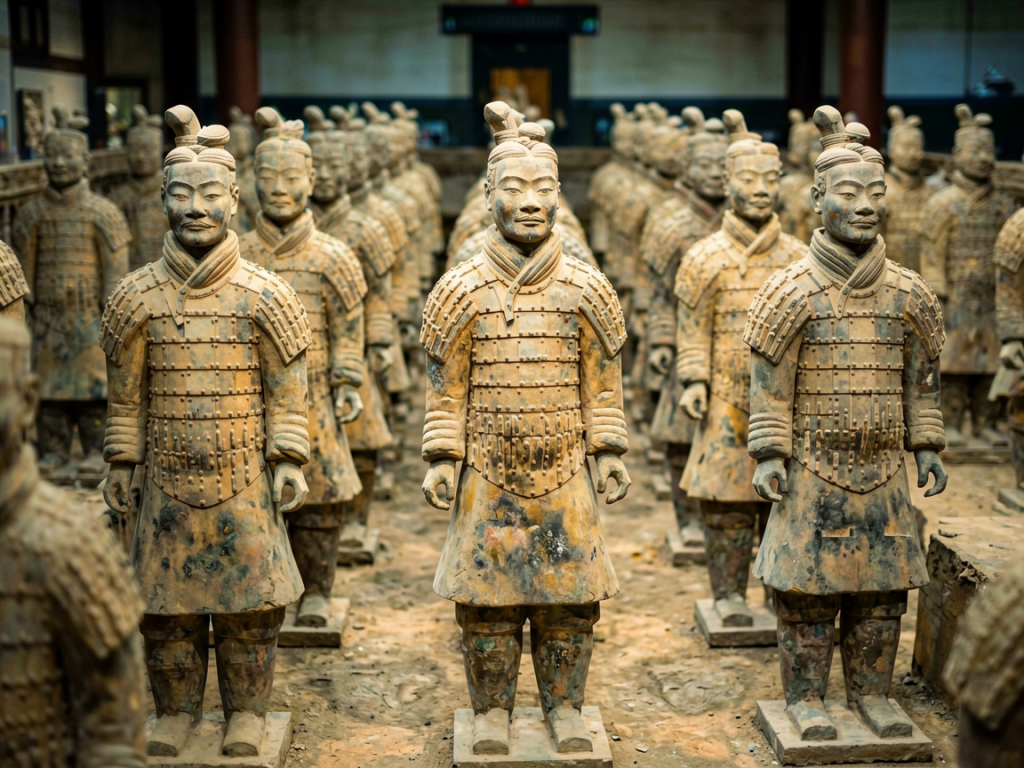
The Terracotta Warriors are one of those things that photos don’t prepare you for. You’ve seen the pictures — rows of life-sized soldiers, each with a unique face. But standing in Pit 1, looking at an army of 8,000 soldiers that’s been buried for 2,200 years — that’s a different experience entirely.
Who Built Them and Why
Emperor Qin Shi Huang, the first emperor to unify China, ordered the construction of his mausoleum immediately after taking the throne at age 13. The project employed 700,000 workers over nearly 40 years. The purpose: to protect the emperor in the afterlife with a clay army that would serve him for eternity.
Qin was obsessed with immortality. He sent expeditions to find the elixir of life, consumed mercury pills (which probably killed him), and built his tomb complex as a miniature version of his empire — complete with palaces, rivers of mercury, and an army to defend it all.
The Discovery
March 29, 1974. Farmers digging a well in Lintong County, about an hour from Xi’an, hit something hard about 5 meters down. It was a terracotta head. The local archaeologist who arrived on the scene immediately recognized the significance. Within a year, the first excavation pit was open, and the Terracotta Army was revealed to the world.
The farmers who made the discovery still tell the story. One of them, Yang Zhifa, spent years after the discovery signing autographs and posing with tourists. He died in 2024 at age 94.
What You’ll See
The site is divided into three pits. Pit 1 is the main attraction — 14,000 square meters of soldiers arranged in battle formation, with vanguard archers at the front, infantry in the center, and flanking units on the sides. About 2,000 soldiers are currently excavated and on display; the rest remain buried for preservation.
Pit 2 is smaller but more impressive in some ways. It houses a mixed unit — cavalry, chariots, archers, and infantry in a more complex formation. This is where you’ll see the most detailed figures, including the kneeling archers with their intricate armor and the general with his distinctive headdress.
Pit 3 is the smallest — the command center. Only 68 figures, mostly officers and a single chariot. The layout suggests this was the headquarters of the army.
The Details That Will Blow Your Mind
Each warrior’s face is unique. There are no duplicates. Archaeologists believe they were modeled after real soldiers in Qin’s army. The height varies by rank — generals are tallest at about 190cm, soldiers are slightly shorter. The original colors (bright red, green, blue, purple) faded within minutes of exposure to air. Only traces remain. Archaeologists are developing preservation techniques that might allow future excavations to keep the colors intact.
The weapons were real. The bronze swords and crossbow triggers found with the warriors were still sharp — coated with a chromium layer that prevented corrosion for 2,000 years, a technology not rediscovered in the West until the 20th century.
Practical Tips
Go early — 8am opening, arrive by 7:45. The crowds arrive at 10am. Hire a guide at the entrance (about $30) — the numbered displays provide basic information, but a good guide brings the history to life. The museum complex includes a bronze chariot exhibition that’s worth the separate ticket. The gift shop sells overpriced mini warriors — buy them in Xi’an instead for a fraction of the price.
Allow 3-4 hours minimum. It’s a 1-hour drive from Xi’an. Combine it with a trip to the Huashan Hot Springs if you have a full day.