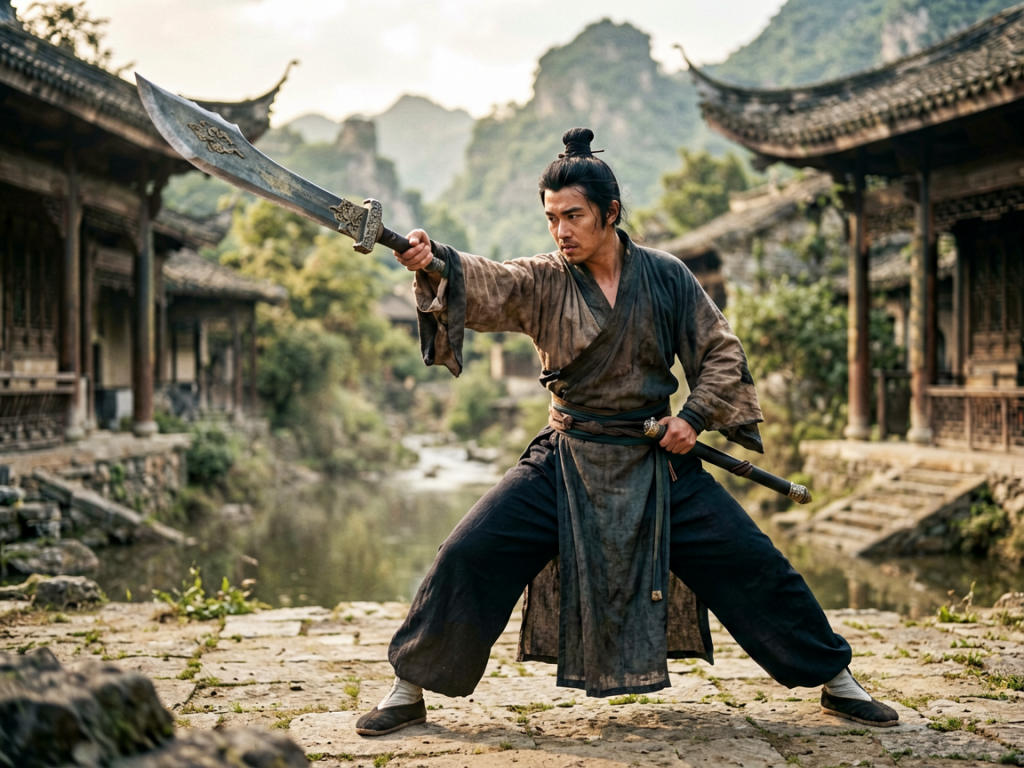
I’ll be honest, I nearly threw out my back before the first session even started. That was my first day trying to pick up a guandao at a small courtyard school outside Chengdu. The instructor, a quiet guy named Lao Chen who’d spent twenty years drilling students in traditional wushu, just handed me the pole and said, “Don’t lift it. Let it find your center.” I laughed. Then I tried to move it three inches off the ground and realized how utterly wrong I was.
That heavy steel blade, roughly forty pounds if you weigh it on a bathroom scale, doesn’t care about your gym bag routine. It demands respect. And honestly, that’s exactly why we still swing it today. You might think ancient polearms belong in museum glass cases next to bronze chariots. But walk through any decent training hall in China, and you’ll see kids in track pants practicing sweeping arcs with them every single morning.
The Weight of History on Your Shoulders
We’ve all heard the stories about Guan Yu. The myth says he rode his red horse across battlefields wielding a ninety-eight-pound blade. The reality is probably a bit lighter, but the legend stuck. Chinese martial artists don’t treat the guandao like a relic. They treat it like a teacher.
When I first picked one up, I expected brute strength to do most of the work. I couldn’t have been more mistaken. The balance point sits right near the curved blade, which means you’re actually pivoting on the shaft, not lifting dead weight. It changes everything. You learn to rotate your hips, drop your shoulders, and let momentum carry the steel instead of fighting it.
Sound interesting? It gets better. The blade itself isn’t just decoration. That crescent shape actually does serious work when you’re practicing cutting angles. Historically, it was designed to trip cavalry horses and slice through chainmail. Nowadays, it’s mostly about building structural integrity in your stance. You’ll develop a grounded posture that translates to just about any other movement.
I’m no expert on Song Dynasty battlefield tactics, but I know what feels right in my own joints. After three months of drilling basic sweeps, my knees stopped clicking when I squatted. My lower back stopped complaining after long walks. That’s the kind of functional carryover you don’t get from chasing muscle pumps.
The beauty of traditional weapons lies in their simplicity. You don’t need fancy equipment or complicated manuals. You just need a floor, a wall to practice against, and the patience to repeat the same motion until it stops feeling awkward. Most beginners try to muscle through the initial resistance. They burn out fast. The wise ones lean into the leverage and let their skeleton do the heavy lifting.
I’ve watched countless foreigners chase the latest crossfit trend or sign up for kickboxing classes. It’s all fun, sure. But nothing prepares your connective tissue like slowly learning to control a battle blade that pulls forward on its own. Your tendons adapt. Your fascia thickens. You literally build a different kind of strength.
Why We Still Swing It Today
Let’s talk about the modern scene. You’ll find guandao practice split into two main camps. On one side, you’ve got traditional martial arts schools where elders prioritize form, breath control, and lineage. On the other, you’ve got competitive wushu athletes who choreograph routines for judges who score based on difficulty and aesthetic flow.
To be fair, both approaches teach valuable lessons. The traditional method slows you down. You spend weeks just learning how to plant your feet before you even attempt a turn cut. The competitive route throws you straight into combinations, jumps, and rapid blade spins. I prefer the slower path myself. It builds patience, which is rare these days.
Here’s the thing about training with a heavy blade. It forces you to pay attention. You can’t zone out while holding thirty-five pounds of forged steel. Every misalignment shows up immediately. Your wrists ache. Your grip slips. Your balance wavers. The guandao doesn’t lie to you. It just corrects you.
I watched a teenager at Lao Chen’s school struggle with a simple windmill rotation for three straight sessions. He kept trying to muscular his way through it. Finally, the old master stepped in, tapped his hip, and told him to stop pulling. The kid relaxed his shoulders, let the shaft roll over his collarbone, and suddenly the whole thing flowed. You could actually hear his breathing sync with the steel slicing through the air.
That moment stuck with me. It’s a perfect metaphor for how Chinese martial arts often operate. You don’t conquer the tool. You harmonize with it. Modern fitness culture loves machines that isolate muscles. The guandao does the opposite. It connects your feet, legs, spine, arms, and hands into one continuous chain.
Right? I know it sounds counterintuitive. Why would anyone voluntarily drag around a weapon that belonged in a warzone? Because the physical feedback loop is unmatched. You learn exactly how much force you’re applying. You feel every wobble before your brain registers it. That kind of instant biofeedback rewires your nervous system faster than any smartwatch could ever hope to.
I’ve spent years watching friends bounce between yoga studios, CrossFit boxes, and Muay Thai gyms. They always chase the next new modality. I never get tired of the guandao. It’s straightforward. It doesn’t change. It just keeps demanding better mechanics, deeper breaths, and cleaner transitions. It’s the kind of practice that rewards consistency over hype.
The Sound of Steel Cutting Air
If you’ve never heard a properly swung guandao, you’re missing out on a surprisingly musical experience. A well-oiled blade whistles when it cuts through the atmosphere. Back in ’19, I bought a secondhand training version from a blacksmith in Shaanxi. It cost me four hundred yuan, and the wood handle smelled faintly of tung oil and old sweat. Best purchase I ever made.
We practiced outside near an old stone bridge until dusk. The sound echoed off the water and made me actually stop mid-swing to listen. There’s a rhythm to it that feels almost meditative. You start counting your steps, matching your breath to each pivot, and eventually the noise just becomes background white noise.
Surprised?
Most people imagine martial arts training as purely physical. We forget how much of it lives in the nervous system. Repeating the same basic cuts hundreds of times rewires your proprioception. You start feeling shifts in gravity before your eyes register them. It’s like tuning an instrument. At first, you’re hitting wrong notes. Eventually, you hit the exact frequency.
I tried comparing it to swinging a baseball bat or throwing a tennis ball. Neither comes close. The guandao operates on rotational leverage that feels completely foreign if you’re used to linear sports. You’re constantly shifting your weight from front leg to back leg while keeping your core tight enough to absorb the recoil. It’s exhausting. It’s also deeply satisfying.
There’s something quietly transformative about hearing that sharp hiss of air displacement. It marks progress. When you first start, the blade drags. You feel the dead weight. After a few months, it sings. You’ll know it the moment it happens. Your cuts snap instead of sweep. Your stances lock into place without conscious effort. The weapon stops fighting you.
I still remember the exact afternoon it clicked for me. I was practicing alone in a narrow alley behind my apartment in Xi’an. Rain had just stopped. The cobblestones were slick. I didn’t even think about it. I just moved. The blade traced a perfect half-circle, sliced upward, and planted back into my guard without breaking stride. I stood there for a full minute, just catching my breath, listening to my own heartbeat.
That’s the part nobody films on TikTok. You don’t get viral clips from mastering basic mechanics. You just get quiet afternoons, sore muscles, and a strange sense of calm that lingers long after you put the pole down.
More Than Just a Cold Weapon
Cultural continuity plays a huge role here. In China, martial arts aren’t just about self-defense or athletic performance. They’re tied to philosophy, discipline, and historical memory. The guandao sits right at that intersection. You’re not just moving metal. You’re walking a path that thousands of practitioners have followed for centuries.
I’ve noticed this especially with younger students. They grow up scrolling through short videos and chasing instant gratification. Then they show up to class, grab a pole that weighs more than their backpack, and suddenly they have to sit with themselves. There’s no swipe left. No skip button. Just you, the floor, and a forty-pound test of patience.
To be fair, it’s not for everyone. Some folks want quick results or flashy techniques they can film for social media. The guandao punishes vanity instantly. You look foolish when you swing too wide. You trip yourself when you rush the recovery. It demands humility, whether you sign up for it or not.
But that’s exactly why it survives. In a world obsessed with efficiency and optimization, we still need tools that remind us how to grind gracefully. The blade doesn’t care about your follower count. It only cares about your stance, your grip, and your willingness to keep showing up.
I’ve seen plenty of trendy fitness fads come and go over my eight years abroad. People chase them, burn out, quit, and move on to whatever’s next. The guandao stays. It anchors people. It gives them a tangible connection to history that doesn’t require a textbook or a lecture hall. You just feel it.
When you hold one, you understand why certain shapes evolved the way they did. The curve isn’t arbitrary. The tip isn’t decorative. Every design choice came from trial, error, and blood. Modern copycats try to replicate the silhouette without grasping the function. Real practitioners know the difference. You’ll notice it in the way they hold the weapon. Loose. Ready. Respectful.
What You Actually Learn Holding One
Let’s break down the practical skills you build, because nobody wants to romanticize heavy steel without understanding the mechanics. First, you develop explosive hip rotation. Every cut originates from your lower body, not your shoulders. Second, you train dynamic balance. You’ll spend a lot of time pivoting on one foot while the other drags or slides into a new position.
Third, you learn spatial awareness. That blade has a long reach, and a careless swing can clip a training partner or smash a wooden dummy. You quickly learn to measure distance and control velocity. It’s like playing chess with physical consequences.
I could be wrong about the philosophical angle, but I genuinely feel that training with antiquated weapons bridges a gap between past and present. When you hold a guandao, you’re touching the same craftsmanship that soldiers once relied on to survive. Modern factories stamp out uniform gear now. Traditional blades are still shaped by hand, tempered in oil, and fitted with ash or mulberry wood that absorbs shock better than anything synthetic.
That tactile connection matters. I’ve watched seasoned instructors run their thumbs along the shaft grain while explaining footwork. It’s a quiet ritual. It grounds the lesson in something real. You aren’t just memorizing steps. You’re feeling the tool respond to your intent.
Look, I went into this expecting to lift heavy things and maybe impress some friends at a dinner party. What I actually got was a crash course in economy of motion, mental focus, and bodily awareness. The weight forced me to stop overthinking. I had to react. I had to adapt. I had to trust the training.
You’ll probably laugh at how clumsy you feel at first. Your arms will shake. Your forearms will burn within minutes. But stick with it. Swap out the ego for repetition. Watch how your stance tightens. Notice how your cuts start snapping instead of dragging. That’s when it clicks. The blade stops fighting you, and starts working with you.
China has kept this weapon alive not because it’s stubborn or nostalgic, but because it simply works. It teaches physics, temperament, and resilience all at once. If you ever get the chance to pick one up, don’t overcomplicate it.