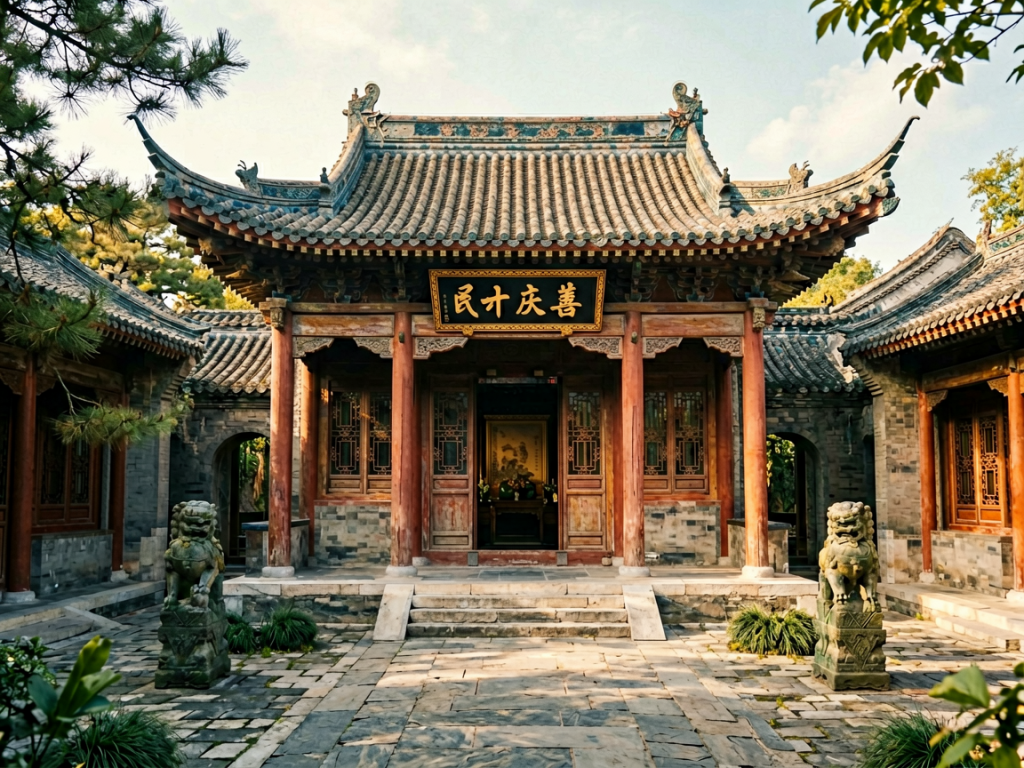
When I first moved to Beijing, I thought I knew what a traditional courtyard looked like. I’d seen the photos. White walls, grey tiles, maybe some red lanterns hanging from the eaves. But standing in the middle of a real siheyuan in the hutongs, holding a cup of jasmine tea that was still too hot to drink, I realized I’d been looking at the scenery and missing the script.
The house wasn’t just shelter. It was a map. A very rigid, very old-fashioned map of who mattered, who didn’t, and where you sat at dinner.
I’m not an architect. I’m just a guy who lived in these cramped, charming spaces for eight years and watched how families actually functioned within them. And honestly? The geometry of the home dictated the geometry of the relationships. If you want to understand Chinese family hierarchy, you don’t read a book on Confucianism. You walk into a courtyard.
The North Face is King
Let’s start with the basics. A standard siheyuan is a rectangle enclosed by four wings of buildings facing inward. Each side has a different role, and they aren’t interchangeable. This isn’t interior design; it’s social order made physical.
The main house faces south. It sits on the north side of the courtyard. In traditional Chinese cosmology, the north is associated with water, winter, and darkness, but also stability. More importantly, the main house gets the best light. It catches the sun from morning until late afternoon. It’s dry. It’s warm.
This is where the patriarch or the eldest matriarch lives. Always. No exceptions.
I remember visiting my friend Lao Li’s family home in Xicheng District. His grandfather, a man who looked like he was carved from the same grey brick as the walls, occupied the central three rooms of the north wing. The doors were wide, the windows overlooked the entire yard, and the furniture was heavy, dark wood. It felt less like a bedroom and more like a throne room.
Why does this matter? Because in a hierarchy, position determines power. By placing the elder in the highest ground with the most light, the architecture physically enforces respect. You don’t just respect your parents because they told you to. You respect them because you literally look up to them, both metaphorically and, in multi-story variations, sometimes literally.
Side Wings: The Children’s Quarters
So, where do the kids go? They take the east and west wings. These are usually lower structures than the main house, often slightly shorter in roof height. They flank the central axis, acting as protective arms around the elder.
There’s a distinct gender dynamic here in older, more traditional setups. Traditionally, the left (east) side was for the senior son, and the right (west) side for the junior son. Today, it’s a bit more flexible, but the principle remains: children live adjacent to, but subordinate to, the parents.
I lived in a converted siheyuan in Dongcheng for a couple of years. My roommate was a young engineer named Wei. He slept in the east wing. I was in the west. The kitchen and bathroom were shared, tucked into the back of these wings, but the sleeping quarters were separate.
The difference in the rooms was subtle but telling. Wei’s room, despite being similar in size to mine, faced east. It got the morning sun. Mine faced west, getting that harsh, burning afternoon heat that made the room feel like an oven until dusk. It sounds like a minor inconvenience, but in a siheyuan, orientation is everything.
The east is associated with wood and spring, symbolizing growth and new beginnings. The west is associated with metal and autumn, symbolizing harvest and decline. So, the younger generation gets the “growth” energy. The elders get the “harvest” wisdom. It’s poetic, sure, but it’s also a reminder that your place in the house matches your stage in life.
And let’s talk about privacy. In a siheyuan, there isn’t much of it. You can hear conversations from the main house echoing across the courtyard. You can see shadows moving behind the paper screens. This lack of privacy isn’t a bug; it’s a feature. It keeps the family tight. It prevents secrets. In a hierarchical structure, transparency maintains control.
The Gatehouse: Controlling Access
You can’t talk about the siheyuan without mentioning the gate. It’s rarely in the center. It’s almost always offset to the southeast corner. Why?
Feng shui, obviously. The southeast is the direction of wind and wood, inviting good qi (energy) into the home while blocking bad energy from the northwest (the direction of death and decay in some interpretations). But beyond the mystical reasons, the gatehouse controls who enters and who stays out.
The gate is the boundary between the public world and the private family unit. When you step through it, you enter a microcosm governed by its own rules. Servants or younger relatives might have a smaller side door, but the main gate is reserved for formal occasions and respected guests.
I recall a wedding celebration in a large, restored siheyuan compound. The bride’s family arrived through the main gate, accompanied by music and firecrackers. The noise was deafening, bouncing off the high walls. The elders stood by the entrance to greet them, a ritual of welcome and assertion of status.
But think about the daily life. The gatekeeper of this space is often the matriarch. She decides who gets invited in for tea and who doesn’t. She manages the flow of people. In many extended families living in modified siheyuans, the grandmother holds the key–not just to the house, but to the social calendar. Her authority is reinforced by her proximity to the main house and her role as the custodian of tradition.
The Courtyard Center: The Stage
Now, let’s look at the empty space in the middle. The courtyard itself. In Western architecture, we often build outward. In Chinese traditional architecture, we build inward. The exterior walls are blank, uninviting, even defensive. All the life happens inside.
The courtyard is the heart of the home. It’s where the family gathers for meals in the summer, where kids play, where laundry hangs, where pomegranate trees grow. But it’s also the stage for family rituals.
Dining etiquette in a siheyuan is strict. The table is usually placed in the main house or a large pavilion in the yard. Who sits where depends entirely on age and rank. The eldest sits facing the door or in the most prominent spot. Younger members sit further away, closer to the service areas. It’s a daily reminder of the social ladder.
I’ve eaten in so many of these courtyards. In one particular home, during Chinese New Year, the whole extended family filled the main hall. There were twelve of us. The table was round, which usually implies equality, but the seating wasn’t random. My host’s father sat at the head. His brothers flanked him. Then the wives, then the children. It was a puzzle of social relations that you had to solve before you even picked up your chopsticks.
If you got the seat wrong, it wasn’t just awkward. It was disrespectful. It showed you didn’t understand your place. The architecture sets the boundaries, but the family enforces the norms.
There’s also the concept of the “inner” and “outer” quarters. In larger compounds, the siheyuan might be part of a series of courtyards arranged along a north-south axis. The outer courts are for receiving guests and conducting business. The inner courts are strictly for family life. Women’s quarters were historically separated, though this has faded in modern times. Still, the idea of zones persists. Some parts of the house are for show; others are for living.
Modern Life in Ancient Walls
So, is all this hierarchy still relevant? You’d think that in a city as modern as Beijing, with skyscrapers and high-speed rail, ancient rules would have crumbled.
They haven’t. They’ve just adapted.
Many siheyuans have been subdivided. One large compound might now house five or six small nuclear families. They share the courtyard but live in separate wings. The tension between old traditions and new realities is palpable. Young couples want privacy. Elders want closeness. The architecture forces a compromise.
I watched a young couple renovate their wing of a siheyuan. They knocked down a wall to create an open-plan living area, something completely alien to the traditional layout. The grandfather grumbled about it, saying it broke the flow of energy and disrespected the structure. But he also admitted the kitchen was much easier to use now.
We’re seeing a shift. The strict north-south axis is sometimes bent. The gate might be replaced by a glass door for security. The plants in the courtyard might be designer succulents instead of symbolic pomegranates. But the underlying logic remains. The elders still command the best rooms. The family still gathers in the center.
It’s fascinating how resilient these cultural structures are. They’re embedded in the bricks and mortar. You can’t easily change the foundation without changing the house.
What It Teaches Us
Living in a siheyuan taught me that space is never neutral. Every wall, every window, every step has meaning. For outsiders, it’s just a cool place to stay. For insiders, it’s a daily negotiation of identity and respect.
The hierarchy isn’t necessarily oppressive, though it can be. It provides structure. In a chaotic world, knowing your place can be comforting. It tells you who to call for advice, who to defer to in arguments, and who to care for in old age.
The siheyuan embodies the Confucian ideal of order. Harmony comes from everyone playing their part. The father leads, the children follow, the elders are honored. It’s a system that has lasted thousands of years.
Today, we might critique it. We might miss the individual freedom that Western apartments offer. But there’s a warmth to communal living that’s hard to beat. Sharing a courtyard means sharing a sky. You see the same moon. You hear the same rain. You’re connected to your neighbors in a way that drywall and hallways rarely allow.
I’ll miss the siheyuan. I’ll miss the creaky wooden floors, the smell of coal briquettes in winter, and the way the light hit the courtyard at sunset. But mostly, I’ll miss the sense of belonging. It’s a complicated, layered feeling, wrapped up in the geometry of a simple square.
If you ever visit Beijing, don’t just look at the Forbidden City. Go find a hutong. Knock on a gate. Ask if you can buy a bottle of water. And while you’re standing there, look up. Notice who sits in the main house. Notice where the kids play. You’ll see the history of China sitting in plain sight, waiting for you to notice.
It’s not just a house. It’s a family tree, drawn in brick and tile. And once you learn to read it, you’ll never see a courtyard the same way again.