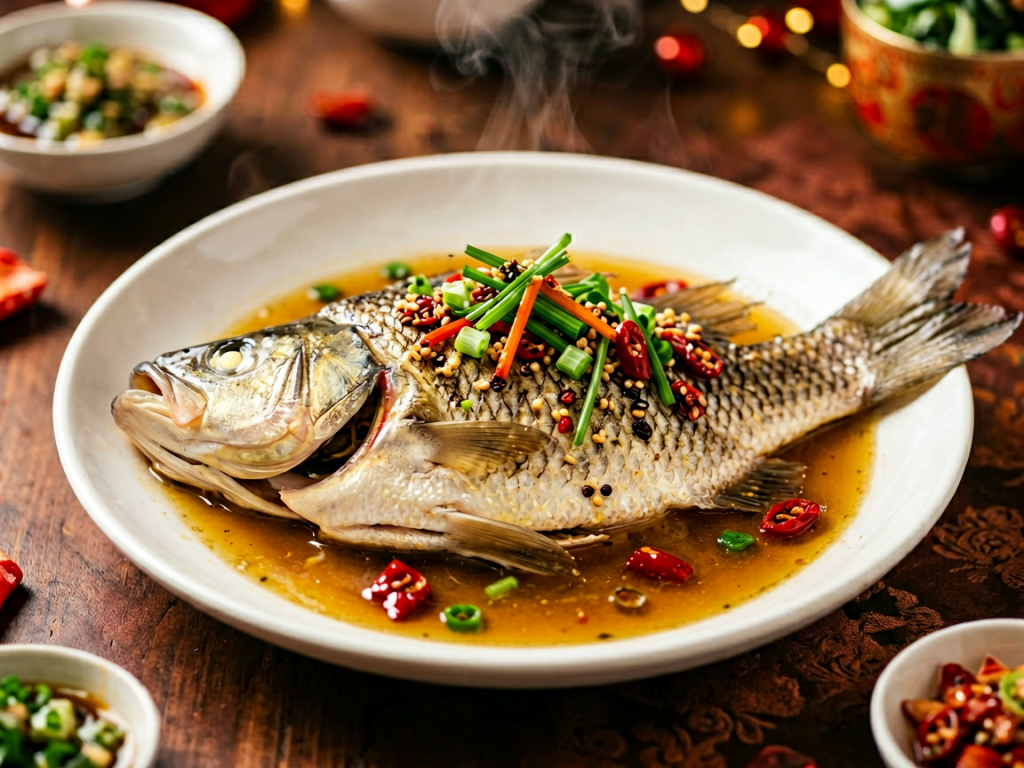
I’ll be honest, the first time I sat down for Chinese New Year’s Eve dinner in Shanghai, I thought it was a trick. There it was, steaming in the center of the round table: a whole fish, head and tail intact, swimming in a ginger-soy broth that smelled like heaven. It looked perfect. It smelled incredible. My stomach was growling loud enough to wake the neighbors.
But as my host mother, Auntie Lin, picked up her chopsticks, she did something unexpected. She didn’t go for the fish. She pointed to the braised pork belly next to it. Then she looked at me and smiled, shaking her head slightly when I reached for the fillet.
“No,” she said firmly. “Not yet.”
I was confused. Was there a rule I missed? A religious restriction? I ate everything else on the table with gusto. The dumplings were stuffed with pork and chives, plump and juicy. The spring rolls crackled with every bite. But that fish just sat there, watching me. Or rather, its glassy eye was watching me, judging my lack of discipline.
It wasn’t until later that night, after the fireworks had faded and the red envelopes were exchanged, that Auntie Lin explained the real reason. And trust me, it’s not just about superstition. It’s about hope, linguistics, and the sheer weight of tradition that hangs in the air during those twelve days of celebration.
The Linguistic Miracle on Your Plate
If you want to understand Chinese culture, you have to start with the language. It’s tonal, it’s poetic, and it’s deeply metaphorical. Nowhere is this more evident than in the vocabulary surrounding food during the Lunar New Year. We’re talking about homophones here–words that sound the same but mean different things–and they are the backbone of the holiday menu.
The fish in question is usually a carp or a sea bass, depending on where you are. But the specific type matters less than the word itself. In Mandarin, the word for fish is “yu.” And guess what? “Yu” sounds exactly like the word for surplus, abundance, or extra.
So, when you serve a fish at New Year’s, you aren’t just serving dinner. You’re serving a wish. You’re literally saying, “May you have a surplus of wealth and good fortune in the coming year.” It’s a verbal charm, plated and steamed. Isn’t that clever?
I remember asking a friend in Beijing why they insist on the whole fish instead of just fish fingers or a steak cut. He laughed and told me that cutting the fish breaks the “surplus.” If you slice it up, you’re dividing the abundance. You’re taking the whole concept of “more than enough” and chopping it into pieces. That’s bad luck. That’s like trying to split your lottery ticket before checking the numbers.
The visual representation is crucial. The whole fish represents wholeness. It represents completeness. When you look at that plate, you should see an unbroken line of prosperity from head to tail. It’s a beautiful image, really. Much more powerful than a neatly portioned side dish.
Why You Must Leave Some Leftover
This is the part that always trips up Westerners. I know because I’ve been the guy staring at half-eaten fish while his Chinese friend politely insists he eat it all. And I’m always stubborn. I hate wasting food. It’s ingrained in me from years of frugality and respect for agriculture back home.
But here’s the thing: on New Year’s Eve, finishing the fish is actually a failure. You have to leave some.
Auntie Lin made this clear to me. “If you finish it all,” she whispered, leaning in as if sharing a state secret, “then there is nothing left for next year. You need the surplus to carry over.” The leftover fish symbolizes the idea that your wealth doesn’t stop when the dinner ends. It continues into the new year. It grows.
So, we take a small piece from the tail end–the symbol of the beginning of the old year–and maybe a bit from the head–and we eat those. But we leave the middle section largely untouched. It sits there, proud and steaming, representing the overflowing bank account that awaits us in 2024.
I’ll admit, I felt weird doing it. I kept thinking about the delicious meat right under my nose. But then I remembered the logic. It’s not waste; it’s investment. You’re investing in next year’s abundance by refusing to consume today’s surplus completely. It’s a financial strategy disguised as dining etiquette.
By the second day of the New Year, that leftover fish is no longer just a symbol. It becomes dinner again. And this time, you eat it all. Because the surplus has been successfully transferred. The magic has happened. Now it’s time to enjoy the fruits of that symbolic labor.
The Ritual of Serving
There’s also a specific way the fish is presented, and it’s strict. The head of the fish must point toward the guest of honor or the eldest person at the table. This shows respect. It’s a subtle cue that acknowledges hierarchy, which is huge in Chinese culture.
In my experience, the elder will rarely touch the fish first. They wait for the host to make a toast. Usually, the host will say a few auspicious phrases–“Gong Xi Fa Cai” (wishing you prosperity) is standard, but you’ll hear more creative variations too.
Then, and only then, does someone break the ritual. But they don’t just dig in. They might dip their chopsticks near the head, touch it lightly, and then withdraw without taking food. This is called “dian dian tou” or nodding. It signifies agreement with the wishes spoken. It’s a non-verbal confirmation that everyone is aligned for the coming year.
I once watched a tense family gathering in Guangzhou where a young nephew was hungry and nearly took a bite before the grandfather nodded. The whole table went silent. You could hear a pin drop. The tension was palpable. The boy quickly pulled back, his face turning red. His grandfather just smiled and gently tapped the table, signaling permission. The relief in the room was instant.
These moments matter. They’re not just about manners; they’re about harmony. The fish is the anchor of that harmony. It holds the table together, both physically and spiritually.
Regional Twists on a Classic
While the concept is universal across China, the execution varies wildly. If you’re in Sichuan, you might get that fish covered in chili oil and peppercorns. It’s numbing, spicy, and intense–just like the province itself. The surplus is there, but it’s aggressive.
Down in Guangdong, the fish is often steamed simply with scallions and soy sauce. The flavor profile is cleaner, letting the freshness of the sea shine through. Here, the emphasis is on purity and clarity. You want to taste the fish, not the spice. It reflects the Cantonese philosophy of preserving the original nature of ingredients.
In northern China, you might find the fish braised in a dark, savory sauce. It’s heartier, warmer. Given the cold winters there, a rich, oily dish feels like a hug. The symbolism remains the same, but the comfort level changes.
I loved experimenting with these regional styles. Each version taught me something new about the local people. The Sichuan crowd is bold and direct. The Cantonese are refined and precise. The Northerners are warm and generous. Yet, underneath it all, that shared belief in “yu” connects them all.
One time, in Hangzhou, I tried a sweet and sour carp. The sugar coating made it sticky. My chopsticks got stuck. I laughed so hard I cried. The host laughed too, saying it meant our ties would be strong and sticky in the new year. I liked that interpretation. Who wouldn’t want strong ties?
The Modern Evolution
Of course, times change. Younger generations in cities like Shenzhen or Chengdu might skip the traditional big dinner for a trip abroad or a night out in a club. But even they try to keep the spirit alive. Many restaurants now offer “New Year Sets” that include the fish, but maybe pre-portioned for convenience.
I’ve noticed a shift in how people talk about it, too. It’s less about blind obedience and more about cultural identity. Young people aren’t doing it because they’re scared of bad luck; they’re doing it because they want to feel connected to their heritage. It’s a way of saying, “This is who we are.”
There’s also a practical side. Supply chains are better now. Fresh fish is available year-round, not just during festivals. So the scarcity value has dropped, but the symbolic value has risen. It’s no longer a luxury item; it’s a required item. Like turkey on Thanksgiving in America, but with more philosophical weight.
Some families have even started using vegan fish substitutes made from konjac or tofu. It’s clever, right? You get the shape, the symbolism, and the texture without the seafood. I tried it once. Honestly? It wasn’t bad. But it lacked the soul of the real deal. The grease, the smell of ginger, the way the skin crisped up–it’s sensory stuff that plants just can’t replicate fully.
Still, innovation is part of Chinese culture. Adapting traditions to fit modern lifestyles shows resilience. If the fish can survive in a vegan form and still bring prosperity, then the symbol is truly powerful.
My Final Thoughts on the Fish
Years have passed since that first awkward dinner with Auntie Lin. Now, when I sit down for New Year’s Eve, I know exactly what to expect. I know to save space for the fish, even if I’m full. I know to leave a piece behind. I know to appreciate the story it tells.
It’s not just dinner. It’s a prayer. It’s a promise. It’s a reminder that we hope for more, much more, in the days ahead. And isn’t that what New Year is all about?
Next time you see a whole fish on a table, don’t just think about the calories. Think about the surplus. Think about the head pointing toward the elders. Think about the leftovers waiting to become tomorrow’s meal.
You might find yourself respecting it more. Or at least, you’ll know why you shouldn’t eat it all.
Happy New Year. May your surplus be great.