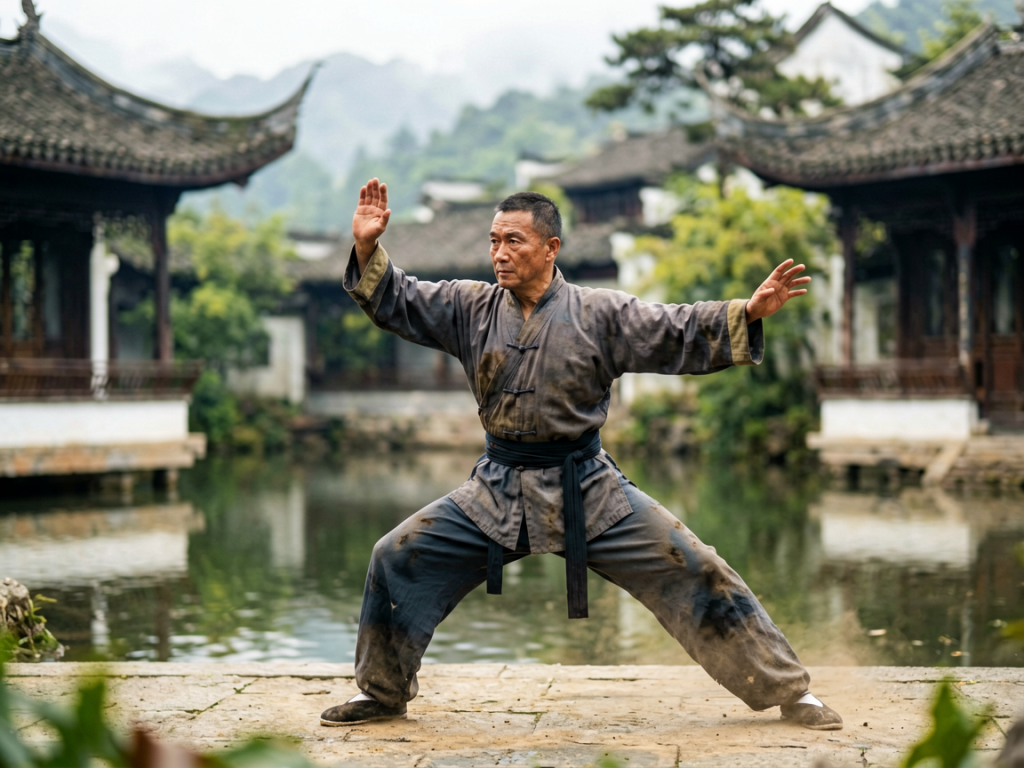
I still remember the first time I got hit with a straight punch in my Wing Chun classes in Guangzhou. It wasn’t flashy. There was no spinning kick or dramatic shout. Just a simple, direct jab that felt like getting struck by a railroad spike. My instructor, Sifu Chen, didn’t even blink. He just smiled that calm, slightly amused smile he always had and tapped his own chest.
“Center line,” he said. “Everything happens here.”
I was frustrated, obviously. I’d been practicing forms for months, moving my arms in those weird, repetitive patterns that looked like I was swatting invisible flies. It didn’t feel powerful. It didn’t feel effective. It felt small. But looking back now, after nearly a decade of living in China and trying to understand the soul of its martial arts, I realize I was missing the point entirely. We’ve all heard the phrase ‘center line’ thrown around in kung fu circles. It’s the most misunderstood rule in Wing Chun, and frankly, it’s probably the most important one.
The Geometry of Survival
Let’s strip away the mysticism for a second. Kung fu, especially Wing Chun, isn’t magic. It’s applied geometry and basic physics. When two people stand face-to-face, there is an imaginary line running straight down the middle of both our bodies. It starts at the forehead, goes through the nose, the solar plexus, the navel, and ends between the legs.
This is the center line. And here’s the thing: it’s the shortest distance between any point in space and your vital organs. If I want to hurt you, or end a fight quickly, I’m going to aim for that line. If you want to defend yourself, you have to protect that same line. It’s not a spiritual concept. It’s survival logic.
In a chaotic street fight, or even in a sparring ring, energy efficiency matters. Throwing a wide, looping haymaker might look cool in a movie, but it takes longer to travel. That extra fraction of a second gives your opponent time to react, block, or strike back. A punch thrown directly down the center line? It arrives faster. It’s direct. It’s unavoidable unless you’re ready to meet it head-on.
I used to think defending the center line meant standing perfectly still and blocking everything. I was wrong. It’s not about being a wall. It’s about controlling the space. Think of it like driving a car on a narrow road. You don’t hug the edge; you stay in the lane that allows you to move freely while keeping an eye on oncoming traffic. In Wing Chun, your hands are always checking that central axis, maintaining contact, sensing pressure, and redirecting force before it can reach you.
Why Your Arms Are Too Long
One of the biggest mistakes beginners make is overextending their strikes. I see it all the time in the parks where old masters demonstrate techniques to tourists. They’ll throw a long, sweeping arc with their arm, trying to show power. But in a real close-quarters encounter, that’s suicide.
When you extend too far, you lose balance. Your structure collapses. And worse, you expose your own center line to counterattack. Wing Chun teaches you to keep your elbows tucked in. Not crushed against your ribs, but comfortably inward. This creates a strong, triangular structure with your forearms and upper arms.
This structure isn’t just for looks. It’s a load-bearing framework. When someone punches at you, you don’t catch the fist with a flat palm like a traffic cop. You deflect it with the side of your forearm. Because your elbow is tucked, that forearm is rigid, strong, and positioned perfectly to intercept attacks coming down that central axis.
I tried this for weeks and kept slipping up. I’d get excited, adrenaline would pump, and I’d pull my arm back to generate more power. Big mistake. Sifu Chen would gently slap my extended hand and say, “Too far. Too slow.” He’d demonstrate how pulling the elbow in allowed him to redirect my punch with minimal effort. It wasn’t about strength. It was about alignment.
Imagine pushing a shopping cart. If you push from the center, it goes straight. If you push from the side, it veers off course and requires constant correction. Your body is that cart. Keeping your strikes and defenses aligned with the center line ensures maximum efficiency and stability. You’re not fighting the opponent’s momentum; you’re using their own force against them by staying centered.
The Myth of the “Soft” Block
There’s a persistent myth that Wing Chun is soft. People hear “internal martial art” and imagine slow, flowing movements like Tai Chi. While there’s certainly fluidity involved, Wing Chun is surprisingly direct and aggressive in its application. The center line theory doesn’t support passive defense.
Consider the concept of simultaneous attack and defense. This is where things get really interesting. Most traditional boxing styles teach you to block first, then counter. Step one: parry. Step two: jab. Simple enough. But in Wing Chun, we don’t wait. We combine them.
Think about the structurepak-chaan technique. You’re sliding your hand down to block an incoming punch while your other hand is already shooting forward along the same center line. You’re not just defending; you’re invading their space at the exact moment they’re attacking. It’s overwhelming for anyone unprepared for it.
I remember sparring with a guy who came from a Muay Thai background. He was tough, fast, and used lots of clinching. At first, he dominated because he could wrap up my arms and knee me. But once we started focusing on center line drills, the dynamic changed. Every time he tried to grab, I was already stepping into his guard, my elbow tight, my hand pressing forward. He couldn’t establish control because I was constantly disrupting his balance and attacking his own center line.
It wasn’t about being softer. It was about being more efficient. By sticking to the center line, I removed the unnecessary motions that left me vulnerable. I wasn’t wasting energy moving away from danger; I was moving through it.
Physics, Not Philosophy
A lot of people try to explain Wing Chun through Taoist philosophy. Yin and yang, flow, emptiness… all nice ideas, sure. But if you’re looking for practical application, stick to physics. Newton’s third law is your best friend here. For every action, there is an equal and opposite reaction.
When you strike down the center line, you’re generating force along the most direct path possible. But it’s not just about punching harder. It’s about directing that force correctly. If you hit someone off-center, they can absorb the impact by rotating their body. It’s like hitting a swinging door. The energy dissipates.
But hit them squarely on the center line? They can’t rotate away easily. Their spine is aligned with the force. The impact travels straight through their torso, disrupting their equilibrium. It’s much harder to stand firm when the force is coming directly at your center of gravity.
This is why footwork is so critical in Wing Chun. You aren’t just standing there throwing punches. You’re advancing along that center line, pressing forward with your body weight. It’s like a truck plowing through snow. You’re not trying to dodge; you’re trying to occupy the same space as your opponent, forcing them to deal with your mass and momentum.
I’ve seen masters who are barely fifty pounds heavier than me dismantle opponents twice their size. It’s not magic. It’s leverage. It’s timing. It’s understanding that the center line is the highway for energy transfer. If you control the highway, you control the fight.
Applying It to Real Life
You don’t need to become a black belt to appreciate this principle. It applies to everything. How you handle conflict, how you approach problems, even how you hold yourself physically.
When I’m feeling stressed or overwhelmed, I catch myself tensing up, moving erratically, trying to react to every little thing. It’s inefficient. It drains my energy. Going back to the basics of center line theory helps me reset. Find your center. Keep your elbows in. Move directly toward what needs to be done, without distraction.
It’s a mindset as much as a physical technique. Stay grounded. Stay focused on the core issue. Don’t waste energy on peripheral noise. Whether it’s dealing with a difficult coworker or navigating a busy subway station in Beijing, staying centered makes everything easier.
I used to think Wing Chun was just a set of moves. Now I see it as a way of interacting with the world. It’s about respect for efficiency, honesty in movement, and clarity of purpose. The center line isn’t just a line on the floor. It’s a standard for conduct.
So next time you watch a Wing Chun demonstration, or maybe try some basics yourself, don’t just look at the hands. Look at the alignment. Watch how the practitioners stay rooted, how they maintain that direct path, how they refuse to go wide or unnecessary. That’s where the real power lies. Not in speed, not in strength, but in precision. And honestly, once you start seeing it, you can’t unsee it. It changes how you move, how you think, and how you interact with everyone around you.
Trust me, it’s worth the practice. Even if you never throw a punch in anger, the discipline of staying centered is a gift in itself.