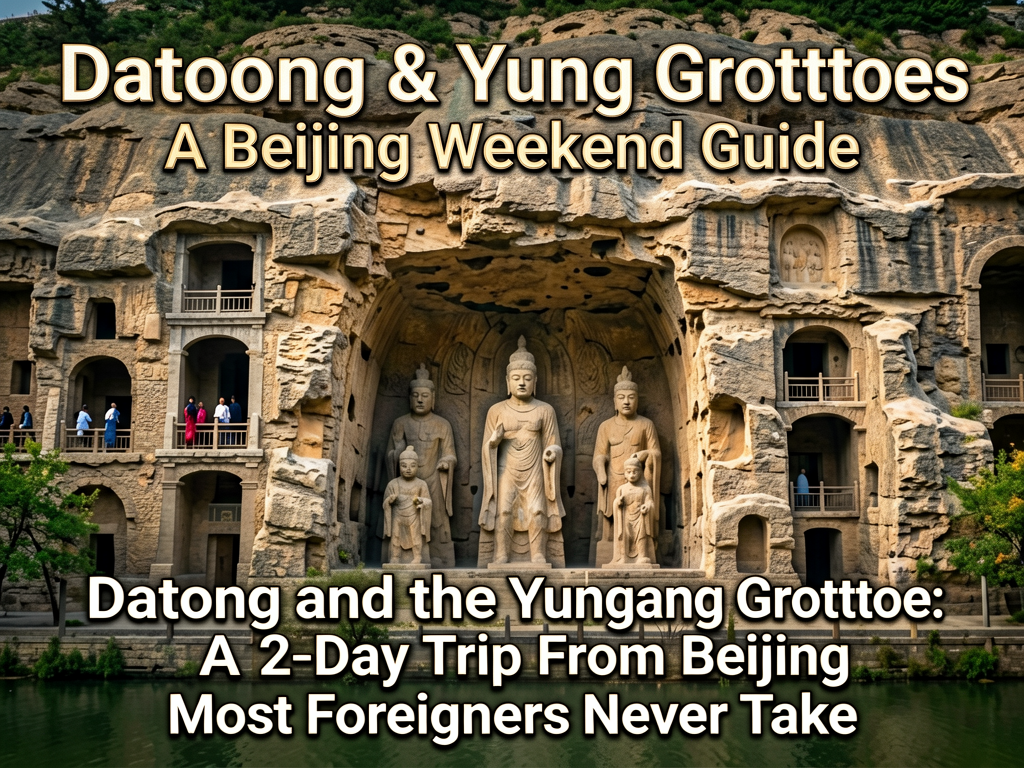
Here’s the thing about China that most foreigners miss. We spend weeks in Shanghai drinking lattes, days in Xi’an fighting crowds for terracotta bits, and maybe a long weekend in Guilin for the scenery. But halfway between the capital and the west lies a place that feels like time stopped in the fifth century.
I’m talking about Datong. It’s not flashy. It doesn’t have the neon glow of Shenzhen or the historic weight of Beijing’s Forbidden City. Instead, it has something heavier. Something ancient. And once you see the Yungang Grottoes, you’ll realize why emperors built their spiritual headquarters there.
If you’ve got two days off from your Beijing life, don’t waste them at another theme park. Pack a bag. Catch the high-speed train. Go north.
The Train Ride Is Half The Experience
Getting from Beijing to Datong is ridiculously easy now. The high-speed rail takes just under two hours. I remember when it took twelve hours by normal train. Back then, you’d share instant noodles with strangers for a whole day. Now? You can leave Beijing at 8 AM, arrive in Datong for lunch, and still have your whole afternoon free.
The trains are clean, quiet, and cheap. A second-class seat costs around 160 RMB. That’s less than a fancy dinner in Beijing. You get a plug socket, decent Wi-Fi (sometimes), and a view of the countryside turning from urban sprawl to dry, dusty hills.
It’s a gentle transition. You’re leaving the frantic pace of the capital behind. By the time the train pulls into Datong South Station, the air feels different. Crisper. Drier. There’s a distinct northern chill even in summer evenings.
I always grab a taxi from the station to the city center. It’s about twenty minutes and won’t set you back more than 40 RMB. The driver might try to sell you on a hotel. Just smile, shake your head, and say you’ve got plans. They respect that. Locals here aren’t pushy. They’re tired from work and just want to get home.
Arriving In Datong: Dirt, Dust, And Delicious Lamb
Datong isn’t pretty. Not in the traditional sense. It’s an industrial city in Shanxi province that survived a coal boom, a bust, and a cultural renaissance. The streets are wide. The buildings are functional. And yes, it can be dusty.
But that dust hides some of the best food in China. Shanxi cuisine is heavy on vinegar and wheat. You’re going to eat a lot of noodles. And if you go to a local restaurant at night, you’re going to eat lamb.
My first night there, I stumbled into a small spot near the South Gate. It wasn’t on any app. Just locals shouting over clattering plates. I ordered the Yangrou Chuan–skewered lamb–and a bowl of Dao Xiao Mian, which is hand-shaved noodle soup.
The lamb was smoky and tender. They brush it with cumin and chili powder before grilling it over charcoal. It’s simple, but it hits hard. The noodles were chewy and slippery, swimming in a broth that smelled of star anise and ginger. I dipped them in the black vinegar they provide at the table.
The vinegar changes everything. It cuts through the fat. It wakes up your tongue. It’s not like the sweet rice vinegar you might know. This is aged. It’s sharp. It’s grown-up.
I sat there, sweating slightly in the cool night air, watching old men play cards at the next table. No one cared that I was alone. No one cared that I didn’t speak Mandarin. They just nodded when I smiled. That’s the vibe in Datong. It’s unpretentious. It’s real.
Yungang Grottoes: When Stone Becomes Spirit
You can’t talk about Datong without talking about Yungang. These aren’t just caves. They’re a mountain carved by human hands to house the divine.
If you’ve seen the Mogao Caves in Dunhuang, you know the general idea. Buddhist monks chiseled statues into cliffs. But Yungang is older. Much older. These were dug in the mid-400s AD during the Northern Wei Dynasty. That’s over 1,500 years ago.
The site is huge. There are five main cave complexes and hundreds of smaller niches. I went with a guide who knew his stuff. He pointed out details you’d miss if you were just wandering around. Like how the faces of the Bodhisattvas look surprisingly Greek.
That’s because of the Silk Road. The styles traveled from India, through Central Asia, and into China. You can see the influence of Gandhara art in the drapery of the robes. It’s a fusion. A melting pot frozen in stone.
Cave 20 is the icon. It’s the big outdoor statue of Amitabha Buddha. The roof collapsed centuries ago, exposing the face. But that’s actually a blessing. The roof would have blocked the light. Now, the sun hits the Buddha’s face directly at noon. It’s golden. It’s warm. It’s alive.
I stood there for twenty minutes. Just staring. The scale is hard to grasp until you’re standing at the bottom looking up. The statue is nearly seventeen meters tall. His ears are so long they touch his shoulders. His expression is serene. Almost bored.
It’s weirdly comforting. Here we are, stressing about rent and visas and relationships. And this guy has been sitting here, smiling, while dynasties rose and fell. Wars happened. Empires crumbled. He didn’t blink.
Don’t rush through the other caves. Cave 5 is spectacular inside. The ceiling is painted with intricate patterns that haven’t faded completely. The central Buddha is the tallest intact statue in the complex. It’s towering. It demands respect.
Some of the carvings are damaged. You can see where bullets hit during later conflicts. You can see where weather eroded the softer sandstone. But it’s not sad. It’s honest. History is visible here. It’s not hidden behind glass barriers.
Wear good shoes. The paths are uneven. And bring water. There are vendors, but the prices creep up the farther you go into the complex. I bought a bottle for 5 RMB. That felt like a steal.
Da Cloud Temple: The Iron Pagoda
If you have half a day left, drive to the Da Cloud Temple. It’s outside the main city but worth the trip. The highlight is the Iron Pagoda.
Despite the name, it’s made of bronze. Or maybe it looks like iron because of the color. Either way, it’s stunning. It’s thirteen stories high and dates back to the Ming Dynasty.
The structure is intricate. Every window, every balcony, every eave is cast in metal. It looks like it was assembled from thousands of tiny puzzle pieces. And it’s stood there for six hundred years without collapsing. That’s engineering magic.
The temple grounds are peaceful. Monks walk slowly between the buildings. There’s incense smoke hanging in the air. It smells like sandalwood and old wood.
I liked this place better than Yungang. It’s quieter. Less crowded. You can sit on a bench and listen to the wind move through the trees. It gives you time to process what you saw yesterday.
Pagoda worship is a big deal here. People circle the tower three times for good luck. I watched an old woman do it with such focus. She wasn’t rushing. She wasn’t checking her phone. She was just moving forward, step by step, faith by faith.
It reminded me why I moved to China. Not for the food, though that’s a close second. Not for the history, though that’s important too. It’s for moments like this. When you see people living their lives with such grounded simplicity.
Why You Should Actually Go
Most foreigners stick to the Golden Triangle. Beijing, Xi’an, Shanghai. It’s safe. It’s easy. It’s well-trodden.
But if you want to understand China, you need to go where the tourists aren’t. Datong is that place.
It’s not polished. It’s not Instagram-ready. The hotels are basic. The internet can be spotty. But the culture is thick. The history is tangible. The food will ruin you for all other noodle soups.
I spent two days there last month. I left feeling lighter. Like I’d shaken off some of the mental clutter that builds up in a megacity.
The train ride back to Beijing is long. Four hours. But I didn’t mind. I slept most of the way. I had my head against the window, watching the landscape blur by. I was thinking about the Buddha’s face. I was thinking about the taste of that lamb. I was thinking about how strange and wonderful it is that someone in the 5th century decided to carve a mountain into a prayer.
So, here’s my advice. Book the ticket. Go for the weekend. Don’t overplan. Leave room to wander. Eat the weird stuff. Talk to the taxi drivers. They have stories. Lots of them.
You might come back thinking China is too big to ever know. But then you find a little hole in the wall in Datong, and you realize you don’t need to know it all. You just need to know enough to be happy.
And trust me, you will be.