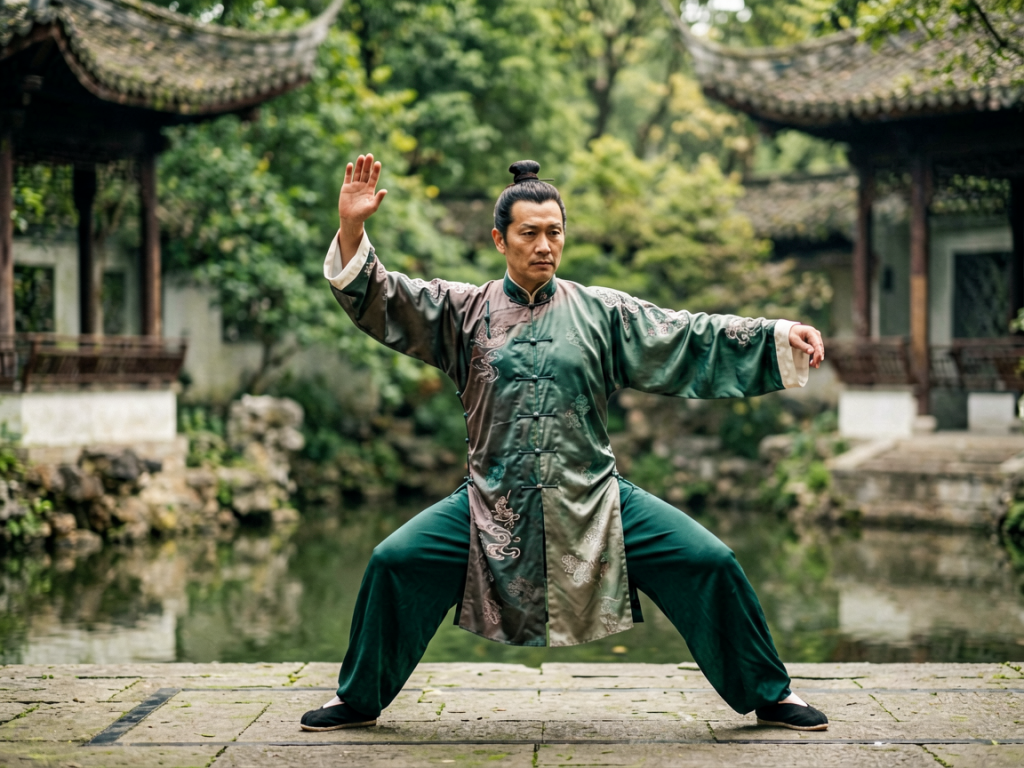
I’ll be honest, the first time I saw someone practice Baguazhang, I thought they were having a medical episode.
We were in a dusty park in Beijing, just before dawn. The air was thick with that specific mix of coal smoke and morning dew that only exists in northern China during autumn. Most of the old men were doing Tai Chi, moving slowly like they were underwater. Then there was this one guy, younger than the rest, spinning in tight circles.
He wasn’t just turning. He was orbiting an invisible center point. His arms flowed around his body like water around a stone. It looked less like fighting and more like he was trying to untangle a ball of yarn with his entire torso.
Is that even a martial art? I asked my friend Lao Wang. He didn’t look up from his tea. That’s Baguazhang, he said. And you’re standing in the wrong spot.
The Walking Is Half The Battle
People think martial arts are about the punches. They’re not. At least, not the good ones. Baguazhang is different because it prioritizes the feet over the hands every single time.
The core of the style is the Circle Walk. You walk in a circle, usually counter-clockwise, for hours. Not minutes. Hours. Your legs stay low, your knees bent, and your upper body remains relaxed but alert.
I tried this once under the guidance of a master named Master Li in Chengdu. He made me walk the circle for twenty minutes without changing direction. Twenty minutes of just stepping left, right, step, pivot. My calves burned. My balance felt wobbly.
“Why?” I panted after ten minutes. “Where’s the punch?”
Master Li smiled. He didn’t sweat. You punch from the hip, he said. But you can’t find your hip if your legs are stiff. The circle teaches you to move your weight while staying rooted. It’s a paradox. Sound confusing? It is.
Most Western martial arts teach you to square up. Boxing has you facing your opponent directly. Karate has you in a static stance. Baguazhang says face nothing. Keep moving. Change angles until you’re behind the other guy before he even knows you moved.
It’s exhausting to learn. Your brain fights it. Humans want to see threats coming head-on. Baguazhang demands you trust your peripheral vision and your gut feeling. You stop looking with your eyes and start looking with your skin.
Eight Palms and The Infinite Variations
Once you can walk the circle without falling over, you add the hands. These are called the Eight Mother Palms. Each palm has multiple forms, and each form branches into hundreds of variations.
I remember sitting in a small studio in Tianjin, watching a woman demonstrate the “Single Sworn Palm.” She extended one arm straight out, palm flat, while the other hand tucked near her waist. Simple, right?
Then she spun. In one fluid motion, she transitioned into a chopping motion, then a grabbing pull, then a striking push. All from the same starting position. It was like watching a snake shed its skin in real-time.
The beauty here is the geometry. Baguazhang uses trigonometry without teaching math. You’re constantly creating triangles with your limbs. If an opponent pushes forward, you don’t push back. You slide off their force, create an angle, and strike their flank.
It’s not brute strength. It’s physics. And leverage.
To be fair, learning the patterns takes years. I’ve been practicing for three years, and I still feel like a toddler trying to juggle chainsaws. The movements are subtle. A slight turn of the wrist changes a block into a throw. A shift in the hips turns a strike into a joint lock.
Most people never get past the basic eight forms. They get bored. Or they get hurt. Or they realize they need to buy better shoes because their feet are killing them. The shoes matter more than you’d think.
You need soles that grip but allow pivot. I ruined three pairs of canvas sneakers in the first year. Now I wear custom-made cloth shoes with layered cotton soles. They cost about fifty yuan a pair. Worth every penny.
From Monk to Merchant
The history of Baguazhang is messy. There are no clear dates. No famous battles recorded in history books. Just stories passed down through oral tradition.
The most common legend traces it back to Dong Haichuan in the mid-19th century. He reportedly learned the art from a Daoist monk on Mount Wudang. Or maybe from a sea captain. Or maybe from a beggar who knew how to fall.
Dong brought the art to Beijing, where it caught the attention of the Imperial Guard. It wasn’t flashy like Shaolin. It wasn’t powerful like Wudang sword forms. It was weird. And it worked.
What makes Baguazhang unique in Chinese culture is its philosophical roots. It’s deeply tied to Daoism. The circle represents the Tao. Constant movement. Change. Adaptability.
In Confucian martial arts, hierarchy matters. You bow, you wait your turn, you respect the form. In Baguazhang, the environment is everything. The floor, the space, the opponent’s momentum–they all dictate your next move.
I met an old man in Shijiazhuang who claimed his lineage went back to Dong’s second student. He showed me a book written in classical Chinese. I couldn’t read it. But he pointed to a diagram of a spiral. “See this?” he asked. “This is not a circle. This is a spring.”
He demonstrated a technique where he wrapped his arm around mine. Instead of pushing me away, he pulled me in while spinning. I ended up facing backward, off-balance, before I even realized he had moved. It was terrifying. And amazing.
This kind of skill doesn’t come from reading books. It comes from thousands of hours of awkward, frustrating practice. You will fall. You will twist your ankle. You will look ridiculous.
But then, one day, it clicks. The circle becomes smooth. The hands become connected. You stop thinking about where to place your foot. You just flow.
Why Nobody Talks About It
If Baguazhang is so effective, why isn’t it on TV? Why don’t we see it in Hollywood movies?
Because it’s hard to film. Fast strikes look cool. Slow, deliberate movements look boring unless you understand them. Baguazhang is slow until it’s instant. By the time you see the punch, you’re already losing.
Also, it’s not commercialized. There are no huge schools selling memberships. There are no gadgets. You don’t need elbow pads or mouthguards. You need patience.
In a world obsessed with quick fixes and six-pack abs in thirty days, Baguazhang asks for thirty years. It asks you to accept that you are wrong about almost everything you know about fighting.
I used to think martial arts were about winning. Now I think they’re about losing gracefully. Baguazhang teaches you to yield. To redirect. To survive by not resisting.
Is this philosophy? Yes. Is it practical? Absolutely. When life pushes you, do you push back? Or do you step aside and let it pass, then find a new angle?
I’ve used Baguazhang principles in my daily life more than in any fight. Traffic jams, rude strangers, bad news. I circle around them. I don’t crash into them. It saves energy. It saves sanity.
Find Your Center
If you’re in China, go find a teacher. Don’t look for the flashy gym in the mall. Look for the park. Look for the group of people walking in circles.
Ask to watch. Ask to try. Bring some fruit or tea if you’re invited in. Hospitality is part of the culture, even in martial arts.
Don’t expect to learn the secret techniques in a weekend. Expect to spend months learning how to stand. Expect to walk the circle until your mind goes quiet.
That’s the real gift of Baguazhang. It’s not about kicking heads off. It’s about finding your balance in a chaotic world. It’s about realizing that movement is life. Stagnation is death.
So, next time you see someone spinning in a park, don’t laugh. They might be practicing something ancient. Something that keeps them young. Something that works.
And if you’re lucky, they’ll let you join the circle.
Just watch your step. And keep your palm flat.