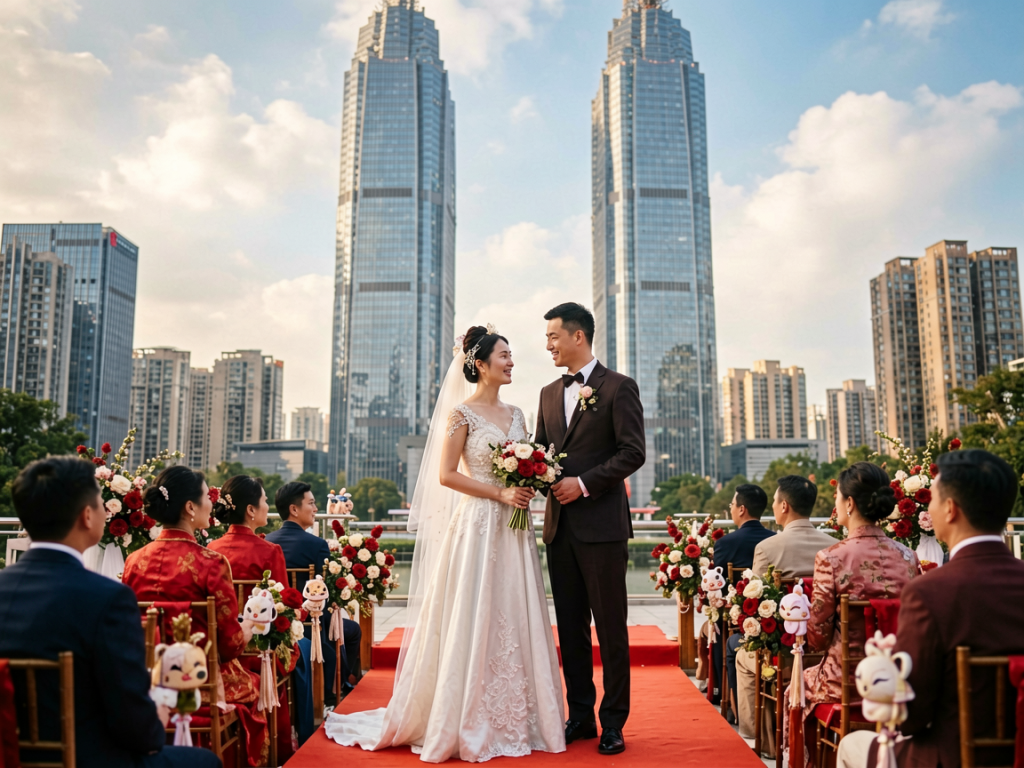
I still remember the first time I really looked up in Shanghai. It wasn’t the Pearl Tower or the Shanghai Tower that caught my eye. It was a pair of sleek, glass-clad towers standing side-by-side in Lujiazui, staring at each other like silent twins.
At the time, I just thought it was good design. Symmetry feels balanced, right? But then I went to Shenzhen, and there they were again. Two identical towers piercing the sky. Then Changsha, Chengdu, even smaller cities like Wuxi. I started seeing this pattern everywhere.
It’s not just coincidence. It’s a specific architectural language that speaks volumes about Chinese history, philosophy, and modern ambition. If you’re wondering why twin towers and twin malls are popping up in every new district across the country, grab a coffee. Let’s talk about it.
The Weight of History and Symmetry
To understand the twin towers, you first have to understand the twin gates. In traditional Chinese architecture, symmetry isn’t just an aesthetic choice; it’s a moral imperative. Think about the Forbidden City in Beijing. It’s built along a central north-south axis. Everything mirrors everything else.
This concept is rooted in Daoist philosophy, specifically the balance of Yin and Yang. Nothing exists in isolation. For every mountain, there is a valley. For every tower, there needs to be its partner. A single tall building feels incomplete, almost lonely, in a cultural context that values harmony above all else.
I’ve seen developers try to put a single, odd-shaped skyscraper in a new district, and it never quite works. It looks awkward against the skyline. But slap another one next to it, even if it’s slightly different, and suddenly the space feels grounded. It feels intentional.
This goes back centuries. Traditional Chinese courtyards, or *siheyuan*, are symmetrical. The main house faces south, flanked by side rooms. This layout creates a sense of order and hierarchy. When modern architects design twin towers, they are essentially translating that ancient courtyard logic into steel and glass.
Feng Shui and the Flow of Qi
Now, let’s get into the spiritual side of things. You can’t talk about Chinese urban planning without mentioning Feng Shui. And I don’t mean the waterbeds and wind chimes you see in Western gift shops. I mean the actual flow of energy, or *Qi*.
In Feng Shui theory, a single tall building can act like a spear, piercing the earth and disrupting the local energy field. It’s considered aggressive. But two buildings standing together create a gate. They frame the space. They channel the Qi gently rather than forcing it.
I once asked a local architect in Hangzhou why he designed his firm’s headquarters as two mirrored cubes. He laughed and said, “One cube is a tomb. Two cubes are a home.” It was a blunt way to put it, but it stuck with me.
Twin towers also serve a practical purpose in high-density areas. They create a microclimate between them. The wind flows differently, the sun hits the street level at different angles. For mall developers, this means more comfortable walking spaces. You aren’t baking in the shade of a single monolith.
There’s also the concept of “guarding the gate.” Many twin tower complexes are positioned at major intersections or near subway lines. They act as guardians, protecting the commercial hub behind them. It’s symbolic, sure, but symbolism drives real estate value in China more than you’d think.
The Economics of Scale and Branding
Beyond philosophy, there’s cold, hard economics. Building two towers at once is often cheaper and faster than building one massive skyscraper. The structural engineering allows for shared foundations, shared parking levels, and shared mechanical cores.
I watched a construction site in Wuhan where they poured the foundation for both towers simultaneously. The cranes danced around each other. It was efficient. It saved months of time. In a market where speed to market is everything, that efficiency is golden.
But it’s not just about saving money on concrete. It’s about brand dominance. When a developer buys a prime plot of land, they want to make a statement. One tower says, “I’m here.” Two identical towers say, “We own this corner of the city.”
Look at the Twin Towers of Guangzhou or the pairs in Tianjin. They become landmarks instantly. People don’t say “Go to the tall building.” They say “Meet at the twins.” That dual identity makes the location easier to navigate and remember. It creates a stronger mental map for residents.
Malls as Modern Community Centers
Here’s where it gets really interesting. Those twin towers are rarely just offices. They are almost always attached to twin malls, or a single mega-mall split between two structures. In China, the shopping mall is not just a place to buy shoes. It’s a community center.
We’ve lost our public squares. The parks are too far, the streets too crowded. So, we go to the mall. And if the mall is split into two towers, it creates a larger footprint for retail without sacrificing the vertical density needed for profitability.
I remember spending a rainy Sunday in Nanjing. Instead of staying home, I went to the twin mall complex. There was an indoor park in one tower and a cinema complex in the other. People were playing chess, eating hot pot, watching movies. It was a self-contained ecosystem.
The twin structure allows for this expansion. One tower might hold the luxury brands, the other the family-friendly stores. Or one is high-end dining, the other is casual fast fashion. This separation of functions keeps the foot traffic flowing. You don’t get bored because the vibe changes as you walk from one tower to the other.
It’s also about perception. A double height entrance at the base of twin towers feels grander. It mimics the scale of ancient temple gates. When you walk under those arches, you feel like you’re entering a special place. That feeling drives spending. Trust me, I’ve felt it myself more times than I can count.
Why It’s Not Just Copy-Paste
You might be thinking, “So they just copy each other.” And yes, there is definitely a trend-following element. Chinese cities move fast. If one developer finds success with twins, the next one does it too to ensure their project doesn’t look outdated before it’s even finished.
But it’s not mindless imitation. Each pair tells a story about its specific location. In coastal cities, the twins are often sleek and modern, reflecting the ocean breeze. In inland historical cities, they might incorporate traditional rooflines or materials like bronze and stone.
I saw a project in Xi’an where the twin towers were designed to look like stone tablets. They weren’t just glass boxes. They respected the Han Dynasty history surrounding them. The twins acted as modern pillars holding up the weight of tradition.
This adaptability is key. The form is consistent–two towers–but the expression varies wildly. It’s like having two siblings. They share DNA, but they have their own personalities. Developers know this. They tailor the “personality” of the twins to fit the neighborhood.
The Future of the Skyline
As China’s urbanization slows down a bit, we’re seeing fewer brand-new districts being built. But the twin tower concept is evolving. It’s becoming about connectivity. Bridges linking the towers at various heights, creating sky gardens in the middle.
I loved the new development in Chengdu where the two towers are connected by a transparent bridge halfway up. You can walk across and look down at the city below. It breaks the isolation of the individual towers. It forces interaction.
This reflects a shift in Chinese society. We’re moving from pure accumulation of space to a focus on experience and connection. The twins are no longer just symbols of power. They are nodes in a social network.
Even the malls are changing. Instead of just retail, they’re hosting art exhibits, tech demos, and cultural festivals. The twin structure provides enough volume to host these events without overwhelming the immediate surroundings.
If you’re visiting a Chinese city soon, take a moment to look for the twins. They’re everywhere. Once you start looking, you’ll see them in the old quarters and the new CBDs alike. They are the bookends of the modern Chinese skyline.
They represent a unique blend of ancient symmetry and futuristic efficiency. It’s a visual language that locals understand instinctively. To us outsiders, it might just look like a lot of glass. But dig a little deeper, and you’ll find centuries of philosophy packed into those parallel structures.
I’m still fascinated by them. Every time I see a new pair go up, I wonder what story this duo will tell. Will they be about commerce? About heritage? Or maybe just about balance?
Next time you’re in a Chinese city, don’t just rush through the lobby. Step outside. Look up. See how the two towers frame the sky. That’s where the real magic happens.