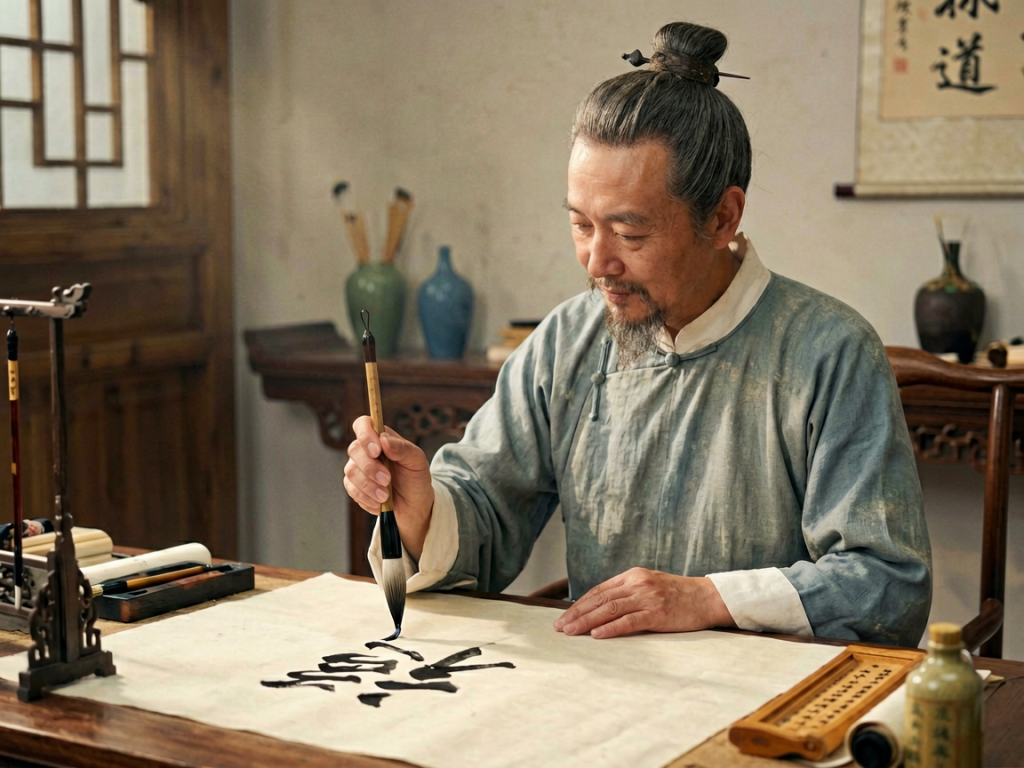
I’ll never forget the first time I saw a master at work in a dusty alley in Beijing. It wasn’t in some fancy gallery with white gloves and spotlights. It was just an old man sitting on a low stool outside his tea shop. He had a brush as long as my forearm and a slab of rice paper that looked fragile enough to tear if you breathed on it too hard.
I watched him dip the brush into ink that smelled like pine soot and history. Then, he moved. His whole arm swung in a fluid arc, and suddenly, a character appeared. It wasn’t just written. It was born. The black lines weren’t flat; they seemed to pulse with energy. I stood there, sipping my lukewarm jasmine tea, completely mesmerized. That was years ago, but I’ve thought about it every single day since.
If you ask anyone in China what the highest art form is, they won’t say painting. They won’t say sculpture, either. Even though China gave the world porcelain and jade carving, the answer is almost always the same: calligraphy. It’s the root of everything. It’s the soul of the culture. And honestly? Once you start looking for it, you realize it’s everywhere. You’re just probably not seeing it.
The Brush Strokes a Living Soul
Here’s the thing about Western art. We tend to separate the tool from the message. You buy a pen to write a letter, and you buy a canvas to paint a picture. In China, those lines didn’t just separate; they merged. Calligraphy is both writing and art. It’s communication and expression tangled together so tightly you can’t pull them apart.
I remember trying to learn basic characters in my early days here. I thought, “How hard can it be? It’s just lines.” Boy, was I wrong. My teacher, Master Li, would watch me struggle with the character for “water” (水). I’d draw straight, rigid lines. He’d shake his head and sigh. Then he’d take my brush and show me how the strokes should flow. One stroke was like a river starting in the mountains. Another was a wave crashing against rocks.
He told me that calligraphy captures the qi, or life force, of the artist. When you write, you’re not just moving your hand. You’re breathing. You’re centering your mind. If your heart is chaotic, your strokes will be shaky. If your spirit is calm, the ink will flow smoothly. It’s a physical meditation. I’ve done plenty of yoga, but nothing centers me quite like holding a brush steady while trying to write a complex idiom.
This connection between the inner self and the outer mark is why it’s revered. It’s raw. It’s unfiltered. A painter can hide behind layers of oil paint. A sculptor can chip away stone until it looks right. But a calligrapher? There’s no hiding. Every slip of the wrist, every fluctuation in pressure, is recorded forever on the paper. It’s terrifyingly honest.
More Than Just Pretty Letters
You might think, “Okay, it’s nice writing. So what?” But in Chinese culture, handwriting has always been tied to character. Literally. There’s a saying: “The handwriting is the man” (字如其人). If someone writes poorly, people assume their thinking is messy or their morals are flawed. If they write beautifully, you assume they are disciplined, educated, and virtuous.
I saw this play out at a wedding a few years back. Instead of just exchanging rings, the couple exchanged calligraphy scrolls. The groom had spent weeks practicing a poem about enduring love. When he presented it to the bride, she didn’t just look at the paper; she looked at the effort, the discipline, the time he’d poured into those strokes. It meant more than any diamond ring ever could.
This idea extends beyond personal relationships. Look at the signs in any temple or museum. The plaque above the entrance isn’t just a label. It’s a piece of art commissioned from a famous scholar or official. The prestige of the writer adds weight to the building itself. It’s a way of claiming cultural authority.
I went to the West Lake in Hangzhou last spring. The pavilions there have plaques written by emperors, poets, and warriors throughout history. Standing there, touching the stone rubbings, you’re literally touching the hands of the past. It’s a tangible link to dynasties that fell centuries ago. That kind of continuity doesn’t happen with just any art form. It happens because the characters themselves are the bridge.
The Philosophy in the Ink
We talk a lot about Chinese philosophy, usually focusing on Confucius or Laozi. But you can’t really understand the philosophy without understanding the aesthetic. Calligraphy embodies the core tenets of Yin and Yang, balance, and harmony.
Think about the composition of a single character. It needs balance. If one side is heavy with ink, the other needs space or lighter strokes to compensate. It’s a constant negotiation between presence and absence, black and white. This mirrors the Taoist view of the universe. Nothing exists in isolation. Everything defines itself against its opposite.
I spent an afternoon with a group of retirees in a park in Chengdu. They were practicing “air calligraphy,” waving their fingers in the air as if holding giant brushes. They weren’t making marks on paper. They were visualizing the movement. It was hilarious to watch at first, but then I realized what they were doing. They were refining the energy before it ever touched the page. It was pure mental focus.
To be fair, this level of dedication takes years. Most foreigners, myself included, quit after a month. Our hands are too stiff. We’re too used to the quick, efficient nature of typing on a keyboard. But that’s exactly why the practice matters. In a fast-paced, digital world, calligraphy forces you to slow down. It demands patience. It asks you to sit still and breathe.
There’s a rhythm to it. Dip, lift, press, drag, release. It’s musical. I’ve heard people say reading good calligraphy is like listening to music. You can feel the tempo. Some characters are frantic, scribbled in a burst of emotion. Others are slow, deliberate, and heavy. The paper becomes a score, and the ink is the sound.
Why It Matters Today
So, why does this old stuff still matter? Why do kids in primary school spend hours practicing basic strokes with thick black markers? Isn’t it inefficient? Why not just type?
I used to ask that question, too. Now I see it differently. In a world where everything is ephemeral and digital, calligraphy offers permanence and weight. When you delete a file, it’s gone. When you erase a digital note, it vanishes. But a scroll? That stays. It ages. It gains patina. It becomes an artifact of a moment in time.
Plus, there’s the cultural identity piece. As China modernizes rapidly, becoming one of the wealthiest nations on earth, people are looking for anchors. What makes us different? What is our heritage? Calligraphy is that anchor. It’s visible in storefronts, in logos, in tattoos. It’s modern and traditional all at once.
I walked through a trendy cafe in Shanghai recently. The logo wasn’t just typed text. It was a stylized calligraphy mark. It felt cool, edgy, yet deeply rooted. It showed that the tradition isn’t stuck in a museum. It’s alive, evolving, and adapting. Young artists are experimenting with abstract calligraphy, blending it with graffiti and modern design. It’s surprising how well it works.
Don’t get me wrong, I love technology. I use my phone for everything. But there’s something deeply satisfying about picking up a brush. The smell of the ink stick. The texture of the paper. The weight of the brush handle. It grounds you. It reminds you that you’re a physical being in a physical world.
My favorite memory involves a trip to Xi’an. I visited the Stele Forest Museum. It’s a maze of stone tablets covered in thousands of years of calligraphy. I spent four hours just walking around, tracing the carved characters with my eyes. I couldn’t read most of them, but I could feel the emotion. I could see the joy in one stroke, the sorrow in another. It was like eavesdropping on conversations from two thousand years ago.
That’s the power of this art. It transcends language. You don’t need to know Chinese to feel the energy in a well-executed character. It’s universal. It speaks to the human condition–our desire for order, our capacity for beauty, our need to leave a mark.
So, the next time you’re in China, don’t just look at the food or the skyscrapers. Look at the signs. Look at the shop names. Look at the scrolls hanging in the homes. See if you can find the rhythm. See if you can feel the breath behind the ink.
You might not be able to write it yourself. Your hand might shake. Your lines might be crooked. But you’ll appreciate it more. And maybe, just maybe, you’ll try it yourself. Grab a cheap brush, some ink, and a sheet of rough paper. Sit down. Breathe. And make a mark. You’ll be surprised how quickly you connect with centuries of masters who sat in the exact same spot, trying to capture the ineffable.
It’s not just art. It’s a conversation. And you’re finally invited to speak.