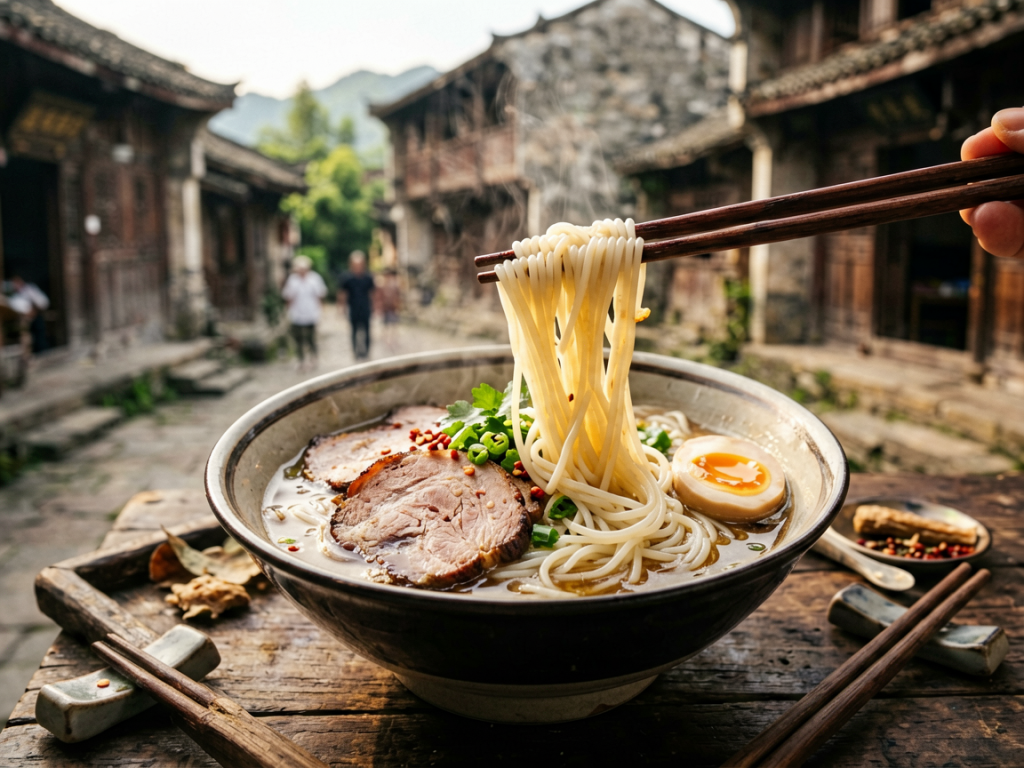
I still remember the first time I ate Xuanwei ham rice noodles in Kunming. It was a rainy Tuesday in late autumn. I was huddled over a small, wobbly plastic stool outside a hole-in-the-wall shop near Green Lake Park. The air smelled like wet pavement and star anise. I didn’t know then that this bowl of soup would ruin me for every other noodle dish in China.
Look, I’ve eaten my fair share of ramen in Tokyo and pho in Hanoi. I’ve slurped hot and sour soup in Guangzhou. But nothing hits the spot quite like the rice noodles of Yunnan. They’re different. They’re heavier, silkier, and somehow more resilient than their wheat-based cousins. But the real question isn’t just about the noodle itself. It’s about the broth, the pickles, and the history trapped in that bowl.
So, what makes Yunnan rice noodles so addictive? Is it the umami bomb of the broth? The crunch of the pickled mustard greens? Or is it something deeper, tied to the ancient migration of the Han people into this mountainous corner of the world?
Honestly, it’s a mix of all three. And if you’re willing to look past the surface, you’ll find a story that’s as complex as the flavor profile itself.
The Noodle That Defies Gravity
First, let’s talk about the star of the show: the rice noodle. In Yunnan, they call it *mifen*. If you’ve only had rice noodles in Thailand or Vietnam, you’re in for a surprise. Those noodles are usually thin, fragile, and translucent. Yunnan rice noodles are different. They’re wider, flatter, and have a distinct chew that I can’t get enough of.
I remember asking a local chef in Dali why they didn’t just use the thin kind. He looked at me like I’d asked why we don’t eat steak with a spoon. “The thick noodle holds the sauce,” he said. “It doesn’t disappear.” And he was right. When you dip a wide, flat rice noodle into a rich beef broth, it grabs onto those flavors. It doesn’t let go.
The texture is key here. Fresh rice noodles have a slippery, almost gelatinous mouthfeel that turns chewy the longer you chew. It’s a paradox. You’re eating something soft, but it fights back a little. That resistance is part of the addiction. You can’t just inhale the bowl. You have to work for it.
And let’s be real, the visual appeal is huge. Seeing those long, white strands steaming in a clear, golden broth is hypnotic. It’s simple, but it’s elegant. Unlike the murky, dark broths of northern China, Yunnan broths are often clear. This clarity lets the natural flavors of the ingredients shine. You can taste the difference between beef, chicken, or mushroom broth immediately. There’s no masking the quality with heavy spices.
The Broth: A History in a Bowl
Now, let’s get into the meat of the matter–or rather, the bones. The broth is where the history lives. Yunnan is a border province. It borders Vietnam, Laos, and Myanmar. For centuries, it has been a crossroads for trade and migration. The Han people moved south, bringing their culinary traditions with them. But they had to adapt to the local ingredients.
One of the most famous styles is the *Guoqiao* rice noodles, or “Crossing the Bridge” noodles. Legend has it that a scholar’s wife would send him lunch while he studied on an island in the middle of a lake. The dish had to stay hot during the long journey across the water. So, she developed a technique using a layer of hot oil on top of the broth to insulate the heat. She’d send all the ingredients separately, and the scholar would add them to the hot broth right before eating.
Sound interesting? It’s a great story, but the reality is even more practical. The oil layer isn’t just for show. It seals in the heat and keeps the broth fresh for hours. In a time before refrigeration, this was a brilliant survival trick. Today, it’s a theatrical dining experience, but the core principle remains: the broth must be hot, rich, and ready to accept the fresh ingredients.
I tried making this at home once. I bought a packet of freeze-dried broth and some fresh rice noodles from a local market. It was a disaster. The broth tasted flat. The noodles were mushy. I realized quickly that you can’t replicate Yunnan rice noodles without the right water and the right patience. The local water in Kunming is soft, which helps the noodles cook evenly. The broth is simmered for 12 hours or more, often with a mix of beef, chicken, and pork bones.
The result is a broth that’s deeply savory but not overwhelming. It’s clean. It’s bright. And it’s addictive because it’s comforting in a way that heavy, fatty broths aren’t. It feels nourishing, not just filling. After a long day of hiking in the Cangshan Mountains, there’s nothing better than a bowl of hot, clear broth to warm you from the inside out.
The Pickles: The Crunch Factor
If the broth is the soul of the dish, the pickles are the heartbeat. You can’t eat Yunnan rice noodles without them. The small dish of pickled vegetables that comes on the side is non-negotiable. It’s usually a mix of pickled mustard greens, chili oil, and sometimes fermented tofu.
I used to ignore the pickles. I thought they were just a garnish. Then a friend in Lijiang sat me down and said, “Add the pickles, or you’re not eating it right.” I was skeptical. Pickles? In a delicate broth? But I did it. I stirred a spoonful of the sour, spicy pickles into my clear beef broth. The change was instant. The broth became tangy, complex, and layered. The crunch of the pickles added a texture contrast that made every bite exciting.
This is where the migration story gets interesting. Yunnan is known for its diverse ethnic groups. The Dai, Bai, and Hani people all have their own fermentation traditions. The pickles in Yunnan rice noodles are a fusion of these traditions. The mustard greens are pickled with salt and chili, creating a sourness that cuts through the richness of the meat. It’s a balance of flavors that’s hard to put into words.
To be fair, not everyone likes the sourness. I know some tourists find it too intense. But I’d argue that it’s the defining characteristic of the dish. Without the pickles, you’re just eating noodle soup. With the pickles, you’re eating Yunnan rice noodles. It’s the difference between a painting and a masterpiece.
And let’s not forget the chili oil. It’s not just about heat. It’s about aroma. The chili oil in Yunnan is usually made with a specific type of chili that’s fragrant rather than fiery. It adds a smoky, nutty depth to the dish. I’ve seen locals add so much chili oil that the broth turns red, but I prefer the clear style. It allows me to taste the subtle nuances of the broth and the pickles.
The Modern Twist: Why We Can’t Stop Eating It
So, why is Yunnan rice noodles so addictive in the modern age? Is it just nostalgia? Or is there something more?
I think it’s the versatility. You can have it for breakfast, lunch, or dinner. You can make it spicy, mild, vegetarian, or meat-heavy. The base is always the same, but the variations are endless. In Kunming, you’ll find shops specializing in different types: beef, chicken, mushroom, pork, fish. I’ve tried them all, and they’re all good in their own way.
But it’s also the speed. In a busy city like Kunming, time is money. Yunnan rice noodles are fast. The broth is pre-made. The noodles are pre-cooked. You just boil them for a minute or two and add the toppings. It’s the ultimate fast food, but it’s fresh and healthy. It’s a meal that doesn’t leave you feeling sluggish. It fuels you.
I’ve seen young professionals in Beijing and Shanghai start Yunnan rice noodle shops. They’re taking this regional dish and making it national. The flavors are traveling, adapting, and evolving. But the core remains the same: the silky noodles, the clear broth, the crunchy pickles.
I could be wrong, but I think this is why it’s so addictive. It’s familiar yet exotic. It’s simple yet complex. It’s fast yet thoughtful. It’s a dish that respects tradition while embracing modernity.
Final Thoughts: A Bowl of History
As I sit here writing this, I’m craving a bowl of Xuanwei ham rice noodles. I can almost taste the salty, smoky ham and the sweet, tender noodles. It’s been three years since I was in Yunnan, but the memory is vivid. It’s a reminder that food is more than just sustenance. It’s a story. It’s a connection to the land and the people.
Yunnan rice noodles are addictive because they’re honest. They don’t try to be something they’re not. They’re just good, clean, flavorful food. And in a world of processed, mass-produced meals, that’s rare. It’s precious.
If you ever get the chance to visit Yunnan, don’t just visit the tourist spots. Go to the local markets. Find the small noodle shops. Sit on a plastic stool. Watch the steam rise from the pot. And then, take that first bite. You’ll understand why it’s so addictive.
Trust me, once you start, you won’t be able to stop. And that’s a good thing.