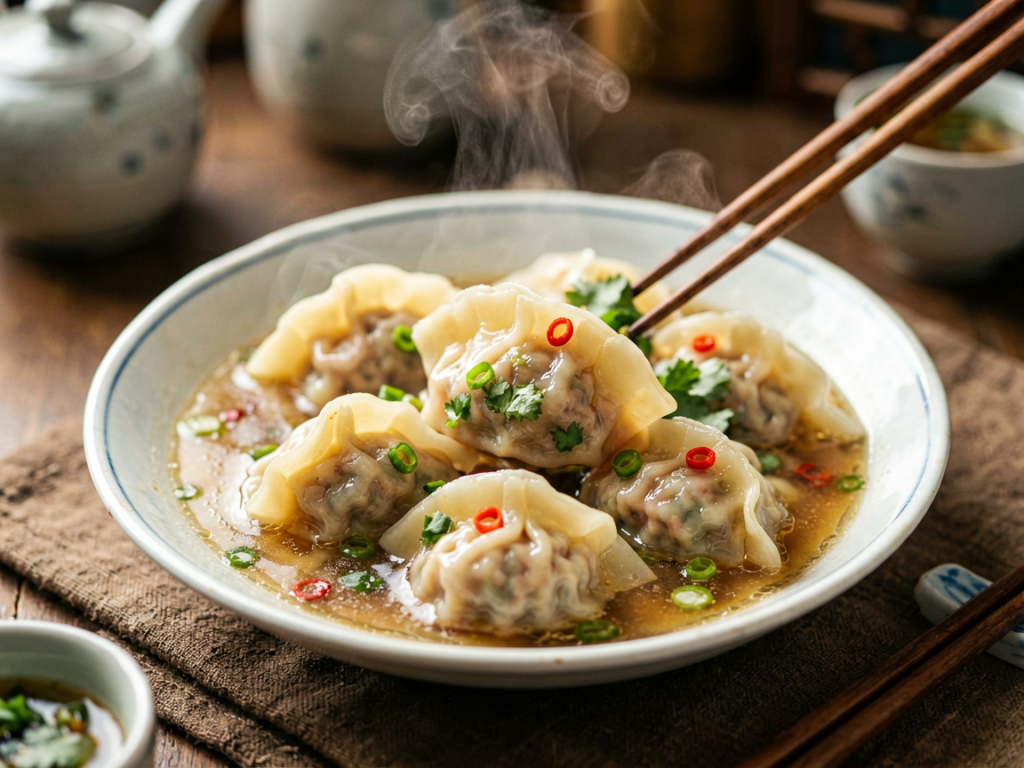
I’ll be honest, I didn’t understand physics until I bit into my first soup dumpling in Shanghai.
I was twenty-two, fresh off the plane, and completely underdressed for the humidity. My host, a local guy named Wei who worked in tech, took me to a hole-in-the-wall spot near Yuyuan Garden. He looked at me with pity and said, “Don’t blow on them.”
I thought he was joking. Who doesn’t blow on hot food? That’s common sense. But Wei shook his head. He pulled out a pair of chopsticks, lifted one delicate, pleated ball, and set it gently onto a small ceramic saucer with a splash of dark vinegar and shredded ginger.
“It’s not just food,” he said. “It’s a pressure vessel. Treat it right, and it’s magic. Treat it wrong, and it’s soup in your lap.”
I laughed. Then I took a bite. And yes, it was a disaster. Hot broth exploded everywhere. But it was also the best thing I’ve ever eaten. That moment changed how I look at breakfast forever.
Xiaolongbao, or soup dumplings, seem simple. They’re just flour, meat, and water, right? Wrong. They are an engineering marvel disguised as street food. Every time I see them steaming in a bamboo basket, I’m reminded of the sheer audacity of Chinese culinary physics.
The Gelatin Paradox
Here’s the thing about regular dumplings. You have dough on the outside and filling on the inside. Usually, the filling is solid or semi-solid. Pork, cabbage, maybe some cheese if you’re feeling fancy.
Soup dumplings flip this logic entirely. The “soup” isn’t liquid when you make it. It’s solid. It’s gelatin.
I spent months learning this in the kitchens of Chengdu. Our chef, Master Li, showed us how to make the aspic. You boil pig skin and chicken feet for hours until the collagen dissolves into the water. Then, you let it cool.
When it hits room temperature, that rich, gelatinous stock turns into a firm jelly. It holds its shape. You can slice it. You can cube it.
Then, you wrap those cubes of solid soup inside thin sheets of dough. You steam them. The heat melts the jelly back into liquid broth. The dumpling expands slightly. The pressure builds. And then, you eat it.
It’s reverse phase change in your mouth. You go from solid to liquid in seconds. Most cultures consider this a bug. In China, it’s a feature.
I remember asking Master Li why anyone would bother with this complexity. He wiped his hands on his apron and looked at me like I’d asked why we breathe oxygen.
“Because it’s alive,” he said. “A normal dumpling is static. It sits there. This? This changes. It reacts to heat. To touch. To you. It’s dynamic.”
To be fair, it’s also incredibly wasteful if you’re careless. But that’s part of the thrill. You’re handling something fragile. Something hot. Something that wants to escape.
Thermodynamics and the Three-Bite Rule
If you haven’t eaten xiaolongbao properly, you’re doing it wrong. I’ve seen tourists stuff two at a time into their mouths. They burn their tongues. They spill broth on their shirts. They leave looking miserable.
There’s a strict protocol here. It’s not snobbery. It’s safety. It’s thermodynamics.
First, you need the vessel. A spoon. Not chopsticks alone. You place the dumpling in a spoon. This contains the potential explosion.
Second, you add the condiments. Black vinegar cuts the grease. Shredded ginger warms the stomach. Some people add chili oil, but I stick to the classic trio. It balances the pH and the temperature.
Third, you bite. But not a big bite. Just a tiny nick in the side. Maybe three millimeters.
This creates a pressure release valve. Steam escapes. The pressure equalizes. Now you can sip the soup. Sip. Don’t gulp. Let it cool slightly against the air. Taste the concentrated pork and pork skin essence.
Finally, you eat the rest. The dough should be thin but tough enough to hold the structure until that very last moment. The meat filling is usually a mixture of pork belly and lean meat, seasoned with soy sauce, sugar, and white pepper.
I tried this method for the first time in Hangzhou. We sat by West Lake. The sun was setting. I followed Wei’s instructions perfectly.
One tiny bite. A sip of hot, savory broth. The warmth spread through my chest. I felt calm. Focused. Alive.
Sound interesting? Probably not to someone who likes their food safe and predictable. But that’s the point. Xiaolongbao demands attention. You can’t eat it while scrolling on your phone. You can’t eat it while rushing to work.
You have to slow down. You have to respect the heat. It forces you to be present. In a country where everything moves fast, a soup dumpling slows time down.
The Geometry of Pleats
Let’s talk about the shape. Look closely at a xiaolongbao. There are folds. Lots of them.
Roughly eighteen to thirty-two pleats, depending on the region and the maker. Why so many?
It’s not just for looks. Although, yes, they are beautiful. The intricate crimping is a sign of skill. But functionally, those pleats serve a purpose.
They reinforce the structure. Each fold adds thickness to the dough at the top, creating a seal. This prevents the broth from leaking out before you’re ready to eat it.
The pleats also distribute tension. When the gelatin melts and expands, the pressure pushes outward. If the dough were smooth and flat, it might burst unevenly. The pleats allow for controlled expansion.
I watched a street vendor in Xi’an make them for three days straight. His hands moved faster than my eyes could follow. Pinch, twist, lift. Pinch, twist, lift.
He didn’t use molds. He didn’t use machines. Just his fingers and decades of muscle memory. He told me he started making them when he was twelve.
“The dough talks to you,” he said. “If you force it, it tears. If you’re too gentle, it won’t seal. You have to listen.”
I don’t know if that’s poetic license or actual advice. But it highlights the tactile nature of this food. It’s hands-on. It requires a sensory connection between the cook and the ingredient.
In the West, we measure cooking in grams and degrees. In China, especially with handmade items like this, we measure by feel. By sight. By the sound the dough makes when you pinch it.
This distinction matters. It explains why store-bought xiaolongbao never taste quite right. The factory can’t replicate the human touch. The pleats are too uniform. The seal is too perfect. It lacks soul.
Cultural Context and Modern Life
People often ask why I care so much about breakfast dumplings. Isn’t that just a meal?
No. It’s a cultural anchor. Xiaolongbao originated in the Nanjing/Shanghai area during the Qing Dynasty. It’s tied to the Jiangnan region, known for its water towns, silk, and refined cuisine.
Eating them is a ritual. It’s associated with family gatherings. Weekend brunches. Celebrations. If you want to impress a Chinese friend, taking them to a good xiaolongbao place is a safe bet.
But it’s also evolved. Today, you find fusion versions everywhere. Crab roe xiaolongbao. Truffle xiaolongbao. Even vegan versions using mushroom gelatin.
I tried the truffle one in Beijing last year. It was expensive. It was fancy. But did it beat the classic pork and vinegar combo? Not really. The earthiness of the truffle overpowered the delicate pork broth.
Sometimes, simplicity wins. The original recipe works because it respects the ingredients. High-quality pork. Fresh ginger. Good vinegar. Thin dough.
That’s the philosophy behind it. Less is more. But the execution must be flawless. One bad ingredient ruins the whole experience.
I’ve learned to apply this to other areas of life. Work. Relationships. Travel. Focus on the core elements. Don’t overcomplicate it. Respect the basics.
Does that make me sound like a guru? Maybe. But I’m no expert. I’m just a guy who ate too many dumplings and liked it.
The Verdict
So, why are soup dumplings a physics problem? Because they defy expectations. They turn solid into liquid. They turn fragility into flavor. They require precision in a chaotic environment.
They challenge you to slow down. To pay attention. To handle heat with care.
Next time you’re in China, or even in a Chinatown near you, don’t just order them because they’re trendy. Order them because they’re an event. A small, edible experiment in thermodynamics.
Bring a spoon. Bring patience. Bring an empty stomach.
And whatever you do, don’t blow on them. Trust me on this one. It took me eight years and ten thousand dumplings to learn that lesson. Don’t make the same mistake I did.
Just bite. Sip. Eat. Enjoy the mess. It’s worth it.