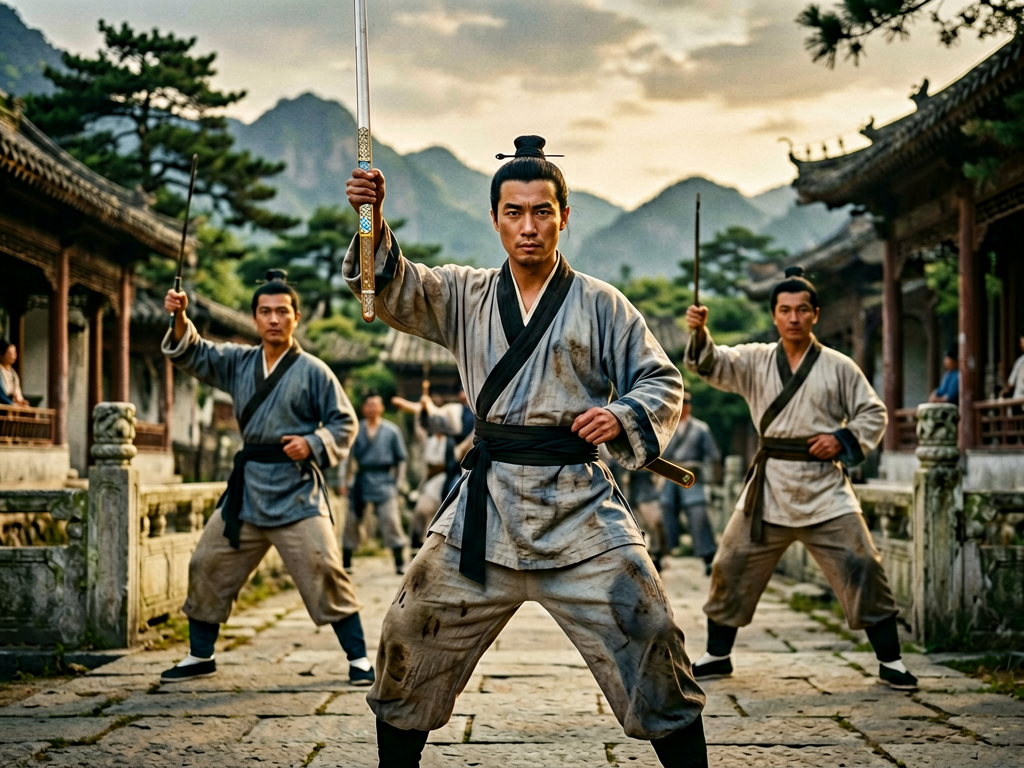
I remember sitting in a stuffy basement gym in Chengdu, watching a guy named Lei crush a sparring partner. He didn’t just hit harder; he moved like water. One second he was dodging, the next he was in your face with a sweep so clean it looked like choreography. I asked him where he learned that fluidity. He grinned, wiped sweat off his brow, and said, “I watch the old movies. The black and white ones. The ones from the 70s.”
I’ll be honest, I thought he was joking. Sanda is modern. It’s Olympic-bound. It’s fast, aggressive, and brutally practical. Why would a fighter need to watch kung fu fantasy films? Those movies are full of flying and magic. But Lei insisted. So, last week, I sat down with a cup of strong Tieguanyin tea and re-watched some of the classics. What I found blew me away.
We’ve got a problem in modern Sanda. We’re obsessed with speed and power. We drill combinations until our muscles burn. We study boxing jabs and Muay Thai knees. But we’ve lost something. We’ve lost the rhythm. We’ve lost the psychological dance. If you want to understand the soul of Chinese combat, you need to look past the current Wushu championships and head back to the golden age of cinema. Specifically, the 1970s.
The Art of the Fake Out
Look, any fighter knows that deception is half the battle. In Sanda, we call it the feint. You throw a high kick to draw up the guard, then drop low for a takedown. It’s basic stuff. But in modern training, we often over-explain our moves. We telegraph our intentions. We rush.
Watch Jackie Chan’s Drunken Master from 1978. It’s not about the drunk acting. It’s about the unpredictability. I spent an evening breaking down that opening fight scene. Jackie doesn’t just stumble. He uses the stumble as a weapon. He lets you think he’s off balance, luring you in, then snaps back with a strike that catches you completely unaware.
Modern fighters are too rigid. We stand in our stances, knees bent, hands up, waiting for the opening. But the old masters in those films? They moved with chaotic grace. They made the opponent feel safe before they destroyed them. I tried applying this in my next sparring session. I stopped trying to be “perfect” and started trying to be “weird.” I let my guard drop for a split second. My partner lunged. I was already gone. It’s easier than you’d expect to throw someone off balance when they expect a wall, not a ghost.
Sound interesting? It’s not just about fighting. It’s about controlling the narrative of the fight. In the 70s films, the hero often wins by making the villain angry. By provoking them into reckless mistakes. That’s psychological warfare. And it’s something we’re missing in our sterile, point-based competitions.
Rhythm Over Raw Power
Here’s the thing about 70s action movies. They were shot differently. The editing wasn’t as frantic as it is today. You could see the connections. You could feel the rhythm. Jet Li might be faster, but Shaw Brothers fighters had a musicality to their movements that we’ve forgotten.
I went to see a demonstration by an old Sifu in Beijing last month. He’s in his seventies. His joints click when he walks. But when he demonstrated a simple palm strike, it had the same snap as a film scene from 1975. It wasn’t about muscle. It was about timing. He explained that the old films captured the *fa jin*–the issuing of power. But they also captured the pause. The breath between movements.
Modern Sanda is all gas, no brake. We rush in, we strike, we retreat. Repeat. But if you watch Wang Lang in Enter the Dragon (well, late 70s, but the style is pure 70s), you see the stillness. He waits. He watches. He lets the momentum of his opponent carry them into his trap. It’s better than most alternatives because it conserves energy. You’re not running a marathon; you’re sprinting in bursts with long, controlled recovery periods.
I tried to slow my breathing down during training. It felt weird at first. I felt slow. I felt vulnerable. But then I noticed my partner was breathing hard. He was tired. I was fresh. I picked my moment. One clean takedown. That’s it. That’s the win. The 70s films teach us that the fight isn’t a blur; it’s a conversation. And you shouldn’t speak every time someone asks you a question.
Environment as a Weapon
We train in padded gyms. We have mats, rings, and protective gear. It’s safe. It’s clean. But it’s also unrealistic. The 70s Wuxia films were filled with forests, temples, narrow alleys, and rooftops. The environment wasn’t just a backdrop; it was a character.
I remember watching The Chinese Boxer and being struck by how the fighters used the trees. They didn’t just jump on them; they swung, they rebounded, they used the vertical space. Modern Sanda is strictly horizontal. We stay on the ground. We clinch, we strike, we grapple. But we ignore the third dimension.
To be fair, you can’t jump off trees in a tournament. But you can use the space. I started paying attention to the walls in my gym. I started practicing turns that used the wall for leverage. I started moving diagonally instead of straight back. It changed my footwork completely. I felt less trapped. I felt like I had more options.
It’s not about trying to do acrobatics. It’s about respecting the space around you. The 70s films show us that the floor isn’t the only surface. The air is a surface. The walls are surfaces. When you stop seeing the gym as a box and start seeing it as a landscape, your tactics shift. You stop running into corners. You start flowing around obstacles. It’s a small mental shift, but it makes you harder to pin down. And in Sanda, being hard to pin down is half the battle.
The Psychology of the Underdog
Let’s talk about the stories. The 70s films are rarely about the strongest guy winning. They’re about the underdog. The guy with the weird style. The guy who studies the craft, not just the muscle. Bruce Lee in Fist of Fury isn’t just strong; he’s determined. He’s angry, but he’s focused. He uses his opponent’s arrogance against them.
Modern fighters often get arrogant. We see a smaller opponent, and we think it’s over. We rush. We get sloppy. We fall for the bait. But if you watch the old films, you see the respect for the craft. The hero always prepares. He meditates. He practices. He understands the philosophy behind the punch.
I’ve seen this happen too many times. A big, strong guy walks into the gym, ignores the technique, and expects to dominate. He loses. Why? Because he didn’t respect the dance. The 70s films teach us that skill beats size. Always. It’s a cliché, but it’s true. I’ve sparred with guys who were 50 pounds lighter than me but moved with such precision that I couldn’t find an opening. They weren’t stronger. They were smarter.
So, what can we learn? We need to cultivate that underdog mentality. Even if you’re the biggest guy in the room, act like you’re the smallest. Stay humble. Stay hungry. Watch the old films not for the spectacle, but for the strategy. See how the hero wins. He doesn’t win by punching harder. He wins by thinking faster. He wins by adapting.
Why It Matters Now
I know what you’re thinking. This is just a blog post about movies. But I promise you, it’s not. Combat sports are evolving. We’re seeing more cross-training, more hybrid styles. But we’re losing the distinct flavor of Chinese martial arts in the process. We’re turning Sanda into just another kickboxing variant. And that’s a shame.
The 70s films capture that flavor. They capture the spirit. The *yi*–the intent. When you watch a Shaw Brothers film, you’re not just seeing punches and kicks. You’re seeing a philosophy. You’re seeing a way of moving through the world that values harmony, balance, and efficiency over brute force.
I’m no expert on film history. I’m just a guy who loves fighting and loves China. But I can tell you this: if you take your training seriously, you need to broaden your horizons. Go to the video store. Find an old, grainy copy of a 70s classic. Watch it. Really watch it. Don’t look at the effects. Look at the footwork. Look at the eye contact. Look at the way they breathe.
You might be surprised. You might find that the answers to your stuck points in training have been sitting on a dusty VHS tape for decades. I certainly did. My next fight is coming up. I’m not going to train harder. I’m going to train smarter. I’m going to move like the water. I’m going to think like the underdog. And I’m going to have a lot of fun doing it.
Trust me, it’s worth the trip down memory lane. The past has a lot to teach us, if we’re willing to listen. And honestly? It’s more fun than drilling jabs for the hundredth time. Give it a shot. You might just find your edge.