I’ll be honest, I felt pretty good about myself when I first arrived in Chengdu. I was thirty, lifting weights, running five-kilometer loops, and generally feeling like I had my life figured out. I thought strength was about how much you could lift or how fast you could sprint. I was wrong. So, so wrong.
It happened on a Tuesday morning in People’s Park. The air was thick with the smell of osmanthus and damp earth. I was sipping my morning tea, watching the locals do their thing. That’s when I saw him. Grandpa Li.
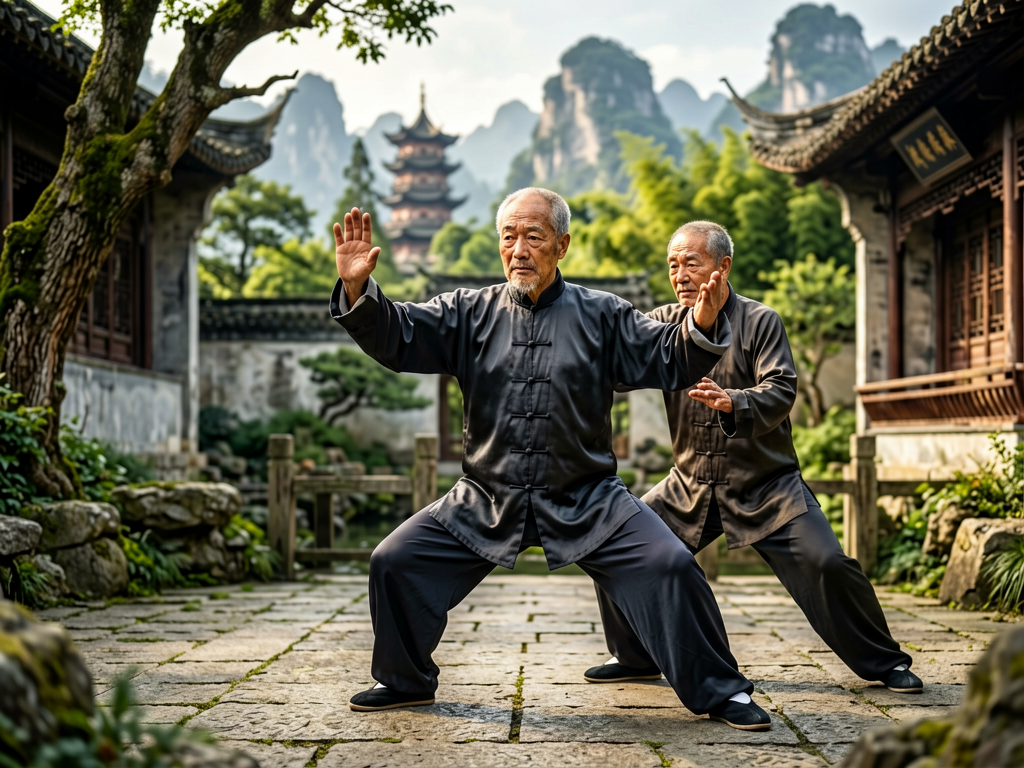
He couldn’t have been taller than five-foot-two. He wore those loose, baggy cotton pants and a shirt that had seen better decades. He looked like he’d been gently folded and put away in a drawer for thirty years. But when he moved, the air seemed to shift around him.
He was doing Push Hands with a guy who looked like he’d been a linebacker in high school. The big guy was pushing, shoving, using brute force. Grandpa Li wasn’t pushing back. He was just… there. And then, with a flick of his wrist, the big guy went flying.
Not falling over. Flying. He ended up three meters away, sitting in a bush.
Grandpa Li didn’t even blink. He just adjusted his sleeve and smiled. That’s when I realized I knew nothing about power. That’s when I started learning about the quiet power of Tai Chi Push Hands.
It’s Not About Muscle, It’s About Physics
Most people think martial arts are about hitting hard. They imagine kung fu movies where guys jump six feet in the air and kick skulls off. That’s Hollywood nonsense. Real martial arts, especially the internal styles like Tai Chi, are about efficiency. They’re about physics.
When you watch Push Hands, it looks slow. It looks lazy. You’re watching two people standing close together, hands lightly touching, moving in slow, circular motions. It looks like a dance for retirees. And sure, a lot of retirees do it. But don’t let the pace fool you.
I spent the first month just watching. I’d sit on a bench with my tea and watch the masters interact. I noticed something strange. The older the practitioner, the less they moved. The young kids, the ones with the shiny uniforms and the intense focus? They were stiff. They were fighting the other person.
The old masters? They were fighting the space around the other person. They were using the other person’s momentum against them. It’s like jiu-jitsu but without the grappling. It’s pure redirection.
Here’s the thing about force. If you push against a wall, the wall doesn’t move. If you push against a person who pushes back, you’re stuck in a stalemate. But if that person moves away just as you push, and then pulls you forward as they retreat, you lose your balance instantly. It’s not magic. It’s mechanics.
Grandpa Li explained it to me later, over a game of chess. He spoke broken English, but his hands told the rest of the story. He showed me how his wrist rotated. How his elbow dropped. How his feet shifted just an inch. It was subtle. Incredibly subtle. But the effect was massive.
I tried to replicate it. I stood in front of a friend and tried to use this “soft” power. I pushed, and he just pushed back. I felt silly. I felt weak. I realized that I had spent years building a body designed to resist force, not to redirect it. My muscles were tight. My mind was loud. I was bracing for impact, and that’s exactly why I couldn’t move.
The Art of Listening
There’s a term in Push Hands called “listening jin.” It sounds poetic, right? But it’s actually a very practical skill. It means sensing your opponent’s intent before they even act.
When you touch someone’s hand lightly, you can feel the tension in their muscles. You can feel where they’re shifting their weight. If they’re about to push forward, their shoulder tenses. If they’re about to pull, their elbow drops. It’s like reading body language, but on a microscopic level.
I remember the first time I actually “heard” something. I was paired with a woman named Sister Wang. She’s in her sixties, sharp as a tack, and terrifyingly skilled. We were in the middle of a session, and I was trying to break through her defense. I was pushing hard, using all my upper body strength.
She didn’t push back. She just listened. She felt my weight shift to my left foot. And in that split second, she stepped to the right. My momentum carried me past her. I stumbled forward, off-balance. Before I could recover, she lightly tapped my back, and I landed on my ass in the dirt.
I looked up at her, expecting her to laugh. She just shook her head. “You are too loud,” she said. “Your body is screaming before you even move. Be quiet. Be still.” It was the best advice I’d ever received, and it had nothing to do with fighting.
This concept of listening applies to everything. When you’re angry, your body tenses. You become predictable. When you’re calm, you’re fluid. You can adapt. Push Hands teaches you to stay calm under pressure. It teaches you that resistance creates friction, but flow creates power.
I started applying this to my daily life. When someone shouted at me in traffic, I didn’t shout back. I just… listened. I felt their anger, acknowledged it, and then moved around it. It’s a strange sensation. It feels passive, but it’s actually incredibly active. You’re engaging with the energy, not blocking it.
Why Age Is Just a Number (Or a Weapon)
We live in a youth-obsessed culture. We see older people in gyms, trying to mimic the workouts of twenty-year-olds. They’re lifting heavy weights, running on treadmills, trying to stay young by fighting time. But in the park in Chengdu, I saw something different.
I saw men and women in their eighties and nineties, moving with a grace that thirty-year-olds could only dream of. They weren’t fast. They weren’t flashy. But they were unstoppable.
Take Old Man Chen, for example. He’s eighty-four. He has arthritis in his knees and cataracts in his eyes. But when he does Push Hands, he’s a ghost. He’s everywhere and nowhere at once. He doesn’t rely on leg strength anymore. He relies on structure. He aligns his bones so that his weight is supported by the ground, not his muscles.
This is why old people can toss you across the room. Not because they’re strong, but because they’ve learned to use the ground. They’ve learned to stop fighting their own bodies and start working with them. They’ve let go of the need to be dominant. And in that surrender, they’ve found immense power.
I asked Chen if he ever got tired of being so good. He laughed, a dry, wheezing sound. “Tired?” he said. “I am not tired. I am free. You young people, you carry so much weight. In your shoulders. In your minds. Let it go. The ground will hold you.” It’s a philosophical truth wrapped in a martial arts lesson.
It’s humbling. It’s terrifying. And it’s beautiful. I watched Chen push a guy who was twice his size. The guy pushed with all his might. Chen just stepped aside, hooked the guy’s arm, and guided him into a gentle bow. No force. No anger. Just guidance.
What You Can Learn From the Masters
So, what’s the takeaway? Do you need to become a master of Push Hands to benefit from it? Absolutely not. But you do need to understand the principles. You need to understand that strength isn’t always about force. Sometimes, it’s about flexibility. Sometimes, it’s about patience.
I used to think that to succeed, I had to push harder, work longer, fight harder. I burned out. I got injured. I was miserable. Then I started training with the masters in the park. I learned to listen. I learned to yield. And strangely, I became stronger.
My workouts became more efficient. My relationships improved. I stopped arguing with people and started understanding them. It’s not that I became passive. It’s that I became effective. I stopped wasting energy on things that didn’t matter.
If you’re in China, or anywhere else, find a park. Find the old people doing Tai Chi. Watch them. Talk to them. Ask them to show you how to stand. You might be surprised by what you learn. You might be surprised by how much power lies in doing nothing.
I’m still a long way from being a master. I still tense up when I’m stressed. I still try to push against walls. But I’m getting better. I’m learning to be quiet. I’m learning to listen. And most importantly, I’m learning to let the ground hold me up.
Next time you’re in a tough situation, don’t push back. Step aside. Feel the momentum. Guide it. You might just find that the quiet power of yielding is the loudest force in the room.
It’s a weird concept. It goes against everything we’re taught about success. But after years of watching Grandpa Li and Sister Wang and Old Man Chen, I’m convinced it’s true. The hardest thing to do is often the easiest thing. Let it go. And watch what happens.
I’m still figuring it out. But for the first time in years, I feel like I’m on the right path. And that’s a feeling worth more than any muscle I could ever build.