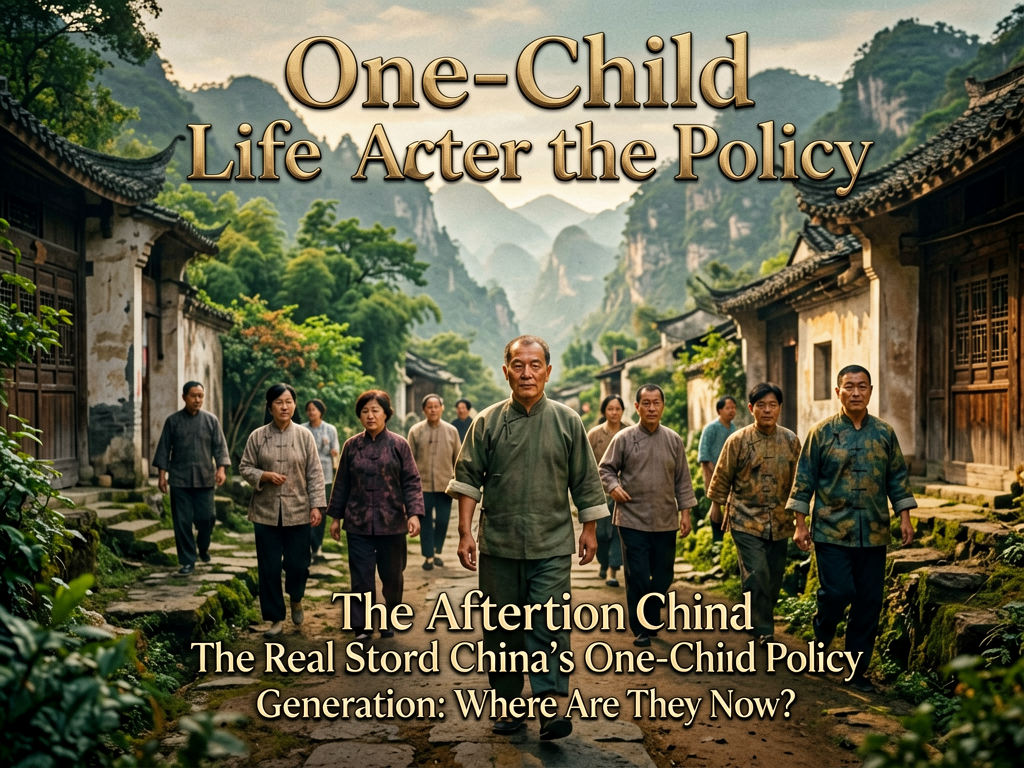
Look, I’ll be honest with you. When I first moved to Chengdu in 2015, I had no idea what I was walking into. I thought I’d find a generic Asian metropolis. Fast-forward three years, and I realized I was living in a society shaped entirely by a single government decree from 1979.
That decree is the One-Child Policy. It’s famous. It’s controversial. But most Westerners I talk to only know the statistics. They don’t know the people. They don’t know the quiet panic in a mother’s eyes when her only son fails his college entrance exam, or the heavy silence at a dinner table when the only child has to choose between their aging parents and their own future.
I’ve spent eight years here. I’ve eaten hotpot with hundreds of them. I’ve listened to their complaints, their dreams, and their fears. And I’m here to tell you that the story is much more complicated than the headlines suggest.
The Little Emperors Myth
You’ve probably heard the term “Little Emperor.” It sounds like a caricature, right? A spoiled brat with a crown. And sure, some kids were spoiled. My neighbor’s son in Xi’an used to throw tantrums when his grandmother wouldn’t peel his shrimp for him.
But that’s not the whole story. Being an only child in China isn’t just about getting everything you want. It’s about carrying the weight of the world on your small shoulders.
I remember sitting with Li Wei, a friend I made while teaching English in Beijing. He’s thirty-two now. He told me about the pressure he felt growing up. He wasn’t allowed to fail. His parents had put all their eggs in one basket. If he got into a bad university, his parents felt their entire life’s investment was wasted.
This isn’t just about money. It’s about face. It’s about legacy. For the generation born between 1980 and 2010, there was no sibling to share the burden. No one to talk to when things got tough. Just you, your parents, and the crushing expectation to succeed.
Is it lonely? Absolutely. I’ve seen grown men cry in car parks because they couldn’t handle the pressure of buying an apartment. It’s a heavy load for a young person to carry.
The Sandwich Generation Crunch
Here’s the thing about the current economic landscape. These kids are now in their thirties and forties. And they are stuck in the middle.
They are the “Sandwich Generation.” They have aging parents who need care, and they are raising their own children. But now, the rules have changed. The government lifted the two-child policy, and now the three-child policy. So, these only children are expected to raise two or three kids while taking care of four parents.
I watched my friend Chen try to manage this last year. His father had a stroke, and his mother needed help with daily chores. Meanwhile, his own daughter was starting kindergarten. He was working sixty hours a week at his tech job in Shenzhen.
He told me over beer one night, “I don’t have time to be sad. I don’t have time to be tired. I just have to keep moving.” That’s the reality. It’s not dramatic. It’s just exhausting.
And let’s talk about money. Housing prices in cities like Shanghai and Beijing are insane. For an only child, buying a home often means pooling resources with both sets of parents. It’s a complex dance of finance and family dynamics that outsiders rarely understand.
My landlord, Mrs. Zhang, paid for her daughter’s apartment down payment. In return, the daughter lives nearby, not far away. It’s a trade-off. Independence is sacrificed for stability. Sound interesting? Maybe not to you, but it’s their normal.
Changing Attitudes Toward Marriage
You might think that having fewer siblings would make these kids more family-oriented. But ironically, it’s doing the opposite. Marriage rates are dropping. Birth rates are plummeting.
I’ve noticed a shift in my own social circle. My friends are more focused on themselves than ever before. They travel. They buy nice clothes. They go to yoga classes. They aren’t rushing into marriage just because society says so.
Take Sarah, a graphic designer I met in Hangzhou. She’s twenty-nine. She told me she doesn’t want to marry unless she finds someone who truly gets her. She doesn’t want to have a child just to continue the family line. She wants to enjoy her life.
This is a huge change. For their parents’ generation, marriage and children were mandatory. For the only-child generation, it’s optional. They’ve seen how much pressure their parents put on them. They don’t want to inflict that on their own kids.
Plus, the cost of raising a child is terrifying. I did the math with a friend once. Between tuition, extracurriculars, and housing, raising a kid in Shanghai could cost hundreds of thousands of dollars. Who wants to sign up for that?
So, we see a rise in “DINK” families (Double Income, No Kids). It’s not a scandal anymore. It’s a choice. And it’s a choice that’s becoming more common every day.
The Mental Health Crisis
I want to talk about something we don’t discuss enough. Mental health. The pressure to succeed has left scars. Anxiety and depression are on the rise among young Chinese professionals.
I’ve seen it in myself. The constant comparison. Everyone is doing better than you. Your cousin got a promotion. Your neighbor bought a new car. You’re still renting. It eats you up.
Therapy is becoming more accepted, but it’s still stigmatized in many circles. My colleague, Mark, avoided talking about his stress for years. He thought he was weak. He didn’t realize that many of his peers felt the same way.
It’s only recently that we’ve seen a shift. More people are opening up. More apps are popping up for mental health support. But the culture of “enduring hardship” is still strong. Many of these only children were taught to suffer in silence.
I love the resilience I see here. But I also see the cracks. And it’s important to acknowledge them. We can’t just praise their success. We have to ask about the cost.
Where Do They Go From Here?
So, where are they now? They’re navigating a rapidly changing world. The economy is slowing down. The job market is competitive. But they’re also more global than ever.
They speak English. They travel. They consume global media. They’re not the isolated products of a closed society. They’re connected. They’re savvy. They’re challenging the traditional norms.
I see them starting businesses. I see them working in tech. I see them creating art that challenges the status quo. They’re not just following orders. They’re thinking for themselves.
And they’re still connected to their families. That bond is strong. Even if they move away, they call their parents every day. They send money home. They take them on trips. The guilt is real, but so is the love.
I think there’s a misunderstanding in the West. We often see the One-Child Generation as victims. And to some extent, they are. But they’re also survivors. They’re adaptable. They’re strong.
They’ve built a life in a system that was designed for them. It wasn’t easy. But they’re making it work. And in many ways, they’re leading the way for a more modern, individualistic China.
So, the next time you hear about the One-Child Policy, don’t just think about the numbers. Think about Li Wei. Think about Chen. Think about Sarah. Think about the millions of people who are shaping China’s future.
They’re not just little emperors. They’re complex, flawed, beautiful humans. And they’re just trying to get by. Just like the rest of us.
I’m curious, what do you think? Does living in a one-child household change your personality? Let me know in the comments. I read every single one. And trust me, you won’t believe some of the stories I’ve heard.
If you enjoyed this deep dive, share it with a friend. Maybe they’ll finally understand why your Chinese friend is so obsessed with saving money. Or why they call their mom every Sunday. It’s not just habit. It’s survival.
Stay curious. Stay open-minded. And keep exploring. That’s what we’re here for.