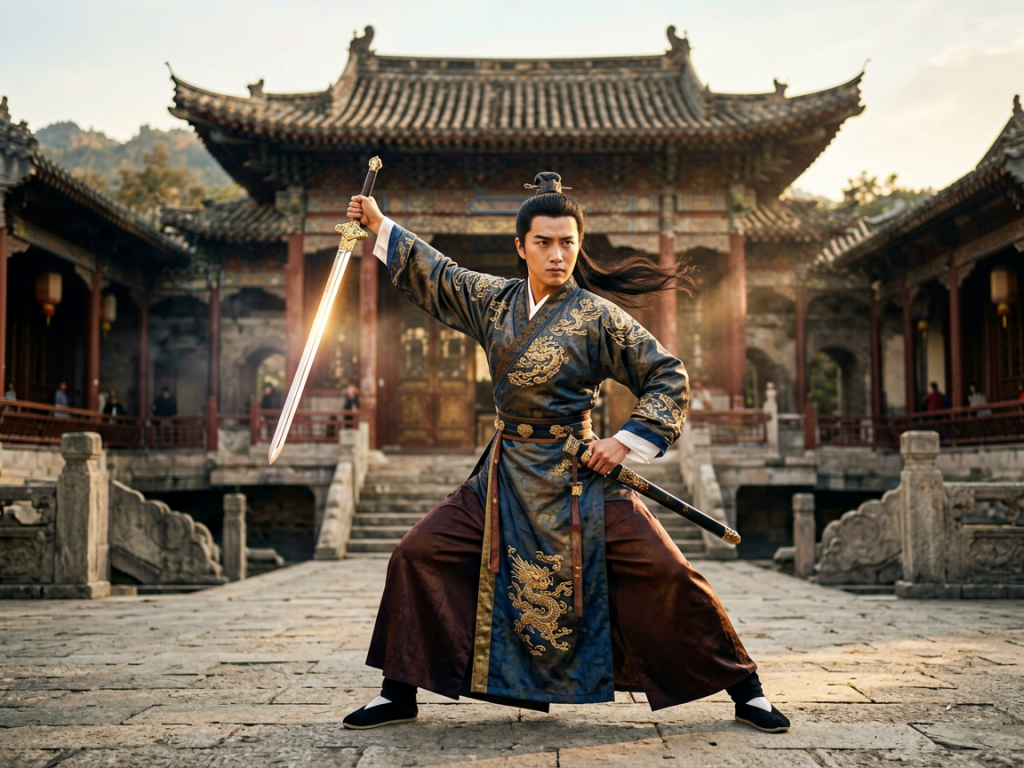
I still remember the first time I actually held a proper jian. It wasn’t the cheap, shiny aluminum toy they sell at tourist traps in Xi’an. It was a heavy, folded-steel blade my sifu bought from a blacksmith in Hangzhou. It felt less like a weapon and more like an extension of my own nervous system.
The balance point was surprisingly high. When I tried to swing it, I nearly took out a potted plant in the corner of the studio. My sifu just smiled. He didn’t say anything. He just handed me a lighter, thinner practice sword and pointed to the floor.
That was ten years ago. I’m no master. I’m just a guy who got obsessed with the history, the physics, and the sheer beauty of Chinese sword forms. If you’re thinking about picking one up, or maybe just trying a class at your local kung fu school, here’s what I wish someone had told me before I started.
We often think of martial arts as purely combat. That’s a misconception. Chinese sword forms, or xing, are as much about poetry as they are about fighting. They’re about rhythm, flow, and understanding how your body moves through space. It’s not about hitting hard. It’s about moving gracefully.
It’s Not Just Waving a Stick Around
The first thing you need to unlearn is the idea that sword forms are just fancy fencing with a different handle. Western fencing is linear. It’s about distance, timing, and striking. Chinese sword forms are circular. They’re about yielding, redirecting, and controlling the opponent’s energy.
I remember watching a video of a young master performing a form called “White Crane Spreads Wings.” It looked effortless. The sword seemed to float. But when I tried to replicate it, my arm felt like lead. My wrists were stiff. The sword felt like a dead weight dragging me down.
The secret isn’t strength. It’s relaxation. You have to be loose. If you tense up, you slow down. And if you’re slow, you’re dead. This is counterintuitive for most Westerners. We’re taught to “power through.” In Chinese sword forms, you have to flow through.
You’ll spend the first few months just learning how to hold the sword. Not swing it. Just hold it. The grip needs to be firm enough so the sword doesn’t fly out of your hand, but loose enough that you can change directions instantly. It’s a delicate balance. Think of holding a baby bird. Too tight, and you crush it. Too loose, and it flies away.
My sifu would correct my grip every five minutes. “Song,” he’d say. That’s the word. Song means to relax, to let go of unnecessary tension. I spent three weeks just standing in a horse stance, holding the sword out in front of me. My arms shook. I sweated through my shirt. But slowly, I started to feel the connection between my dantian–my core–and the tip of the blade.
Choosing Your First Sword
You don’t need to spend a fortune. But you also shouldn’t buy the cheapest thing on Amazon. A bad sword will ruin your form before you even start. It’ll be unbalanced, sharp edges will be uneven, and the handle will be the wrong size.
For a beginner, I recommend a stainless steel jian with a flexible blade. You want something that can bend slightly without breaking. This flexibility helps you learn the correct angle of attack. If the sword is rigid, you’ll develop bad habits trying to force it.
Length matters too. The sword should reach the ground when you hold it at your side. Not above your head. At your side. If it’s too long, it’s unwieldy. If it’s too short, you lose reach. Most people fall between 34 and 40 inches. Measure yourself. Or just ask the instructor at your school. They’ll have a few lying around.
I bought my first decent sword from a guy in Chengdu who sold them out of the back of his van. He didn’t have a shop. He didn’t have a website. He just knew his stuff. He handed me a sword and said, “Hold it. Feel it.” I did. And I knew. That’s how you know.
Don’t bother with decorative swords. Those are for hanging on a wall. They’re often made of poor quality metal and have no balance. They’re dangerous because they’re unpredictable. Get a practice sword. It’s safer and it’ll help you learn faster.
Basic Movements You’ll See Everywhere
Every form, whether it’s Shaolin, Wudang, or Emei, shares a common vocabulary. You’ll see these moves again and again. Once you recognize them, you’ll start to see the patterns.
First, there’s the cut. Simple, right? But a proper cut isn’t just arm movement. It’s a whole-body motion. You step, you turn your waist, and you let the sword follow. The power comes from your legs and hips, not your biceps. I used to try to chop with my arm. My sifu laughed. He said I looked like I was trying to kill a fly with a hammer. Much better to use a scalpel.
Then there’s the thrust. This is deceptive. It looks slow, but it’s fast. The key is to keep your elbow tucked in. If your elbow pops out, you’re exposed. You’re leaving your side open. Keep your elbow close to your ribs. It’s like you’re holding an orange under your arm. This protects your body while you attack.
Parrying is the third pillar. In Western fencing, you block. In Chinese sword forms, you deflect. You don’t meet force with force. You redirect it. Imagine a river hitting a rock. The water doesn’t stop. It flows around it. That’s what you’re doing with your sword. You guide the opponent’s blade away, then you counter.
I remember sparring with a guy who was strong. Really strong. He kept trying to overpower me. I kept getting pushed back. Then I stopped trying to fight him. I started yielding. I let his attacks slide off my blade. I turned with his force. And suddenly, he was off balance. I didn’t even have to hit him. He just fell over. That was the moment I understood the philosophy behind the movements.
What to Expect in Your First Class
Walking into a kung fu school can be intimidating. You’ll see people moving in perfect sync. They’ll look like they’re in a trance. Don’t worry. They were beginners once too. They just practiced more.
Most classes start with warm-ups. Lots of stretching. Then you’ll do forms without the sword. This is called “empty hand” practice. It’s crucial. If you can’t move your body correctly without a weapon, you’ll look ridiculous with one. You’ll learn footwork. You’ll learn stances. You’ll learn how to shift your weight.
Then comes the sword. The instructor will demonstrate a sequence. Maybe ten moves. You’ll copy it. Then they’ll add ten more. And another ten. It feels like learning a song. You learn the notes. Then you play the melody. Then you add the rhythm.
Don’t rush. I know it’s frustrating to move slowly. You want to be fast. You want to look cool. But speed is a byproduct of accuracy. If you’re sloppy, you’re slow. If you’re precise, you’re fast. Focus on the details. Is your wrist straight? Is your elbow down? Are you looking where you’re pointing?
I spent a whole month on just two moves. One was a cut. The other was a block. My classmates were doing full forms. I was stuck on basics. I felt left behind. But my sifu insisted. “The foundation determines the height of the building,” he said. He was right. When I finally moved on, my form was cleaner and stronger than anyone else’s.
Why You Should Keep Going
There are days when you’ll hate it. Your arms will hurt. Your mind will wander. You’ll question why you’re spending your evenings waving a piece of metal around in a gym.
But then there are the good days. The days when it all clicks. When you’re moving and you forget to think. When the sword feels like part of you. That feeling is addictive. It’s better than any video game. It’s better than any meal.
I’ve traveled all over China looking for different styles. I’ve seen masters in the mountains of Shaolin. I’ve seen teachers in the parks of Beijing. I’ve seen kids practicing in the streets of Guangzhou. The common thread isn’t the technique. It’s the attitude. There’s a calmness there. A respect for the craft.
Learning a sword form teaches you patience. It teaches you humility. It teaches you that you don’t know everything. You’re always learning. And that’s a beautiful way to live.
If you’re curious, go to a class. Talk to the instructor. Ask to watch a practice. You don’t have to join. Just observe. You might be surprised by what you see. And you might be surprised by what you feel.
I’m still learning. I’m still making mistakes. I still take out potted plants sometimes. But I’m having fun. And that’s really all that matters. So grab a stick. Or a sword. Or just your arms. And start moving. You’ll be glad you did.