Most people think Kung Fu is about flying through the air and breaking concrete slabs with their bare hands. I used to think that too. I watched enough movies to believe that a true master could defeat ten guys while sipping tea.
Then I showed up at the Shaolin Temple complex in Dengfeng, Henan province, at 4:30 in the morning. The air was crisp and smelled faintly of incense and damp earth. My legs were already shaking before I even tied my shoes.
Here’s the thing: traditional Kung Fu training isn’t about the flashy moves you see on Instagram. It’s about repetition. It’s about doing the same boring movement ten thousand times until your body does it without you thinking. It’s exhausting. It’s humbling. And it’s the best thing I’ve ever done.
I’m no martial artist. I’m a writer who likes to travel. But after spending a full day embedded with a group of serious students, I learned more about discipline in twelve hours than I have in ten years of casual gym memberships.
Waking Up Before the Sun
Don’t get me wrong, I’m a morning person. Usually. But 4:30 AM is a different beast entirely. The dormitory was cold, the kind of cold that seeps through your bones even if you’re wrapped in a thick blanket.
The bell rang at 4:15. It wasn’t a digital alarm. It was a physical gong, deep and resonant, vibrating right in your chest. You didn’t just wake up; you woke up with a start. Every student was out of bed in under two minutes. No snoozing. No excuses.
We gathered in the main courtyard, a vast open space surrounded by old temple buildings with red pillars. There were about thirty of us. Half were locals, kids who had been training since they were five. The other half were international tourists like me, mostly guys in their thirties and forties who wanted to find themselves.
Our instructor, Master Li, stood at the front. He wasn’t yelling. He never yelled. He just stood there, perfectly still, watching us line up. That silence was scarier than any shout. It made you want to get it right the first time.
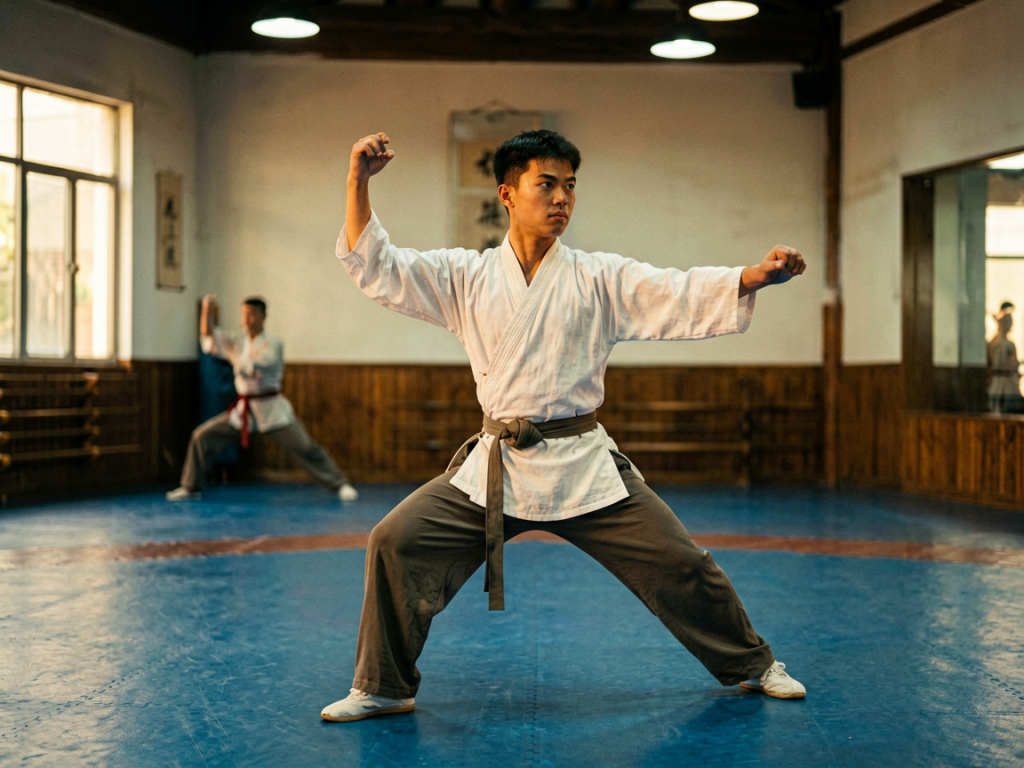
First up was the Horse Stance, or Mabu. If you’ve never tried this, imagine sitting in an invisible chair. Your legs are spread wide, knees bent, back straight. You hold it. You don’t move. You just breathe.
For beginners, holding it for thirty seconds is a victory. For me, my thighs started burning after ten seconds. By the end of the twenty-minute session, I couldn’t feel my legs. I was swaying like a leaf in the wind.
Master Li walked around, tapping students on the back with a bamboo stick. Not hard, just enough to remind you to keep your spine straight. “Relax,” he said in broken English. “But don’t fall.”
It sounds contradictory, right? But that’s the point. You have to be strong enough to hold the position, but relaxed enough to breathe. If you tense up, you’ll cramp. If you’re too loose, you’ll collapse. It’s a balance that takes years to master.
The Grind of the Basics
After the Horse Stance, we moved on to the basic strikes. Punches, palm strikes, and kicks. Nothing fancy. No spinning back fists. No jumping crescent kicks.
We spent an hour just doing front punches. Chui Quan. Step, punch, retract. Step, punch, retract. Over and over. My shoulder ached. My wrist felt like it was going to snap.
I wanted to stop. I wanted to sit down. But looking around, I saw kids half my age keeping up with the rhythm. One girl, maybe twelve years old, was smiling. She looked like she was having fun. I looked like I was dying.
Sound interesting? Trust me, it gets harder.
The real challenge wasn’t the physical pain. It was the mental boredom. Doing the same thing over and over is mentally draining. Your mind wants to wander. It wants to think about your emails, your rent, your dinner plans.
But you can’t let it. You have to stay present. Every punch has to be perfect. Every step has to be solid. If your mind drifts, your form breaks. And if your form breaks, Master Li taps you with the bamboo stick.
I started to notice things I never had before. I noticed how my weight shifted from my front foot to my back foot. I noticed how my hips rotated with every punch. I noticed that when I relaxed my shoulders, my punches actually had more power.
It’s a form of moving meditation. You’re so focused on your body that you don’t have room to worry about the rest of the world. It’s freeing, in a weird way.
By the time we finished the basic drills, it was nearly 7 AM. We were drenched in sweat. The sun was just starting to peek over the mountains. The air was cooling down, but we were still hot.
We didn’t have time to rest. We had to wash up and get ready for breakfast. And let me tell you, the breakfast at a Kung Fu school is not a light meal.
Surviving the Meal
You can’t train like a monkey if you don’t eat like one. The dietary requirements for serious martial arts students are strict. High protein, complex carbs, no sugar, no processed food.
We sat in the mess hall, a large cafeteria-style room with long wooden tables. The smell was incredible. Steamed buns, congee, boiled eggs, and a variety of vegetable dishes.
I was starving. My body was screaming for calories. But the food was simple. Plain rice, stir-fried greens, tofu, and chicken breast. No spicy sauce. No heavy oil. Just clean, solid fuel.
I watched the older students eat. They didn’t rush. They chewed slowly. They finished everything on their plates. There was no wasting. In the martial arts world, wasting food is considered disrespectful.
I tried to mimic them. It was hard. My hunger was a physical ache. But eating slowly helped me digest. It helped me prepare for the next round of training.
After breakfast, there was a short break. About thirty minutes. Most students sat quietly. Some meditated. Others practiced forms in the corner. I just sat there, staring at the wall, trying to recover my energy.
I struck up a conversation with a guy named Dave from Canada. He’d been training for three years. He told me that the hardest part wasn’t the physical training. It was the loneliness.
“When you train this hard, you don’t have time for parties or dating,” he said. “You’re either training, sleeping, or eating. It’s a simple life. A hard life. But a pure one.”
I thought about that as I wiped my bowl clean. I’ve lived a messy life. Lots of distractions. Lots of noise. Dave’s life sounded incredibly focused. Maybe that’s what I was looking for.
Forms and Flow
The afternoon session was different. Instead of basics, we learned forms. A form, or Tao Lu, is a sequence of movements. It’s like a dance, but every movement is a fight.
Our instructor taught us a simple five-move sequence. Block, strike, kick, punch, stance. It looked easy when he did it. His movements were fluid, like water flowing down a stream.
When we tried it, it was clumsy. We were stiff. We were thinking too much about where our hands should be, rather than letting them move naturally.
Master Li corrected us constantly. “Flow,” he said. “Don’t fight the movement. Let the movement happen.”
It took us two hours to get the sequence right. Two hours of repetition. Two hours of frustration. Two hours of failing.
But then, something clicked. For about ten seconds, I moved without thinking. My body remembered what my mind was trying to do. I blocked, struck, kicked, punched, and held the stance. It felt powerful. It felt right.
I don’t know if I’ll ever be able to do it again. But for those ten seconds, I felt like a martial artist. I felt connected to something ancient and strong.
That’s the magic of Kung Fu. It’s not about the moves. It’s about the connection between your mind and your body. It’s about finding that flow state where action and thought become one.
It’s easier to describe than it is to explain. You have to experience it.
Reflections on the Floor
When the training finally ended, it was past noon. We were exhausted. Our muscles trembled. Our minds were blank.
We gathered in the courtyard for a final meditation. We sat cross-legged on the floor, eyes closed, breathing deeply. The noise of the temple faded away. The birds sang. The wind blew.
For the first time all day, I was truly present. I wasn’t thinking about my train ticket home. I wasn’t worrying about my work emails. I was just breathing.
I looked around the circle. I saw the kids, the tourists, the monks. We were all different. We spoke different languages. We came from different cultures. But in that moment, we were the same.
We were all students. We were all trying to get better. We were all willing to suffer for a moment of clarity.
I’m not saying you should quit your job and move to China to learn Kung Fu. That’s extreme. But I am saying that you should try it. Even for a day.
You don’t need to be an athlete. You don’t need to be young. You just need to be willing to be uncomfortable.
Life is easy. It’s comfortable. We spend most of our time avoiding pain. But pain is where growth happens. Discomfort is where change happens.
Spending a day in a Kung Fu school taught me that. It taught me that discipline isn’t a punishment. It’s a gift. It’s the gift of giving yourself the chance to be better than you were yesterday.
So, the next time you’re feeling stuck, or lazy, or unmotivated, try something hard. Try something that makes you uncomfortable. Try holding the Horse Stance until your legs shake.
Trust me, you won’t regret it. And you might just find yourself in the process.
Anyway, I’m heading to the market now. I’m starving, and I’m going to eat everything in sight. I’ve earned it.