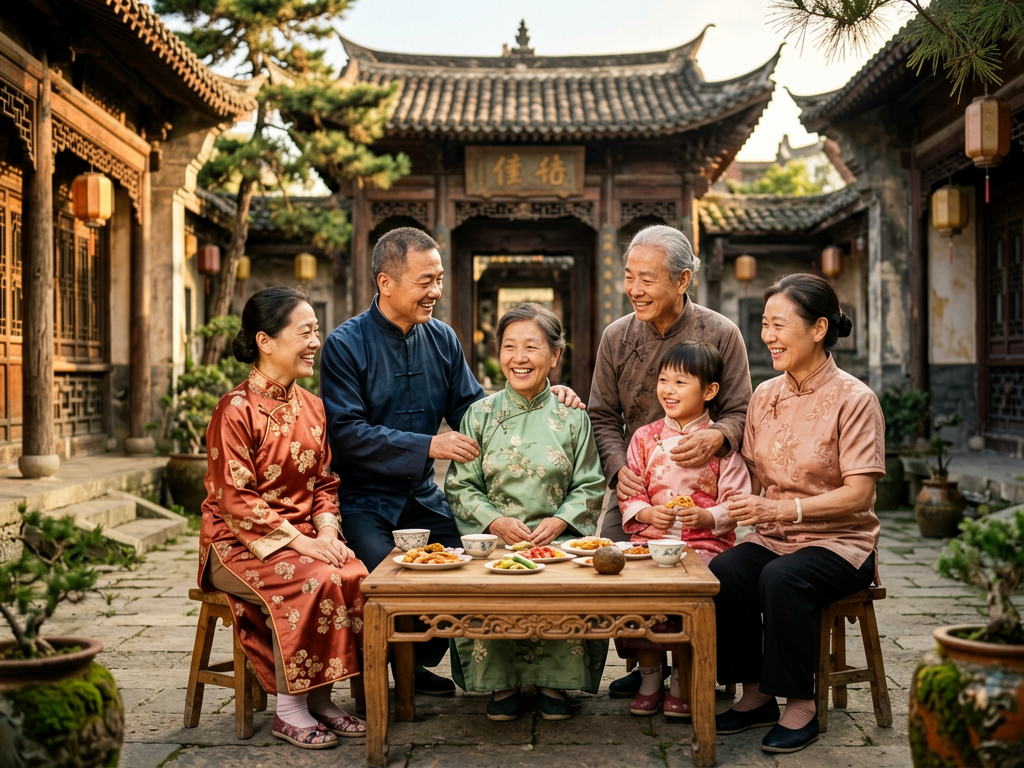
Here’s the thing about Chinese families: they don’t just stay connected. They cling to each other with a tenacity that often baffes outsiders. I moved to Beijing eight years ago, fresh-faced and thinking I knew what a “close family” looked like based on my own nuclear household. I was wrong. I was naive. I thought connection meant weekly dinner dates and holiday cards. In China, connection is a relentless, loving, sometimes suffocating, but always profound web of obligation and affection that spans centuries.
I remember my first Lunar New Year in a typical Beijing *hutong* neighborhood. The air smelled of frying dough sticks and gunpowder. Inside my host family’s cramped apartment, it was chaos. Three generations were crammed into a space that looked too small to hold them all. My host mother, Auntie Li, was shouting over the radio, trying to get the right temperature for the dumpling filling. Her father, my eighty-year-old host grandpa, was trying to explain how to fold the dumplings correctly, his hands shaking slightly but his instructions precise. And then there was my twenty-year-old cousin, glued to his phone, occasionally nodding at the elders without looking up.
On the surface, it looked like a disaster. But by the time we sat down to eat, that fractured energy had coalesced into a warm, humming unity. That’s the essence of it. Chinese families stay connected not by ignoring differences, but by weaving them into a single, strong fabric. And honestly? It’s a beautiful thing to witness, even if you don’t fully understand the rules of the game yet.
Food is the Universal Language of Care
You cannot talk about Chinese family dynamics without talking about food. In the West, if someone asks, “Have you eaten?” it’s often just a polite greeting, like “How are you?” In China, it’s a literal check-in. It’s an expression of love. It’s a demand for well-being.
I’ll never forget the time I visited my friend Wei’s family in Chengdu. We were just two friends hanging out, talking about work. Suddenly, Wei’s mother appeared from the kitchen with a bowl of spicy beef soup. She didn’t ask if I was hungry. She just shoved the bowl into my hands and told me to eat before it got cold. When I tried to politely decline, saying I wasn’t very hungry, she looked at me with genuine concern. To her, my lack of appetite was a sign of distress. Was I sick? Was I stressed? Was I being difficult?
So, I ate. And let me tell you, that soup was incredible. Rich, numbing, comforting. But the point wasn’t the soup. The point was the act of feeding. In Chinese culture, providing food is the primary way parents show they care for their children, and it’s how children show gratitude to their parents. It’s a loop that never breaks.
This extends far beyond the immediate family. When you meet your partner’s parents for the first time, you are judged by how well you appreciate their food. If you leave the plate clean, you are happy. If you complain, you are difficult. It’s simple, yet it carries so much weight. I’ve seen marriages nearly fail over a poorly prepared dish, and I’ve seen friendships blossom over a shared bowl of hot pot. It’s easier than you’d expect to bond with someone if you’re willing to eat what they love.
And it’s not just about the taste. It’s about the effort. The hours spent marinating meat, the careful selection of ingredients, the slow simmering of broth. All of that time is a tangible expression of love. When you realize that someone spent four hours making something just for you, you can’t help but feel connected to them. You can’t help but feel responsible for their happiness. That’s the hook. That’s the glue.
The Digital Bridge: WeChat and Family Groups
Now, let’s talk technology. I used to think older Chinese generations were resistant to tech. I was wrong again. My grandpa in the *hutong*? He’s on WeChat more than I am. He sends me voice messages at 7 AM. He forwards me articles about health tips, many of which are fake news, but the intent is pure. He wants me to be safe. He wants me to be healthy.
WeChat family groups are the modern hearth of the Chinese home. These groups are often chaotic. You’ve got uncles sharing political opinions, aunts posting photos of their garden vegetables, and cousins arguing about politics or relationships. It’s noisy. It’s overwhelming. And I love it.
I’m no expert on social media trends, but I’ve noticed that these groups serve a vital function. They keep the family in your peripheral vision, constantly. You don’t need to call your mother every day to know she’s okay. You just check the group chat. If she posts a photo of her lunch, you know she’s eating well. If she shares a video of a grandchild dancing, you feel that spark of pride and connection. It’s low-effort, high-reward intimacy.
But there’s a dark side to this, too. The pressure to perform happiness in these groups is real. You can’t just post a sad status update. You have to curate your life. You have to show that you’re successful, that you’re happy, that you’re taking care of your parents. It’s a lot of pressure. I’ve had uncles message me privately to ask why I haven’t posted in the family group for a week. “Are you okay?” they ask. “Why are you hiding?”
It’s intrusive, sure. But it’s also protective. In a country where social safety nets are still developing, the family is the ultimate safety net. The digital group is just the modern tool for maintaining that net. It ensures that no one falls through the cracks. If you’re struggling, the family will know. And they will help. That’s the trade-off. You lose some privacy, but you gain a safety net that few other cultures can match.
Filial Piety in the Modern Age
Let’s address the elephant in the room: filial piety. It’s a Confucian concept that’s been around for thousands of years. It basically means you owe your parents respect, obedience, and care. In the past, this meant living with your parents until you died, or at least until they died. It meant making career choices based on what would please your parents, not what you wanted.
Today, it’s more complicated. I’ve seen young professionals in Shanghai move to other cities for better jobs, leaving their parents behind in smaller towns. They hire nannies to care for their aging parents. They send money home regularly. They visit during holidays. Is this filial piety? Some traditionalists say no. They say it’s cold. They say it’s neglect.
I disagree. I think it’s adaptation. Life is harder now. The cost of living in megacities is astronomical. If a young person stays in their hometown to care for their parents, they might struggle to provide even the basics. By moving away, they can earn more money, which they then funnel back into their parents’ care. It’s a different kind of sacrifice. It’s a sacrifice of presence for the sake of provision.
I’ve seen this play out in my own life. My friend Lin moved to Shenzhen to work in tech. She sees her parents only twice a year. But every month, she sends them enough money to cover their utilities, their groceries, and even a nice vacation. She buys them smart home devices so they can video call her easily. She’s present in a way that matters to them. They’re happy. They’re secure. She’s happy. She’s successful. Everyone wins.
But it’s not always smooth. I’ve had conversations with older Chinese friends who feel abandoned by their children. They have money, but they don’t have time. They have video calls, but they don’t have hugs. It’s a sadness that lingers in the background. It’s a price paid for modernization. And honestly, it breaks my heart a little. But it’s the reality we live in. We can’t go back. We have to find new ways to connect.
The Rituals That Bind Us
Beyond food and tech, there are rituals. Big ones. Lunar New Year, Mid-Autumn Festival, Qingming Festival. These aren’t just holidays. They’re mandatory reunions. The *Chunyun* travel rush during Lunar New Year is the largest annual human migration on Earth. Hundreds of millions of people travel back to their hometowns. They endure crowded trains, long delays, and high prices. Why? Because family is non-negotiable.
I spent a Qingming Festival in a small village in Zhejiang. It’s a day to honor ancestors. We cleaned their graves, offered food, and burned incense. It was quiet. It was solemn. And it was powerful. Standing there with my cousins, all dressed in black, bowing to the past, I felt a sense of continuity that’s rare in the West. We’re not just individuals. We’re links in a chain. We’re responsible for those who came before us, and those who will come after.
These rituals remind us of where we come from. In a rapidly changing society, where everything feels uncertain, these traditions provide an anchor. They tell us who we are. They tell us who our parents are. They tell us who our grandparents were. It’s a sense of identity that’s deeply rooted in the soil of the land and the blood of the family.
I used to find these rituals tedious. I wanted to skip the bowing, the eating, the talking. Now, I crave them. I miss them when I’m far away. I miss the smell of the incense, the taste of the sweet rice balls, the sound of my aunt’s laughter. They’re not just traditions. They’re memories. And they’re the things that keep us connected when the distance gets too wide.
It’s Messy, But It’s Real
So, how do Chinese families stay connected? They do it by being present. They do it by feeding each other. They do it by arguing, loving, forgiving, and enduring. It’s messy. It’s loud. It’s demanding. But it’s real.
In the West, we often prize independence. We want to stand on our own two feet. We want to make our own choices. And that’s great. But sometimes, I look at Chinese families and I feel a pang of envy. They don’t have to stand alone. They have a crowd. They have a team. They have a history.
If you’re living in China, or you have Chinese friends, don’t be afraid to dive into their world. Accept the extra food. Join the WeChat group. Bow to the ancestors. It might be uncomfortable at first. You might feel like you’re losing your individuality. But trust me, you’ll find something else. You’ll find a sense of belonging that’s hard to find anywhere else.
I’m still learning. I still mess up. I still forget to send a red envelope on the right day. But I’m trying. And that’s what matters. Connection isn’t about perfection. It’s about effort. It’s about showing up. And in Chinese families, showing up is everything.
Next time you’re invited to a family dinner, don’t just show up for the food. Show up for the people. Listen to their stories. Ask about their past. Share your own. You might just find that you’re not just eating a meal. You’re building a bridge. And that’s worth more than any gold.