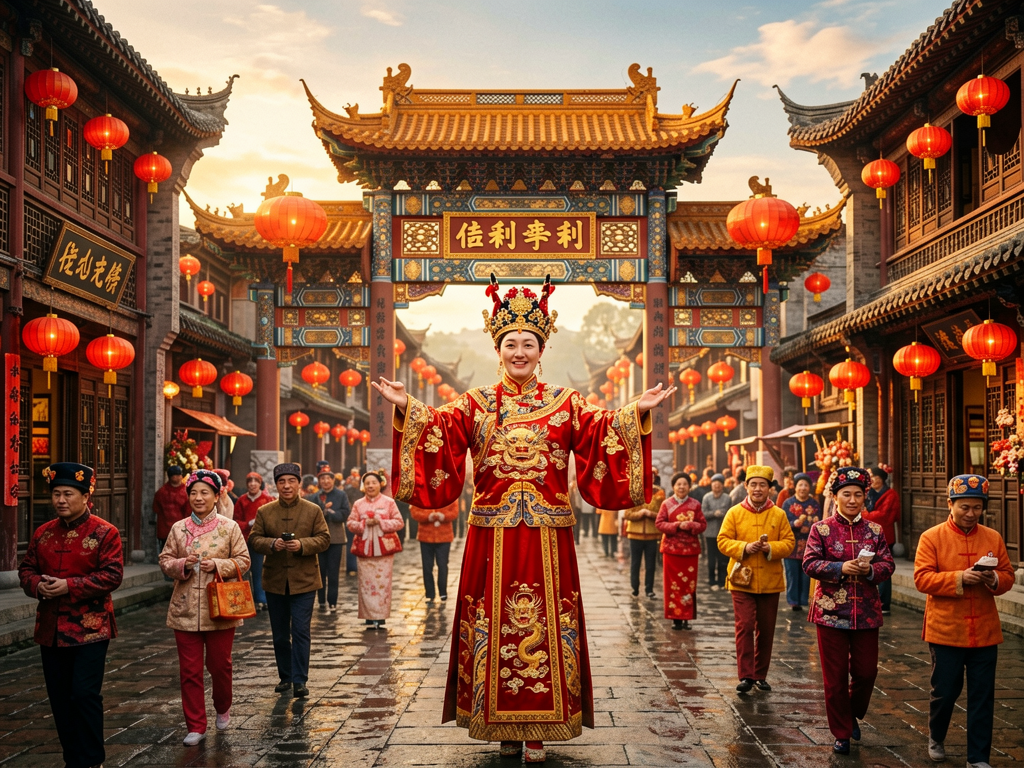
The Air Tastes Like Gunpowder and Pork
I remember standing on a balcony in Shenzhen in 2016, holding a bag of spicy duck necks, watching the sky turn purple. It wasn’t a storm. It was just the first hour of the Lunar New Year. The air was thick with sulfur, smoke, and the distinct, metallic smell of cheap firecrackers. My American friends were covering their ears, looking confused. I was just eating my snack, waiting for the main show.
That’s the first thing you need to understand. This holiday isn’t quiet. It’s not a time for introspection or hushed tones. It’s a sensory overload designed to wake you up.
We often think of celebrations in the West as polite. We have parades, maybe a few sparklers, and then we go home to watch football. In China, the New Year is a riot. It’s chaotic, noisy, and exhausting. And I love it.
The noise isn’t just for fun. It’s functional. According to legend, a monster named Nian was afraid of loud noises and the color red. So, we make as much noise as possible to keep bad luck away. It’s a cultural defense mechanism that has lasted for millennia.
Honestly, it’s better than most alternatives for breaking the winter slump. You can’t stay depressed when the sky is exploding around you.
It’s a Marathon, Not a Sprint
Most people think Chinese New Year lasts three days. That’s a common mistake. It actually stretches over two weeks, peaking on the actual day, but the energy doesn’t drop until the Lantern Festival.
I used to rush through it. I’d fly home for New Year’s Eve, stay for two days, and try to leave before the traffic jams hit. That was a huge error in judgment. You miss the best parts if you treat it like a long weekend.
The real magic happens in the limbo between the official holidays. The streets in smaller cities go quiet, but the homes get loud. You’re invited to dinner at your aunt’s house. Then your cousin’s. Then your boss’s.
I spent one year in a small town in Sichuan. I wasn’t invited to many dinners, so I just knocked on doors. People there were confused but delighted by my persistence. They’d offer me hot pot, dumplings, and fruit.
The food changes every day, too. It’s not just one meal. It’s a sequence. There’s the reunion dinner on New Year’s Eve, which is huge. Then there’s the morning visits, where you eat sweets and nuts. By the fifth day, you’re back to work, but the food trail continues.
It’s exhausting, sure. But it’s also incredibly warm. You can’t fake that kind of hospitality.
The Great Migration: Chaos with Purpose
You’ve heard of it. The Chunyun, or the Spring Festival travel rush. It’s the largest annual human migration on Earth. Hundreds of millions of people move from cities to hometowns.
I’ve tried to explain this to foreigners. They don’t get it. They think, “Why go back? Just stay in the city. It’s easier.”
But that’s the point. It’s not about ease. It’s about connection.
I remember buying a train ticket for my parents in 2019. It took me forty-five minutes to find one. The system crashed twice. My dad was sweating in the station, holding a crumpled piece of paper. When he finally boarded, he was sitting on the floor of the train car, surrounded by bags of gifts.
He was happy.
That’s what this holiday is about. It’s about bridging the gap between the modern, fast-paced life we lead in cities like Shanghai or Beijing and the traditional roots we left behind.
The trains are packed. The buses are full. The roads are gridlocked. But everyone is going home. There’s a shared purpose in that chaos. It’s beautiful in a way that’s hard to describe.
I’ll be honest, I was skeptical at first. I thought it was just inefficiency. But after a few years, I saw the point. It’s a yearly reset button. It reminds us where we came from.
Red Envelopes and Social Debt
Let’s talk about the money. The hongbao, or red envelopes. It’s a huge part of the holiday. You give them to kids, to employees, to younger relatives. You receive them from elders.
It’s not just about the cash. It’s a social contract. It’s about reciprocity and respect.
I’ve seen people get into awkward situations because they forgot the right amount to give. It’s not about being cheap. It’s about following the rules. If you give too little, you look disrespectful. If you give too much, you put pressure on the other person.
I once gave a red envelope to my neighbor’s kid. He looked at it, then at me, then back at it. He didn’t want to open it in front of me. That’s the etiquette. You never count the money in front of the giver.
It feels transactional to some, but it’s really about care. The money is a symbol. It’s a wish for good fortune.
I used to hate giving them. It felt like a tax. But then I realized it’s a way to show you remember the person. It’s a small gesture that means a lot.
To be fair, the amounts can be steep. I spent a few thousand yuan on red envelopes in one year. But when I saw my niece’s face light up, I didn’t care.
Why It Matters Now More Than Ever
China is changing fast. The cities are modernizing. The traditions are fading in some places. But Chinese New Year remains a constant.
It’s a anchor. It pulls us back to a shared identity.
In a world that feels increasingly fragmented, this holiday brings everyone together. It doesn’t matter if you’re rich or poor, young or old. On New Year’s Eve, we’re all doing the same thing. We’re eating, we’re celebrating, we’re hoping for a better year.
I’ve lived in eight different cities in China. Each one celebrates differently. Beijing has huge temple fairs. Shanghai has light shows. Shenzhen, where I am now, has fireworks that light up the whole bay.
But the core is the same. It’s about family. It’s about hope. It’s about starting fresh.
I’m no expert, but I’ve learned that you don’t understand China by reading the news. You understand it by sitting on a floor, eating dumplings, and listening to the noise outside.
That noise is life. It’s loud, it’s messy, and it’s important.
So, the next time you hear firecrackers, don’t cover your ears. Look up. Watch the sky. And maybe, just maybe, you’ll understand why we do this every year.
It’s not just a holiday. It’s a heartbeat. And it’s beating strong.