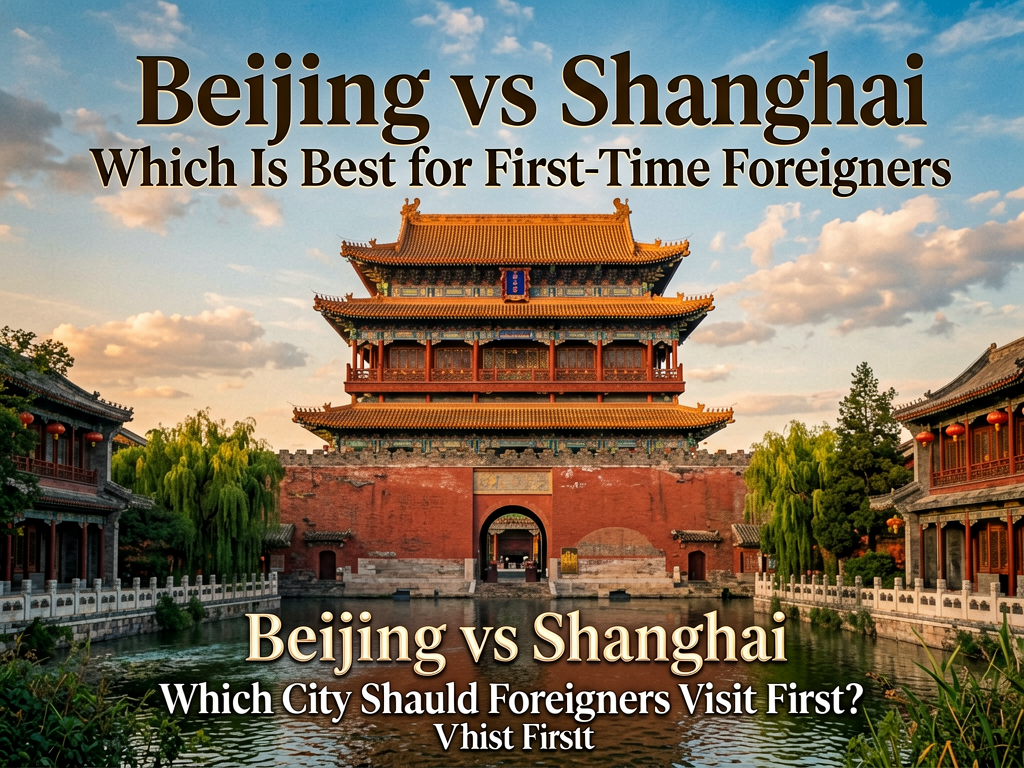
I still remember the first time I stepped off the plane in Beijing. It was winter, and the air hit me like a cold slap. I was shivering, my nose was red, and I had no idea where I was going. But then I saw the Temple of Heaven. Those giant, blue-tiled roofs against the gray sky just stopped me in my tracks.
I was hooked. Instantly.
Fast forward eight years, and I’m still here. I’ve lived in both Beijing and Shanghai for significant stretches of time. I’ve drunk soy milk with locals in hutong alleys and watched the sunrise over the Bund. I’ve argued about history in one city and fashion trends in the other.
So, when friends ask me which city they should visit first, I don’t give them a generic answer. It depends on what they’re looking for. But if I had to pick just one for a first-timer, I’ve got a strong opinion.
Let’s break it down.
The Historical Weight of Beijing
Beijing isn’t just a city; it’s a museum with a population of 21 million. It’s heavy, grand, and deeply serious. When you walk through the Forbidden City, you’re not just looking at old buildings. You’re standing where emperors ruled half the known world.
The scale of things here is intimidating in the best way. The Great Wall isn’t some small hike; it’s a massive fortification stretching across mountains. I remember hiking the Mutianyu section with a group of locals. We stopped halfway up, exhausted, and looked back at the city sprawl below. It felt epic.
But Beijing is also about the small stuff. The hutongs. These are the narrow alleyways that have existed for centuries. Life here is slower, more communal. You’ll see old men playing chess on folding tables and grandmas hanging laundry overhead.
I love the hutongs because they feel authentic. In other cities, these areas are often gentrified into tourist traps. Here, they’re still home. I spent a rainy afternoon in a small teahouse in Shichahai, just listening to the rain hit the tiles. No Wi-Fi, no distractions. Just me and the history around me.
The food in Beijing is another huge draw. You can’t leave without trying Peking duck. And I mean the real deal, not the pre-sliced stuff you get at some chain restaurants back home. I took a friend to Quanjude once. The skin was so crispy it shattered when you bit it. The meat was tender, wrapped in thin pancakes with scallions and sweet bean sauce. It was a religious experience.
Is it perfect? No. The traffic is a nightmare. The air quality can be rough in winter. And the crowds at major sites are overwhelming. But for a first trip, that historical weight is hard to beat.
The Modern Pulse of Shanghai
Then there’s Shanghai. It’s the opposite of Beijing in almost every way. It’s fast, stylish, and incredibly foreign-friendly. If Beijing is the brain of China, Shanghai is its heart and its wallet.
I moved to Shanghai for two years, and I loved the energy. Everything moves quicker here. People talk faster, walk faster, and eat faster. The city never really sleeps. I’ve seen taxis backed up at 3 AM on a Friday night.
The skyline is insane. Walking across the Nanpu Bridge at night, looking at the Pearl Tower and the Shanghai Tower, makes you feel like you’re in a sci-fi movie. It’s futuristic. It feels like the future of the world, not just the future of China.
But the real charm of Shanghai is in its contradictions. You can have a French pastry for breakfast, take a high-speed train to the countryside for lunch, and drink craft beer in a former French concession bar at night. The architecture reflects this too. The Bund is lined with colonial-era banks and hotels, right across the river from glass skyscrapers.
I remember walking down Wukang Road one weekend. The trees were in full bloom, casting dappled shadows on the sidewalk. There were cafes, boutiques, and art galleries everywhere. It felt like Paris, but with a distinct Chinese twist. I bought a book at a small independent bookstore and drank a pour-over coffee that cost more than my daily commute back home.
And the food? Shanghai cuisine is sweet, savory, and incredibly refined. Xiao long bao, the soup dumplings, are my weakness. I’ve eaten thousands of them. There’s a small stall near my old apartment in Jing’an that makes them perfectly. You bite a tiny hole, sip the hot broth, and then eat the dumpling with ginger and vinegar. It’s comfort food at its finest.
Shanghai is easier for foreigners to navigate. There’s more English signage, more expat communities, and a general vibe of openness. If you’re nervous about traveling to a new culture, Shanghai is a gentle introduction. It’s safe, clean, and surprisingly familiar.
The Cultural Clash
Here’s the thing that trips people up. Beijing and Shanghai have different personalities because their histories are different. Beijing was the political center. It’s about power, tradition, and authority. Shanghai was a treaty port. It’s about commerce, trade, and individualism.
This difference shows up in the locals, too. Beijing residents are known for being straightforward, loud, and humorous. They’ll tell you exactly what they think of your haircut or your opinion. It can feel blunt, but it’s usually just friendly banter. I’ve made lifelong friends through those blunt conversations.
Shanghainese, on the other hand, are often seen as more reserved, polite, and sometimes even arrogant. They pride themselves on being sophisticated. You might feel like an outsider for longer in Shanghai. But once you break through that ice, the connections are deep. They value efficiency and style in a way that’s unique to the city.
I had a friend who visited Beijing first. He loved the history but felt overwhelmed by the intensity. He said people stared at him a lot. Then he went to Shanghai. He felt more invisible, which he preferred. He liked that he could blend in more easily.
But another friend, a history buff, went to Shanghai first. He found it too commercial. He missed the ancient roots. He said Shanghai felt like a theme park of history, whereas Beijing felt like the real thing.
So, which is right for you? It really depends on your travel style.
The Logistics of Choice
Let’s talk practical stuff. Both cities have world-class airports and metro systems. You won’t have trouble getting around. In Beijing, the metro is clean and efficient, but it gets packed during rush hour. In Shanghai, the metro is even more extensive, and the stations are often more modern and easier to navigate.
Payment is another key factor. In both cities, you need to use WeChat Pay or Alipay. Cash is rarely used. I helped a friend set up his payment apps when he first arrived in Beijing. It took an hour of paperwork. In Shanghai, it was slightly smoother, but still a hassle for new arrivals. Don’t expect to swipe your credit card at every corner store.
Accommodation prices are similar, but the neighborhoods differ. In Beijing, staying near the Forbidden City or in the hutongs is pricey and limited. In Shanghai, you have more options in the French Concession or near the Bund. Both are expensive, but Shanghai offers more variety in terms of boutique hotels and serviced apartments.
And let’s not forget the weather. Beijing has four distinct seasons. Summers are hot, winters are freezing. If you’re visiting in winter, you’ll need a serious coat. Shanghai has a more temperate climate. Winters are cold and damp, but not brutally so. Summers are humid and sticky, like a sauna. I hate the humidity in Shanghai. It’s relentless.
If you’re a foodie, both cities are paradises. But they offer different experiences. Beijing is about hearty, salty, wheat-based dishes. Noodles, dumplings, pancakes. Shanghai is about rice, sweet sauces, and delicate flavors. If you prefer bold tastes, go to Beijing. If you prefer subtle, complex flavors, go to Shanghai.
My Honest Verdict
I’m no expert, but I’ve spent enough time in both places to have a strong preference. If this is your first time in China, I’m going to say Beijing.
Why? Because the historical significance is unmatched. You can see more iconic landmarks in Beijing than anywhere else in the country. The Great Wall, the Forbidden City, the Temple of Heaven, the Summer Palace. It’s a lot to take in, but it’s the China most people dream of seeing.
Shanghai is amazing, don’t get me wrong. It’s cleaner, quieter, and more modern. But it feels like a global city first and a Chinese city second. Beijing feels undeniably, unmistakably Chinese.
I want foreigners to understand the depth of this culture. Beijing gives you that. It challenges you. It demands your attention. You have to deal with the crowds, the cold, and the language barrier. But in return, you get a sense of scale and grandeur that you won’t find anywhere else.
That said, if you’re not into history, or if you’re afraid of crowds, maybe start with Shanghai. It’s a safer bet for a nervous traveler. But don’t stay there too long. You’ll miss out on the soul of the country.
I’ve seen people go to Shanghai, have a great time, and never feel the need to go to Beijing. I’ve also seen people go to Beijing, fall in love with the grit and the glory, and then find Shanghai too shallow. It’s a tough call.
Just remember, you can always go back. China is huge. There’s plenty of time to explore the south later. But the first impression matters. And for me, the first impression of China is Beijing.
So, pack your bags. Book your tickets. And get ready for an adventure that will change the way you see the world. Whether you choose Beijing or Shanghai, you’re in for a treat. Just make sure you’re ready for the ride.
Trust me, it’s worth it.