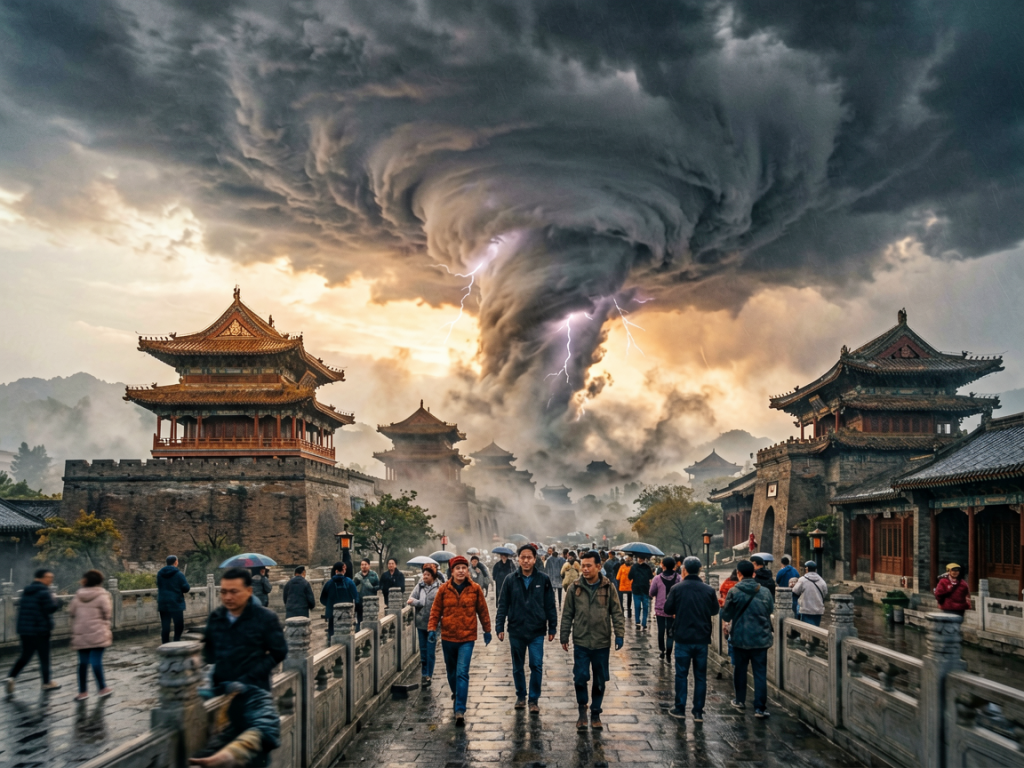
The Summer Showers That Turn Into Full-Blown Typhoons
I still remember the first time a typhoon hit me like a freight train. It was July 2024, and I was holed up in a second-floor apartment in Quanzhou. The wind didn’t just howl. It screamed through the alleyways, rattling the steel shutters until I thought the whole building would slide right off its foundation.
Most visitors think Chinese weather is just hot and humid. They’re not wrong. But coastal provinces like Fujian, Guangdong, and Zhejiang get some of the most intense tropical storms on the planet. By 2026, the forecast apps are sharper, but the raw power hasn’t changed one bit. You still need to respect it.
Here’s the thing about typhoons in China. They don’t give you much warning. One minute the sky is a blinding blue, and two hours later it looks like a bruised plum. Local authorities usually lock down subway lines and close schools, but they rarely tell foreigners exactly what to do. You’re on your own until the rain stops.
I learned that lesson the hard way when I tried to trek across a flooded crosswalk in Xiamen. The water was chest-deep and moving fast enough to knock over a scooter. I stood there, soaked to the bone, watching locals wade past me with umbrellas tucked under their arms like normal. They’ve got decades of practice handling this stuff.
So what do you actually pack? I stopped buying fancy outdoor gear after my third trip. A cheap, reinforced umbrella from a neighborhood store works fine. I keep a small waterproof backpack slung over my shoulder whenever the humidity hits ninety percent. You’ll thank yourself later.
Food delivery apps make life so much easier when the skies open up. I order a hot pot base from a stall three blocks away, and a kid on a yellow scooter drops it off at my lobby gate within twenty minutes. The rain hammers the tin awning while I wait, and honestly, it feels pretty cozy. Just keep your phone charged. You’ll need it.
You’ll also notice something funny about Chinese architecture during these storms. Most newer buildings have those deep overhangs and ground-floor shops built with concrete steps that slope upward. It’s not fancy engineering. It’s just generations of people figuring out how to keep water out. I love that practicality.
If you’re staying put, don’t bother boarding up windows unless your landlord asks you to. People here just push desks against glass doors and watch the storm roll through. I spent one evening in Shenzhen mapping the raindrops racing down my balcony railing. It wasn’t romantic at first. By hour four, I was genuinely fascinated.
The key is patience. Typhoons pass quickly if you let them. Trying to fight the weather or rush through a closed district only gets you stranded. I used to get so frustrated back in my early days. Now I just brew some tea and wait it out. The city always opens again.
Foreign travelers often underestimate how fast things change during these storms. Train schedules flip overnight. Ferry terminals shut down without notice. I keep a folder of offline PDFs with station addresses and hotel contact info. It beats panic when your original route vanishes.
You’ll also want a decent pair of slip-on shoes with grip. Wet tile floors turn into ice rinks once the humidity drops. I bought a pair from a discount chain in Dongguan for thirty-five yuan. They survived three monsoon seasons and still hold up better than my expensive hiking boots.
Weather emergencies here aren’t about surviving. They’re about adapting. I’ve seen neighbors share generators, trade dry clothes, and cook noodles on camping stoves in stairwells. It’s messy, loud, and surprisingly warm. I wouldn’t trade that experience for a five-star hotel anywhere.
When the Sky Turns the Color of Ash
Smog days don’t hit everyone the same way, but they hit hard enough that you can’t ignore them. I walked into a park in Chengdu last winter and couldn’t see the mountain range behind the city. Not even a ghost of it. Just a flat, yellow-gray blanket hanging over everything.
Foreign travelers often panic when the AQI numbers jump past three hundred. They assume the air will instantly choke them. It doesn’t work like that, though. Your body adapts faster than you expect, especially if you stick to the basics. I still carry a box of KN95 masks in my bag. It’s become as routine as my toothbrush.
You’ll find these masks everywhere now. Convenience stores, pharmacy chains, even street vendors selling skewers will toss one in your bag if you ask politely. They cost about five yuan each. Cheaper than a bottle of water, and they save your lungs on bad days.
I remember one December morning when the smog rolled in so thick I couldn’t read the street signs. I stepped outside anyway, wrapped in a thick wool coat, and just walked. Locals were doing tai chi in the plaza, completely unfazed. Some had scarves tied over their faces. Others coughed quietly into their sleeves. Nobody acted like it was an apocalypse.
That’s the cultural piece tourists miss. Weather emergencies here aren’t treated as dramatic events. They’re just background noise. People plan around them. They open windows when the air clears. They stay indoors when it doesn’t. There’s no melodrama involved.
Apps are your best friend for tracking the shifts. I use a couple of different ones just to cross-check, but most of us rely on whatever comes pre-installed on our phones. You’ll get push alerts before the pollution spikes. I usually adjust my plans accordingly. I skip long bike rides and stick to museum visits or indoor teahouses.
Speaking of teahouses, I found this tiny spot near Wuhou Shrine that serves jasmine green with lotus seed paste. It costs twenty-five yuan for a full set. I sat there for three hours while the gray sky pressed against the paper windows. It felt like stepping into a painting. Really peaceful.
Don’t trust the old Western advice about wearing surgical masks for smog. They won’t seal properly. Get something with actual filtration ratings, or buy a reusable face shield with replaceable filters. I picked mine up at a sports shop in Guangzhou for about eighty yuan. It looks weird, but it breathes way better than the cheap disposable ones.
And please, stop asking shop owners if they sell air purifiers on bad days. Almost every household already has one running in the corner. I saw a grandpa in Beijing hooked up to a humidifier and a small HEPA unit while he played chess on the sidewalk. Modern life adapts quickly.
You’ll notice something interesting about Chinese coffee culture during smog season. Independent cafes start pushing hot herbal blends and roasted barley tea. I tried a cold-pressed chrysanthemum drink in Hangzhou that tasted like honey and rain. It cost eighteen yuan. I bought three more on the way home.
Smog days ruin outdoor plans, but they force you inside. I spent an entire Saturday reading old travel journals while listening to a jazz radio station in a basement bookstore. The owner left a thermos of ginger soup on my table. Small kindnesses stack up when the air gets heavy.
By spring, the haze usually burns off with the winds. You’ll start seeing the sky crack open again. I love that moment. The first clear day always makes everything look sharper, brighter, almost too vivid. It’s like the city wakes up and stretches its shoulders.
Keeping the Lights On When the Grid Flips
Power outages sound terrifying when you’re used to flipping a switch and expecting instant light. In China, they happen more often than you’d think. Usually because of summer AC overload or winter heating demands. Sometimes it’s just maintenance work that runs long.
I learned about the real risk during a heatwave in Nanjing last year. The breaker tripped at my guesthouse around two in the afternoon. No warning. No flickering lights. Just darkness and the sudden roar of cicadas kicking in. My AC died. The fans spun lazily in the dead air.
Most people here don’t panic. They grab a cold towel, sit on a plastic stool in the shade, and scroll through their phones until the grid stabilizes. I watched an elderly neighbor outside pour water over his head just to cool down. He smiled when he saw me sweating through my shirt. Offered me a bottle of barley tea from his fridge.
You need a plan before the lights go out. I keep a small LED lantern charged in my drawer. It sounds silly, but it saves you from stumbling around in the dark. I also carry a portable power bank that actually holds a charge. Twenty thousand milliamps gets you through a solid twelve-hour blackout.
Hotels and hostels usually have backup generators, but they only run common areas and elevators. Your room might still cook like an oven if the AC cuts. I’ve started packing a lightweight cotton sheet to drape over my bed. It traps less heat than polyester, and it absorbs sweat better.
Water pressure often drops at the same time electricity does. I stock up on bottled water whenever I hear storm warnings or grid maintenance notices. Six-pack of mineral water costs about fifteen yuan. Worth every penny when you realize you can’t flush a toilet or boil noodles.
There’s a strange community vibe that kicks in during blackouts. Strangers gather in courtyards or stairwells with flashlights on their phones. Kids play tag in the dim light. Someone usually brings out a portable speaker and plays old pop songs from the nineties. I joined in once in Hangzhou. We sat on crates and drank cold beer while the city hummed around us.
It’s easy to feel helpless when you’re waiting for power to return. Don’t. Use the downtime. Read a book you’ve been meaning to finish. Write in a journal. Learn to fold clothes neatly. I actually got really good at organizing my suitcase during a three-day outage in Xi’an.
When the electricity finally clicks back on, the whole building erupts in noise. Fans spin up. TVs turn on. Someone laughs loudly down the hall. It feels like waking up from a nap in a crowded room. You’ll never look at a light switch the same way again.
I’ve noticed that foreign travelers handle these moments differently than locals. We try to control everything. Locals roll with the punches. I’m no expert, but switching to that mindset saved me more stress than any gadget ever could. You stop fighting the flow.
Backup charging stations appear everywhere during major outages. Street vendors bring solar panels. Pharmacies hand out free power strips. I grabbed a quick juice and recharged my camera at a convenience store in Wuhan while the clerk showed me how to fold a paper fan. Simple, effective, human.
Building a Real Toolkit for the Unexpected
Handling weather emergencies in China isn’t about buying expensive survival gear. It’s about shifting your mindset. You stop fighting the environment and start working with it. That change happens fast once you actually experience the rhythm of local life.
I keep a simple go-bag in my closet now. Just a waterproof pouch with cash, a multi-port charger, a small first-aid kit, and a printed map of my neighborhood. Digital maps fail when cell towers drop. Paper doesn’t care about the weather. I’ve used it twice. Both times I felt like a damn explorer.
Cash still matters more than tourists realize. Many smaller vendors and street stalls stop accepting digital payments during system updates or network congestion. I withdraw about two thousand yuan every month just to stay liquid. It sits in a locked drawer at home. Never hurts to have backup.
Relationships beat gadgets every time. I’ve made friends with the security guard at my building, the auntie who runs the noodle shop downstairs, and the guy who fixes bicycles on the corner. They know when the weather is turning. They warn me before I step outside. That kind of local intel is priceless.
Learn basic Chinese weather phrases. “Qiang” for strong, “yu” for rain, “feng” for wind. I mix them up sometimes, but people laugh and correct me gently. It builds rapport. Plus, you’ll actually understand the radio announcements instead of staring blankly at a translated app screen.
Travel insurance helps, but it moves slowly during mass disruptions. I learned that the hard way when I missed a flight after a typhoon grounded all regional airports. The paperwork took weeks. I stopped relying on it for daily inconveniences. Instead, I budget extra days into every trip. Flexibility saves you money and stress.
By 2026, the infrastructure is smarter than ever. Solar panels cover more rooftops. Battery storage improves city grids. But nature still wins the tug-of-war sometimes. Accepting that gives you freedom. You stop scheduling every hour and start leaving room for the unexpected.
I’ve traveled to forty-two countries since moving here. None of them prepared me for how deeply weather shapes daily life in China. It’s not an obstacle. It’s part of the culture. You breathe with it. You adapt to