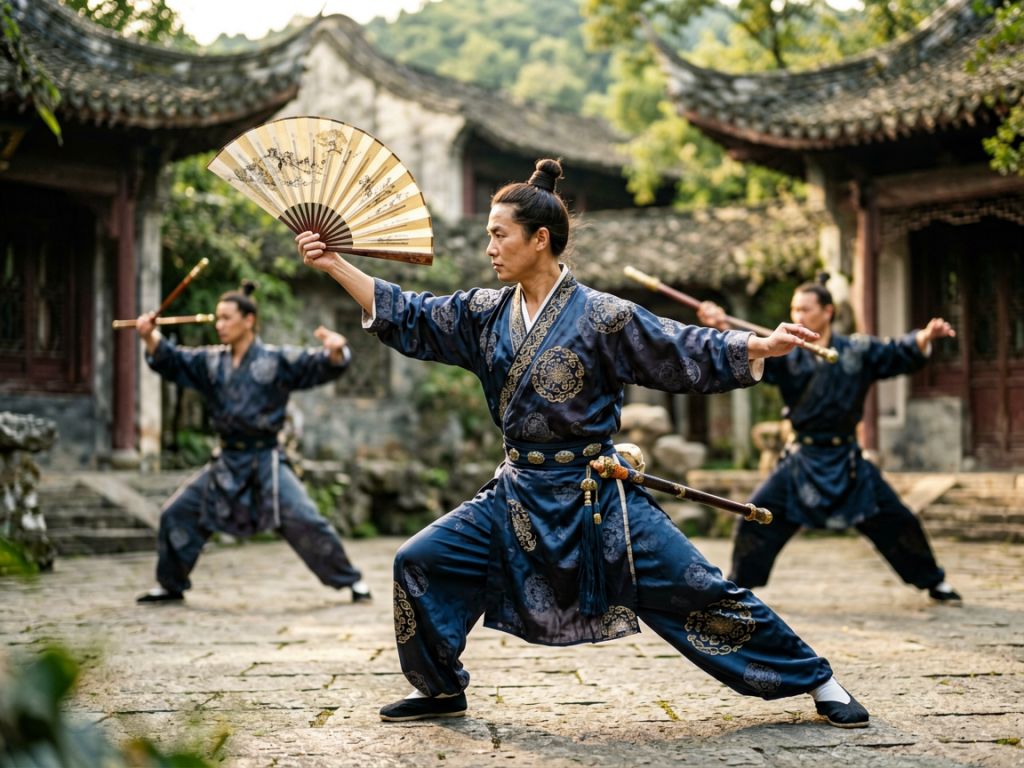
I still remember the first time I heard a three-section staff crack the morning air. It was just after six in a damp Henan park, fog clinging to the plane trees. Old Master Li stood barefoot on the dewy grass, swinging the wooden poles like they were extensions of his own arms. The rhythm wasn’t pretty at first. It sounded like a broken chair being dragged across concrete. But then, suddenly, it clicked. The middle section spun, the ends snapped into place, and the whole thing hummed.
That moment changed how I saw Chinese martial arts forever. We’ve all seen the wire-fu spectacles on screen, but real kung fu weapons aren’t about looking cool. They’re about understanding your own body. They force you to move differently. They teach patience when every instinct screams to rush.
The Sound of Wood Meeting Air
Training with a three-section staff isn’t like learning a sword or a spear. You don’t just grip one end and thrust forward. You have to manage three separate pieces connected by steel chains. Your wrists take the brunt of it. Your forearms burn. Your ego gets bruised when you whack yourself in the shoulder for the third time in ten minutes.
I tried it under Master Li’s watchful eye for almost two weeks before I stopped drawing blood. He didn’t yell. He just adjusted my grip and said, “Stop fighting the chain. Let it breathe.” That line stuck with me. The weapon doesn’t dominate you. You negotiate with it.
People assume these tools are obsolete because firearms exist. That’s true on a battlefield. But martial arts were never just about battlefield tactics. They’re about control, timing, and spatial awareness. The three-section staff forces you to read distance in real time. You can’t afford to be sloppy. One misjudged flick and you’re nursing a bruised rib for a month.
Master Li charged me thirty yuan an hour for private lessons. Most students quit within a week. They wanted quick wins. They wanted to spin the poles like action heroes. I stayed because I noticed how my posture shifted. My shoulders dropped. My breathing deepened. The weapon demanded presence. I couldn’t scroll through my phone while swinging it. It physically couldn’t wait.
Why We Still Train With Archaic Tools
Modern fitness studios focus on hypertrophy and steady-state cardio. CrossFit boxes chase speed and metabolic conditioning. I’m not knocking those systems. They work for their specific goals. But traditional weapons training does something completely different. It rewires how you think about movement.
I spent a rainy Tuesday afternoon in Shanghai watching a young woman practice the iron fan. She wasn’t wearing spandex. She wore loose cotton trousers and a faded t-shirt. Her movements were slow, almost meditative. She opened and closed the brass-bound fan between blocks of granite, tracing angles that would slice through soft tissue if she ever had to.
Sound interesting? It should be. The iron fan looks delicate. It folds neatly into a palm-sized disc. Most tourists think it belongs in a museum or on a stage performer’s back. But in skilled hands, it’s a devastating tool. The ribs cut. The hinge punches. The flat plates block strikes without absorbing shock.
We train with these weapons today because they bridge the gap between combat and philosophy. You can’t brute-force a three-section staff. You can’t muscle an iron fan into submission. They demand coordination, breath control, and mental clarity. If your mind wanders, the chain tangles. If your breathing hitches, the fan sticks. It’s a physical meditation.
I’ve watched corporate executives trade boardroom stress for chain-whip routines. They come in stiff-necked and anxious. They leave loosened up and grounded. The weapons don’t care about your job title. They only care if your weight is centered. That simplicity is exactly why they survive.
The Iron Fan’s Quiet Philosophy
Master Lin introduced me to the iron fan during a tea ceremony in Hangzhou. He pulled it from his sleeve like a magician pulling a rabbit, but with zero theatrics. Just a smooth gesture. He placed it on the low table beside my matcha bowl and told me to watch how he held it.
“Most people grip it like a knife,” he said through a translator. “That’s why they fail.”
He showed me the proper hold. Fingers relaxed. Wrist loose. Weight distributed evenly. It felt ridiculous at first. Like holding a butterfly instead of a tool. But once I stopped clenching, everything changed. The fan responded to micro-adjustments. I could redirect strikes using momentum instead of muscle.
That’s the secret nobody talks about. Traditional Chinese weapons aren’t designed for maximum damage. They’re designed for maximum efficiency. The iron fan teaches you to conserve energy. It forces you to use leverage instead of force. It’s easier than you’d expect once your brain stops overthinking.
I’ve tried other folding blades. Some are sharper. Some are heavier. None of them taught me to relax. That’s the real value here. Modern self-defense classes throw you into panic drills. They want you to react fast. But reacting fast without control just means you’ll miss. The iron fan slows you down so you can actually see what’s happening.
There’s a specific price range for quality iron fans in Guangzhou markets. You’ll pay anywhere from eighty to three hundred yuan depending on the brass thickness and hinge craftsmanship. Cheap ones snap. Good ones last decades. I bought mine from an old craftsman in Liwan District. He stamped his seal on the handle. I keep it on my desk next to my laptop. It’s a quiet reminder to breathe before I react.
What Beginners Get Wrong
When I first started, I thought I’d pick up the three-section staff quickly. I’d watched enough videos to look decent online. Reality humbled me in twenty minutes. The chain kept whipping backward. My shoulders ached. I couldn’t even complete a single clean rotation without tripping over my own feet.
Most newcomers make the same mistake. They treat the weapon like an extension of their arm. It’s not. It’s a separate entity with its own momentum. You have to anticipate where it wants to go before it gets there. That takes months of repetitive, frustrating practice.
I could be wrong, but I think modern culture hates waiting. We want instant results. Same-day delivery. Instant messaging. Martial arts weapons training runs counter to that entire mindset. You can’t rush it. You just show up, swing the chain, and wait for your nervous system to adapt.
The payoff is worth it though. There’s a specific feeling when the three-section staff finally clicks. It’s not loud. It’s quiet. The chains go slack for a split second, then tighten perfectly on command. Your arms stop working. The weapon starts moving itself. That’s the moment you realize you’ve been doing it wrong this whole time.
I attended a regional wushu tournament in Nanjing last spring. A twelve-year-old kid nailed a three-section staff routine so clean it silenced the crowd. He didn’t shout. He didn’t pose. He just flowed. His instructor stood in the front row, nodding slowly. That kid had been drilling basic spins since he was seven. Patience compounds. Anyone can learn flashy tricks. Few can master fundamentals.
Keeping the Fire Alive
I’ve walked through dozens of martial arts schools across China over the last eight years. Some are tourist traps. Others preserve ancient lineages with serious dedication. The ones that survive do so because they understand that tradition isn’t about fossilizing the past. It’s about keeping skills relevant.
Modern practitioners don’t carry iron fans to market disputes. We don’t practice three-section staff routines to defend against armed attackers. We do it because it makes us better humans. It improves balance. It sharpens reflexes. It teaches respect for objects that look harmless until they’re in motion.
To be fair, not everyone buys into this. I’ve heard gym-goers roll their eyes at traditional weapon drills. They want weighted squats and sprint intervals. And honestly? Those have their place. But nothing replaces the mental discipline required to untangle a chain mid-swing. Nothing replaces the focus needed to make a folding fan respond to a feather-light wrist flick.
I’m no expert. I’ve never faced a real threat with either weapon. But I’ve spent enough time around masters who live with them daily to know what works. These tools strip away ego. They force humility. They remind you that mastery isn’t about domination. It’s about harmony.
If you ever find yourself in a Chinese park at dawn, watch closely. You’ll spot the old men swinging wooden staves. You’ll notice the quiet instructors practicing with folded brass. Don’t dismiss them as relics. They’re keeping a conversation alive. One that stretches back centuries. One that still has something to teach us today.
Trust me, you’ll want to try it. Just bring a good pair of gloves. And leave your expectations at the gate. The weapons don’t care how many videos you’ve watched. They only care if you’re willing to listen. I still struggle with the chain every now and then. Sometimes it wraps around my leg. Sometimes it knocks over a water bottle. I laugh. I reset. I swing again. That’s the whole point.