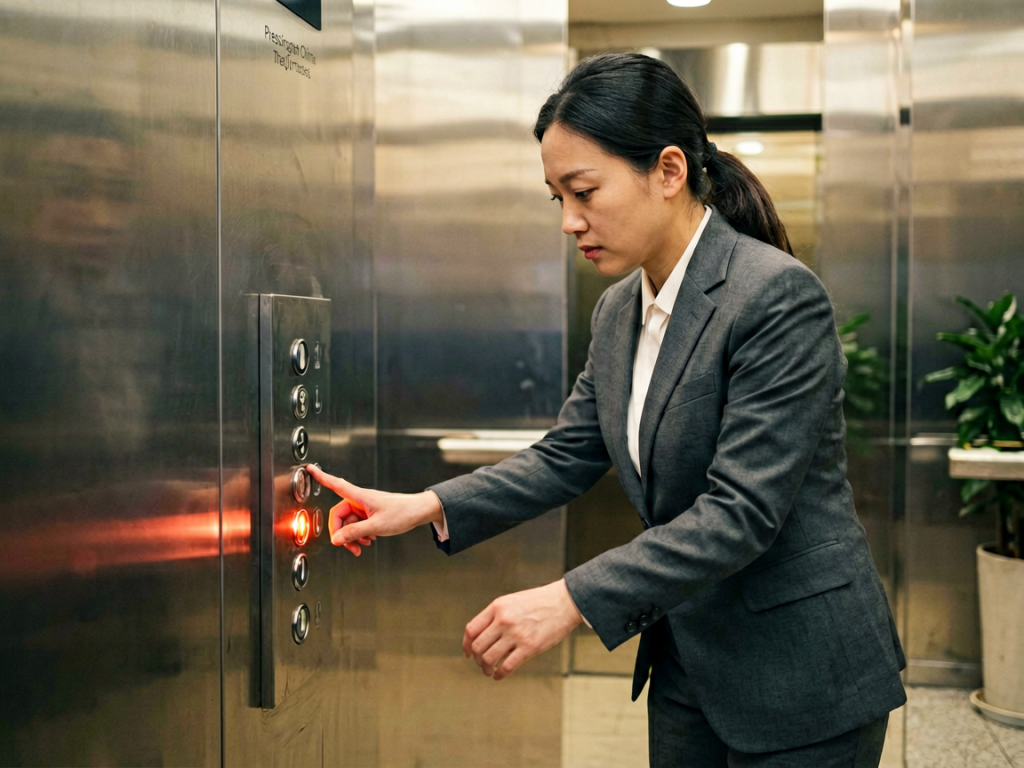
I still remember the first time I froze in front of a bank of elevators in Beijing. It was a Tuesday morning, rush hour, and I was clutching a Starbucks cup that I definitely shouldn’t have been holding while carrying a heavy laptop bag. There were four doors, all closed, waiting to be summoned. I looked left. I looked right. Nobody else was moving.
My instinct was to just walk up and press the ‘Down’ button for the lobby floor. But something stopped me. A subtle energy hung in the air, thick and heavy. I watched a young man in a sharp suit step forward, tap his phone screen once, and then gently press the button with two fingers. He didn’t look at me. He didn’t apologize. He just claimed the space.
That moment stuck with me. In the West, an elevator is just a metal box. Here, it’s a stage. And the buttons? They’re not just controls. They’re territory markers. If you’ve ever worked in a Chinese office building, you know exactly what I’m talking about. It’s a quiet power play that happens every single day, often without anyone saying a word.
The Hierarchy of the Hold Button
Let’s start with the basics: who gets to hold the door? It sounds simple, right? You see someone running, you hold the door. But in a high-rise in Shanghai or Shenzhen, the rules are far more complex. It’s not just about politeness; it’s about status and awareness.
I learned this the hard way during my second month in China. I saw a senior executive, someone who clearly outranked me, rushing toward the elevator. I instinctively hit the ‘Close Door’ button, thinking I was being efficient. The doors slammed shut right in his face. The silence that followed was deafening. My colleague beside me looked at me with pity. “You can’t hold the door for him,” she whispered. “He needs to arrive first. If you hold the door, you make him wait. That’s disrespectful.”
It took me weeks to wrap my head around that logic. In Western corporate culture, efficiency is king. Speed matters. But here, social harmony and hierarchy often trump raw efficiency. Holding the door for a superior implies they are slow or need assistance. Instead, the proper move is to wait. Let them approach. If they are truly late, they will press the button themselves aggressively. If they are not, you wait. It’s a subtle dance of respect.
And what about the juniors? If you’re an entry-level employee, your job is to be the usher. You stand by the panel. You watch for your boss. You press the floor number before he even steps inside. You never, under any circumstances, let your manager press their own button. That would be a breach of protocol. It suggests you aren’t attentive enough or that you don’t recognize their importance.
The Art of the Finger Tap
Have you ever noticed how people press buttons in China? It’s different. It’s precise. There’s a specific technique to it that I call the “Two-Finger Tap.”
I’m no doctor, but I’ve observed that pressing with a single finger feels too aggressive, almost like you’re accusing the machine. Slapping it with an open palm feels careless. The sweet spot is using the index and middle fingers together. Lightly. Briefly. It conveys confidence without dominance.
This isn’t just aesthetic. It’s about personal space and hygiene, which became huge topics post-pandemic. Touching public surfaces is now a calculated risk. You want to minimize contact time. So, the tap is quick, clean, and detached. It signals that you are busy, you are prepared, and you don’t need to fumble around.
I tried to mimic this at first, but it felt awkward. I ended up looking like I was conducting an invisible orchestra. But once you get it down, it changes your entire presence. You move through the lobby with purpose. You aren’t just waiting for an elevator; you are managing the flow of traffic. And trust me, people notice. There’s a certain gravitas to someone who knows exactly when and how to interact with the interface.
The Silent Negotiation of Floor Selection
Now, let’s talk about the actual destination. Which floor gets pressed? This is where the true power dynamics come into play. Imagine you’re in an elevator with three colleagues: yourself, a mid-level manager, and a junior associate. Who decides which floors to select?
Traditionally, the lowest-ranking person does the work. The junior goes to the panel and asks, “Who is going where?” This seems inefficient, doesn’t it? Why ask when everyone just knows? But it’s about deference. By asking, the junior acknowledges that the others’ time is more valuable. It gives them the space to relax while the junior handles the logistics.
I used to think this was silly bureaucracy. Now, I see it as a form of social lubrication. It prevents awkward silences. It creates a shared task. When the junior presses the button, everyone shares a moment of collective action. It’s a tiny ritual that reinforces the group structure.
But there’s a catch. If you’re the senior person, you have to play along. You can’t just sit there and ignore it. You need to nod. You need to say, “Ah, yes, floor 12. Thank you.” If you stay silent, you look arrogant. If you try to press it yourself, you look micromanaging. You have to accept the service gracefully. It’s a performance for everyone involved.
I’ve seen bosses mess this up. One time, a visiting American VP walked in, ignored the junior who was reaching for the panel, and pressed the button himself. The junior froze. The rest of the room shifted uncomfortably. The VP thought he was being helpful. But in that context, he was undermining the local hierarchy. He made the junior look useless and himself look insensitive. It was a classic case of cultural mismatch, played out in a ten-second elevator ride.
The Group Chat Before the Ride
We live in the age of digital convenience, and nowhere is this more evident than in Chinese office buildings. Before you even step into the elevator, the decision has often already been made via WeChat.
I’ve been part of chats where five people are heading to the same building. Someone will message, “We’re taking the west bank elevators. Floor 15 and 16.” This is pre-negotiation. It saves time. It reduces anxiety. Everyone knows the plan before they arrive at the physical location.
This digital coordination changes the physical interaction too. Because the plan is set, there’s less hesitation at the panel. You don’t have to ask, “Where are we going?” You just press the button. The confidence comes from prior agreement. It’s smoother, faster, and less prone to error.
But it also means you can’t be spontaneous. If your plans change, you have to update the chat immediately. If you show up at the wrong elevator because you didn’t text back, you’re the problem. You’re the one causing the delay. In this environment, communication is currency. And if you don’t spend it wisely, you lose value.
Reading the Room: When to Stay Quiet
Sometimes, the best move is no move at all. I’ve been in elevators with senior leaders who prefer solitude. They don’t want to chat. They don’t want small talk. They just want to get to their floor in peace.
In these cases, pressing the button becomes a delicate operation. You watch them closely. If they seem stressed, you handle everything silently. You press the button. You hold the door. You step in last. You don’t make eye contact unless necessary. You become a shadow.
This requires high emotional intelligence. You have to read facial expressions, posture, even the tone of their breathing. Are they tired? Are they angry? Are they focused? Your actions should reflect their state. If you’re too chatty, you’re annoying. If you’re too silent, you’re cold. It’s a fine line.
I remember one time, I was riding with a director who had just lost a major client. She was quiet, staring at the floor numbers changing. I wanted to offer comfort, but I knew better. I just pressed the button for her floor. I stepped out before her. I gave her the space to decompress. It was a small gesture, but it meant everything. She nodded at me later. No words needed.
The Modern Shift: Technology vs. Tradition
Things are changing, though. Newer buildings are installing smart elevators. You scan a QR code, input your floor, and the system assigns you a car. No buttons to press. No hierarchy to navigate physically. Just pure digital efficiency.
At first, I loved it. It was easier. I didn’t have to worry about offending anyone by pressing the wrong button or holding the door incorrectly. But then I realized I missed the human element. These interactions, as complicated as they are, are a way of connecting. They force us to pay attention to each other.
In a world that’s becoming increasingly automated, these tiny rituals matter. They remind us that we’re working with people, not just algorithms. Yes, the rules are confusing. Yes, it’s easy to mess up. But mastering them shows you understand the culture. It shows respect. And in China, respect is everything.
I still get nervous sometimes. I’m in a new building, with unfamiliar colleagues, and I freeze before the panel. But then I remember: it’s not about perfection. It’s about intention. Are you trying to be helpful? Are you aware of the social context? If you are, you’ll usually get it right.
Next time you’re in a Chinese office building, watch the elevator bank. Don’t just look at the numbers. Look at the people. Watch who moves first. Watch who hesitates. Watch who presses the button. You might just learn more about the workplace culture there than you ever would from a manual.
It’s a small thing, really. Just a plastic button. But it carries so much weight. And honestly? That’s what makes life in China so fascinating. Everything has a deeper meaning if you look close enough. Even the elevator.