I remember standing in a dusty gym in Shanghai back in 2016. The air smelled like old rubber mats and stale sweat. Across from me, a guy in white shorts threw a kick so fast I barely saw his leg move. He didn’t hit me, obviously. My coach was watching closely. But the speed? It was terrifying.
A week later, I watched a performance at a local cultural center. Dancers moved like water. They spun through the air, landing on one foot with impossible grace. There were no punches thrown. Just pure, calculated beauty.
Both were called Wushu. Both were Chinese martial arts. But they were as different as ballet and brawling.
If you’re new to Chinese culture, this confusion is normal. You see “Wushu” on a T-shirt, on TV, and in your kung fu movie, and you assume it’s one big happy family. It isn’t. It’s two completely different sports sharing a last name.
Let’s clear this up once and for all.
Wushu Taolu Is Art, Not Fighting
I’ll be honest, I was skeptical at first. When I heard people talk about Taolu, I imagined actual combat. I thought, “Well, obviously you practice forms to fight.”
Turns out, that’s not quite right.
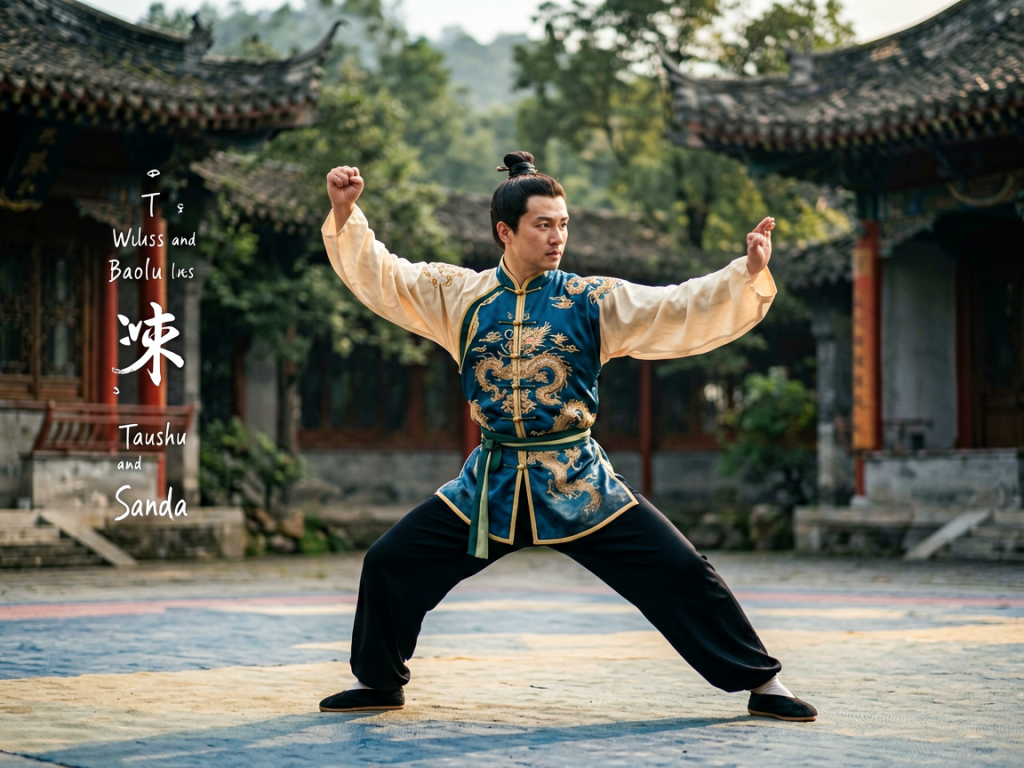
Taolu translates to “forms” or “routes.” It’s choreographed. Think of it as martial arts gymnastics with a blade or a staff in hand. You perform a set sequence of movements that have been refined over decades, sometimes centuries.
The goal isn’t to hurt someone. The goal is to look like you could hurt someone, while simultaneously doing a backflip and sticking the landing.
I spent an afternoon with a Taolu coach named Master Li in Hangzhou. He wore a crisp blue uniform that looked like it had never seen a moment of stress. He showed me a simple sword form. It involved three steps, a spin, and a thrust.
“Easy,” I thought.
Then he made me do it fifty times. Without breathing hard. Without losing focus. Without looking like I was trying.
The judges in Taolu competitions score on difficulty, execution, and overall impression. Did you jump high enough? Did your stick the landing? Was your hair perfectly neat after the spin? That’s it.
There’s no opponent. There’s no fear. There’s just you, the form, and the clock.
It’s beautiful, sure. I loved watching the World Wushu Championships on TV. The athleticism is insane. But if a real fighter walked into the ring during a Taolu match, the performer would be in trouble. Fast.
Don’t get me wrong. Taolu builds incredible core strength, flexibility, and balance. It teaches discipline. But it’s essentially a performance sport now. It’s about aesthetics and precision.
Is it effective for self-defense? Probably not on its own. But is it amazing to watch? Absolutely.
Sanda Is Where It Gets Bloody
Now, let’s talk about Sanda. Also known as Sanshou or Chinese Kickboxing.
This is the side of Wushu that doesn’t care how pretty you are. This side cares if you can knock someone out.
Sanda combines striking and throwing. You can punch, kick, knee, elbow, or throw your opponent to the mat. It’s fast, aggressive, and incredibly dynamic.
I went to a Sanda tournament in Beijing a few years ago. The atmosphere was electric. Fans weren’t clapping politely like at the Taolu show. They were screaming. Chanting. Cheering for every takedown.
The fighters wore boxing gloves and thick shin guards. But their technique was distinctly Chinese. Instead of just circling like Western boxers, they closed the distance, threw a low kick, and then executed a sweep that sent their opponent flying.
One match stuck with me. A fighter named Zhang Lin went down early. He took a heavy punch to the ribs. The crowd gasped.
But Zhang didn’t panic. He waited for his opponent to throw a high kick. As the leg came up, Zhang slipped under it, grabbed the leg, and swept the supporting foot. His opponent crashed onto the canvas.
Zhang stood over him, raised a fist, and the crowd exploded.
That’s Sanda. It’s practical. It’s brutal. And it works.
Unlike Taolu, Sanda has opponents. Real ones. Trying to hurt you. You have to react in milliseconds. You have to read body language. You have to handle pain.
I tried a beginner Sanda class in Chengdu. The instructor told us to spar lightly. “Lightly” meant “try not to break my nose.”
Within five minutes, I was exhausted. Not because of the cardio, but because of the mental load. In Taolu, you memorize moves. In Sanda, you adapt. Every second is different.
It’s harder than you’d expect. Much harder than just hitting a bag.
The Same Root, Different Branches
So why do they share the name Wushu?
Historically, they used to be more connected. Traditional martial arts schools taught both forms (Taolu) and fighting applications (Sanshou/Sanda). If you couldn’t fight, the form was useless. If you couldn’t move gracefully, your fighting was clumsy.
But in the 1950s, the Chinese government wanted to standardize martial arts for national health and display. They created the modern Wushu system.
They separated the two paths for competition purposes. One path became purely aesthetic. The other became purely combat-oriented.
Today, they are distinct sports with separate international federations and championships.
You won’t see a Taolu athlete suddenly stepping into a Sanda ring. They train for different muscles, different minds, and different goals.
A Taolu athlete trains for hours to perfect a single jump. A Sanda athlete spars for hours to improve their reflexes.
One is like a dancer. The other is like a boxer.
Does that mean one is better? No. It depends on what you want.
If you want to look cool in a movie, pick Taolu. If you want to feel confident walking home alone, pick Sanda.
Which One Should You Try?
I’m no expert, but I’ve tried both. And I have some strong opinions.
Start with Taolu if you are flexible, artistic, and disciplined. It’s great for kids and older adults. It’s low impact. You won’t get punched in the face. You’ll just get tired of jumping.
It teaches you respect for tradition. You learn the history of the weapons. You learn to appreciate the beauty of motion. It’s meditative in a way. You focus entirely on your body.
I found it surprisingly hard to master the basic stances. Holding a horse stance for two minutes feels like eternity. But once you get it right, you feel powerful.
Choose Sanda if you like action, competition, and physical challenge. It’s intense. It’s sweaty. It’s adrenaline-pumping.
You need to be careful with Sanda. There’s a risk of injury. Concussions happen. Broken bones happen. But the safety gear helps, and good coaches prioritize technique over brutality.
Sanda teaches you humility quickly. You will get knocked down. A lot. And you will have to get back up.
That mindset transfers to real life. Dealing with failure, staying calm under pressure, moving efficiently. These are valuable skills.
I met a Sanda practitioner in Xi’an who worked as an engineer. He said the fights helped him manage stress. “In the ring, everything is simple,” he told me. “Hit or don’t hit. Move or stay. No office politics.”
That resonated with me.
The Modern Landscape
Both sports are growing globally.
Taolu is now part of the Asian Games. Sanda is gaining traction in MMA circles. Many MMA fighters study Sanda for their clinch work and throws.
It’s cool to see this evolution. The lines are blurring a bit. Some Taolu athletes cross-train in Sanda to understand the mechanics better. Some Sanda practitioners do Taolu for flexibility.
But the core distinction remains.
One is for show. The other is for fight.
When you watch the Olympics or the World Championships, keep this in mind. Don’t judge a Taolu athlete by how hard they kick. Don’t judge a Sanda athlete by how pretty they pose.
Appreciate them for what they are.
The Taolu artist is a poet of motion. The Sanda fighter is a chess player with fists.
Both require years of dedication. Both represent the rich heritage of Chinese culture. Both are worthy of respect.
I still miss the smell of those Shanghai gyms. I miss the silence before a Taolu performance. I miss the roar of the crowd during a Sanda knockout.
China has so much to offer. Martial arts are just the tip of the iceberg.
If you ever visit, try both. Spend a morning with a Taolu master. Spend an evening at a Sanda match.
You’ll walk away with a deeper understanding of China. Not just the history books, but the living, breathing culture.
And maybe, just maybe, you’ll learn to stick a backflip. Or at least dodge a punch.
Either way, it’s worth it.