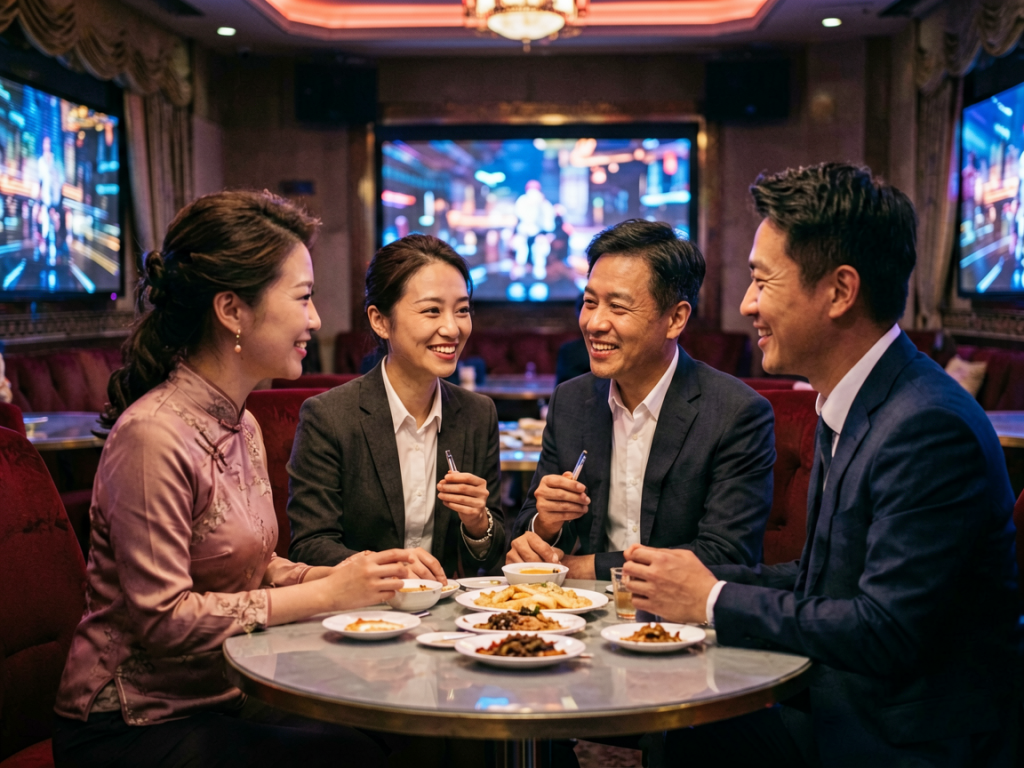
The Door Opens, and the Real Party Begins
You think you know what karaoke is. Maybe you picture a dimly lit bar in Seoul or a chaotic pub in London. But nothing, and I mean nothing, prepares you for a private KTV suite in China. I walked into my first one eight years ago in Shenzhen, expecting to sing a few bad songs with some colleagues after work.
I didn’t realize I was walking into a theater production where everyone had a script they hadn’t memorized yet. The room was huge, lined with soundproof foam that swallowed noise whole. There were plush velvet couches arranged in a U-shape, a massive screen, and a mini-bar stocked with everything from expensive imported beer to those tiny bottles of Baijiu that burn like liquid fire.
The air smelled faintly of incense and fried snacks. A maid came in to light the candles–actual candles–and place the menu. I looked around the table. My boss, Mr. Chen, was already arranging the seating chart in his head. I sat next to him, which was polite but dangerous. You never sit next to the leader unless invited. That’s rule number one.
This isn’t just singing. It’s a high-stakes social ritual. It’s where friendships are forged, careers are made, and egos are carefully managed. If you miss a cue, you don’t just miss a note. You lose face. And in China, losing face is worse than dying, or so it feels when you’re holding the microphone.
Seating Arrangements Are Everything
Let’s talk about that seating chart for a second. In Western cultures, we usually just claim the nearest empty spot. Here, you wait. You hover. You watch Mr. Chen take the central spot on the main couch, facing the screen. This is the “head” position. It’s reserved for the person of highest status in the room.
To his left sits the second-highest ranking person, then the third. You. You end up on the far right, the “bottom” seat. It’s perfect for pouring drinks and checking the song list. It’s also perfect for observing the power dynamics in play. I noticed my junior colleague, Xiao Li, trying to squeeze onto the main couch next to Mr. Chen.
Mr. Chen gently tapped Xiao Li’s shoulder and pointed to the side seat. It wasn’t rude. It was firm. It said, “Know your place.” The room went quiet for a split second. Then, someone started a song, and the tension dissolved into applause. But I saw the shift in Xiao Li’s posture. Shoulders dropped. Eyes lowered. He got the message.
This is what I call the geography of respect. Every inch of that velvet couch represents hierarchy. If you sit in the wrong spot, you aren’t just being awkward. You’re challenging the structure. And nobody wants to be challenged before the appetizers even arrive.
The Art of the Toast: Drinking as a Love Language
Once the initial settling-in is done, the drinking begins. And it’s not about getting wasted. Well, not entirely. It’s about showing sincerity. In China, if you don’t drink with your superior, you’re saying you don’t respect them. If you don’t drink enough, you’re not loyal. If you drink too much too quickly, you’re unrefined.
I watched a dance unfold that night. Mr. Chen raised his glass of Maotai, a clear, potent spirit that costs more than some people’s monthly rent. He stood up. Everyone else stood up too, except me. I was still figuring out the rhythm. My boss nudged me. “Stand,” he whispered. So I stood.
He toasted the group. We all echoed the toast, clinking our glasses lower than his. This is crucial. When you clink glasses with someone senior, your rim should be below theirs. It’s a subtle physical bow. I fumbled mine, hitting my glass against Mr. Chen’s at the same level. I felt the heat rise in my cheeks. I mumbled an apology in broken Mandarin.
He laughed it off, but the next time, he poured me another shot. It wasn’t punishment. It was a second chance. He wanted me to get it right. By the end of the hour, I was holding my glass with two hands, bowing my head slightly as I drank. It felt ridiculous. It felt intimate. It felt like I was finally part of the tribe.
We’ve heard that alcohol lowers inhibitions. In Chinese business culture, it raises transparency. People say things they wouldn’t say in a boardroom over a bottle of Baijiu. They complain about their bosses. They reveal their family struggles. They promise favors. And because you’re all slightly drunk, you believe each other.
Singing Your Way Through Office Politics
Then came the singing. Or rather, the performance. You don’t just pick a song. You pick a statement. Choose a ballad about lost love? You’re signaling vulnerability. Choose a high-energy pop track? You’re showing you’re fun and approachable. Choose a classic patriotic anthem? You’re playing it safe, showing loyalty to the collective.
Xiao Li, the guy who messed up the seating, decided to make up for it. He picked a difficult, fast-paced rock song. He nailed it. The room cheered. Mr. Chen clapped louder than anyone. In that moment, Xiao Li had regained some of that lost face. He proved he had talent, energy, and skill.
But here’s the kicker: he didn’t take the mic immediately. He waited for the senior manager, Sarah, to ask him to sing. He didn’t want to seem arrogant. He wanted to be invited. It’s a delicate balance of ambition and humility. You have to be good enough to impress, but humble enough to be invited to show it.
I tried to sing once. I picked a simple folk song. I was terrible. My voice cracked on the high notes. The room giggled. Not mean giggles, but the kind of warm, forgiving laughter you give a friend. It was okay. It showed I wasn’t taking myself too seriously. It showed I was human. And in a room full of polished professionals, being human is often more valuable than being perfect.
The microphone is passed around like a torch. If you hold it too long, you’re hogging the spotlight. If you refuse to sing, you’re being difficult. The trick is to sing one song, step back, praise the next singer, and keep the energy flowing. It’s a chorus of mutual admiration. Everyone is praising everyone else. It’s exhausting. It’s beautiful.
The Aftermath: What Sticks With You
When the night finally ended, around 2 AM, we stumbled out into the humid Shenzhen night. My head was spinning from the noise and the alcohol. But something had shifted. The formal barrier between us had thinned. Mr. Chen was buying us dinner at a street-side stall.
No more titles. No more seating charts. Just guys eating skewers and complaining about the traffic. I realized then that KTV isn’t about the music. It’s about the shared space. It’s a pressure cooker for social bonds. You see people when they’re tired, when they’re loud, when they’re emotional. You see their true selves.
I’ve been to many such nights since. Some were awkward. Some were legendary. But I always go now. I know the rules. I know where to sit. I know how to hold my glass. And I know that when I sing that off-key folk song, I’m not just making noise. I’m building trust.
So, if you get invited to a Chinese KTV night, don’t try to leave. Don’t pretend you can’t sing. Stay. Listen. Watch. Learn. Because in those four hours, you’ll learn more about Chinese culture, friendship, and survival than you ever will in a textbook. And hey, at least the snacks are free. Right?