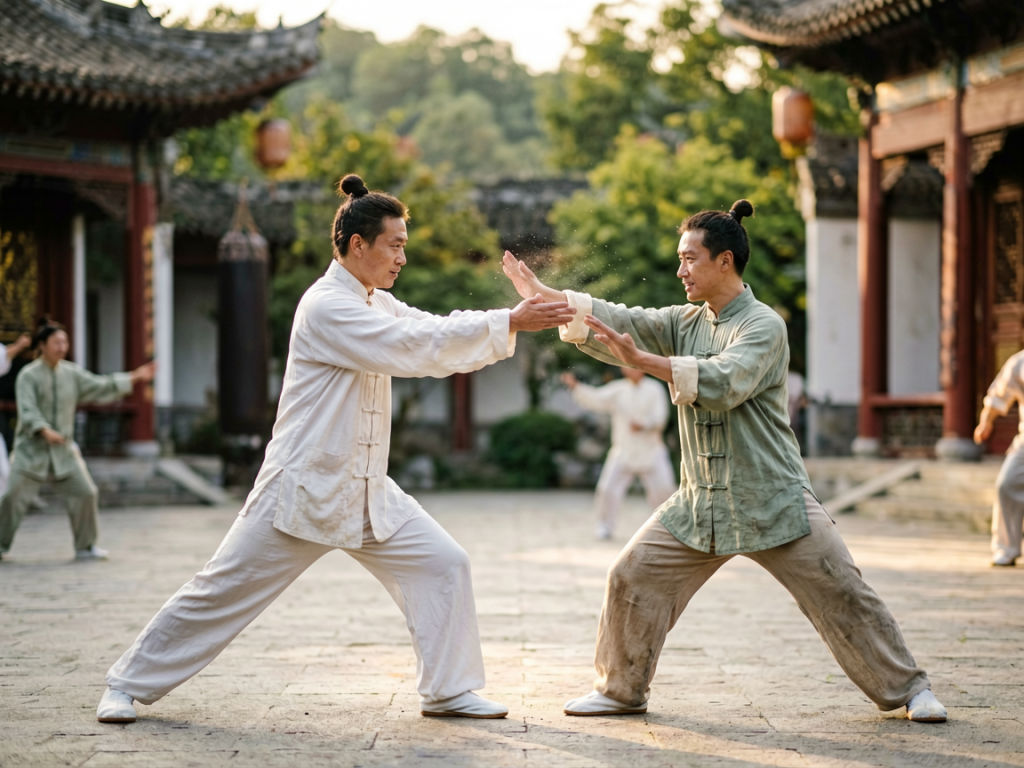
Remember that summer in Chengdu? It was humid enough to peel your skin off. I was sitting in a dusty gym, sweating through my white uniform, watching a kid do a backflip that defied gravity. He landed it perfectly. The crowd cheered. Then, another kid charged in to spar. My guy dodged, spun, and delivered a kick that stopped an inch from his opponent’s face. No contact. Just air.
I remember thinking, “If someone actually hit him, he’d be on the floor.”
That moment stuck with me. It’s the elephant in the room for anyone who’s ever watched a Wushu competition or trained in a modern school. You see incredible athleticism. You see moves that look like they belong in a Bruce Lee movie. But ask the instructor about full-contact sparring, and they’ll politely change the subject. They’ll talk about forms. They’ll talk about discipline. They won’t talk about getting punched in the nose.
I’ve lived in China for eight years now. I’ve trained in Tai Chi in parks. I’ve watched Sanda matches. I’ve even tried to learn some traditional Kung Fu styles that claim to be combat-ready. And I’m here to tell you that most Wushu competition schools have intentionally moved away from full-contact sparring. It’s not because they’re afraid. It’s because the game changed, and so did the goal.
The Olympic Effect Changed Everything
To understand why your local Wushu master won’t let you punch each other in the face, you have to look at Beijing. Specifically, you have to look at the 2008 Olympics. Or rather, the fact that Wushu isn’t there. Yet.
Wushu has been pushing for Olympic inclusion for decades. And to get into the Games, you need judges. You need a sport that can be scored fairly without relying on who hits harder. Full-contact fighting is messy. Referees call fouls. Injuries happen. It’s unpredictable.
So, the Chinese Wushu Association made a choice. They streamlined the sport into two categories: Taolu (forms) and Sanda (sparring). But here’s the twist. Taulu got all the glory. It’s the flashy stuff. The tumbling. The spinning crescent kicks. It’s beautiful. It’s safe. It’s easy to judge on a scale of 1 to 10 based on difficulty and execution.
Sanda, which is full-contact, exists in the shadows. It’s still alive, sure. You can find Sanda gyms. But the mainstream Wushu schools? The ones that teach kids how to flip and spin? They focus on Taolu. Why? Because that’s where the medals are. That’s where the fame is. And that’s where the funding flows.
If you teach full-contact sparring, you risk breaking your student’s nose. If you teach forms, you risk nothing. You just risk their flexibility. The incentive structure is totally skewed toward performance, not combat.
Performance Over Combat
I used to think this was a betrayal of martial arts. I really did. I believed that if you couldn’t fight, you weren’t practicing a real martial art. But then I spent time with some of these athletes. I saw their dedication. I saw their pain.
One of my friends, Li Wei, is a provincial-level Wushu athlete. He trains six hours a day. His legs are stronger than most bodybuilders I know. But ask him to spar, and he hesitates. Not because he’s weak. Because his whole training regimen is built around precision, rhythm, and aesthetics. He’s trained his body to move in ways that look good on stage, not necessarily ways that work in a bar fight.
Full-contact sparring changes how you move. You lower your stance. You protect your chin. You don’t spin 360 degrees in the air because you might get taken out mid-air. Those flashy kicks? Deadly in theory, but risky in practice against a boxer who knows how to slip them.
Most Wushu schools know this. They don’t want to teach their students to box. They want to teach them to perform. And performance requires a different skill set. It requires control. Extreme control. You have to hit a target with the force of a hammer, but stop just before impact. That’s hard. That’s actually harder than just hitting someone.
But once you prioritize that kind of control, full-contact sparring becomes a liability. It disrupts the form. It introduces chaos. And chaos doesn’t score points in Taolu competitions.
The Safety and Liability Issue
Let’s talk about money. And fear. Running a martial arts school in China is a business. A small one, but a business nonetheless. Parents send their kids there. They pay monthly fees. They expect their children to come home safe, happy, and maybe a little cooler than their classmates.
If a kid gets concussed in a sparring session, who pays? The school. The insurance premiums skyrocket. The reputation takes a hit. Parents complain. The government steps in. It’s a nightmare for a small owner.
Compare that to Taolu. Sure, kids pull muscles. Maybe they sprain an ankle during a difficult jump. But those are minor. They heal fast. There’s no brain damage. No broken teeth. No lawsuits.
I remember talking to an instructor in Xi’an. He was frustrated. He said, “I learned Sanda when I was young. I know how to fight. But my students? They’re here for the certificate. For the college entrance exam bonus points. They don’t want to bleed. They want to point.”
He was right. The demand drives the supply. Parents don’t want fighters. They want disciplined students who look impressive at school events. So the schools give them what they want. Safe, clean, spectacular forms. No blood. No bruises. Just beauty.
The Rise of Sanda Gyms
Does this mean Wushu can’t fight? Absolutely not. It just means you’re going to the wrong place if you want to spar.
There’s a separate ecosystem in China called Sanda gyms. These are the real deal. Think of it like the difference between a ballet class and a MMA gym. One is art. The other is war. Sanda gyms teach full-contact sparring. They use boxing gloves. They allow kicks to the body and head. They have actual fights.
I’ve visited a few of these places. The atmosphere is completely different. It’s loud. It’s aggressive. The smell of sweat and rubbing alcohol is thick in the air. People get hit. Hard. And everyone loves it.
But here’s the catch. Sanda is often considered a subset of Wushu, but it’s treated like a distinct sport. The main Wushu association promotes Taolu as the cultural face of Chinese martial arts. Sanda is the athletic cousin that stays in the background. You won’t find Sanda in every community center. You’ll find it in specialized gyms, usually run by former fighters who want to train serious competitors.
If you walk into a typical “Kung Fu” school in a residential neighborhood, you’re likely looking at Taolu. If you want to learn to fight, you need to hunt down a Sanda trainer. And that’s not always easy for foreigners. The language barrier is real. The cultural expectations are different. The mainstream Wushu industry simply isn’t built for it anymore.
What This Means for You
So, where does that leave us? Are these schools useless? I wouldn’t say that. I love watching Wushu Taolu. It’s one of the most impressive physical feats in sports. The flexibility required is insane. The balance is supernatural. If you go to a Wushu class for fitness, discipline, and art, you’ll have a blast. You’ll meet great people. You’ll learn to appreciate the beauty of movement.
But if you walk in expecting to learn how to defend yourself in a street altercation, you’re setting yourself up for disappointment. The curriculum isn’t designed for that. The instructors aren’t incentivized to teach that. The students aren’t paying for that.
I’ll be honest. I was skeptical at first. I thought, “This is fake.” But I realized it’s not fake. It’s just different. It’s competitive gymnastics with a martial arts aesthetic. And there’s nothing wrong with that. It serves a purpose. It preserves culture. It creates athletes. It just doesn’t create fighters.
And that’s okay. We don’t need every martial artist to be a fighter. We need variety. We need artists. We need performers. But we also need to be clear about what we’re getting into.
Don’t go to a Wushu competition school expecting to spar full-contact. Go to a Sanda gym if you want to fight. Go to a Wushu school if you want to fly. Know what you’re signing up for. It makes the whole experience richer. You stop complaining that the fish isn’t meat, and you start enjoying the fish for what it is.
I’ve seen too many beginners quit Wushu because they felt tricked. They wanted to be Bruce Lee, but they got a dancer. It’s a shame. Because the dance is incredible. The discipline is real. The culture is deep. It’s just not what you might have expected.
Next time you see a kid doing a spinning heel kick in slow motion, smile. Don’t think, “He can’t hit.” Think, “Look at that control. Look at that strength. Look at that art.” It’s a different kind of power. And in my book, it’s worth respecting.
Just don’t bet your wallet on it being able to save you from a drunk guy in a alley. For that, you’ll need to find the Sanda gym. And trust me, once you try that, you’ll never look at the forms the same way again. You’ll see both sides of the coin. The beauty and the brutality. And that’s a pretty cool place to be.