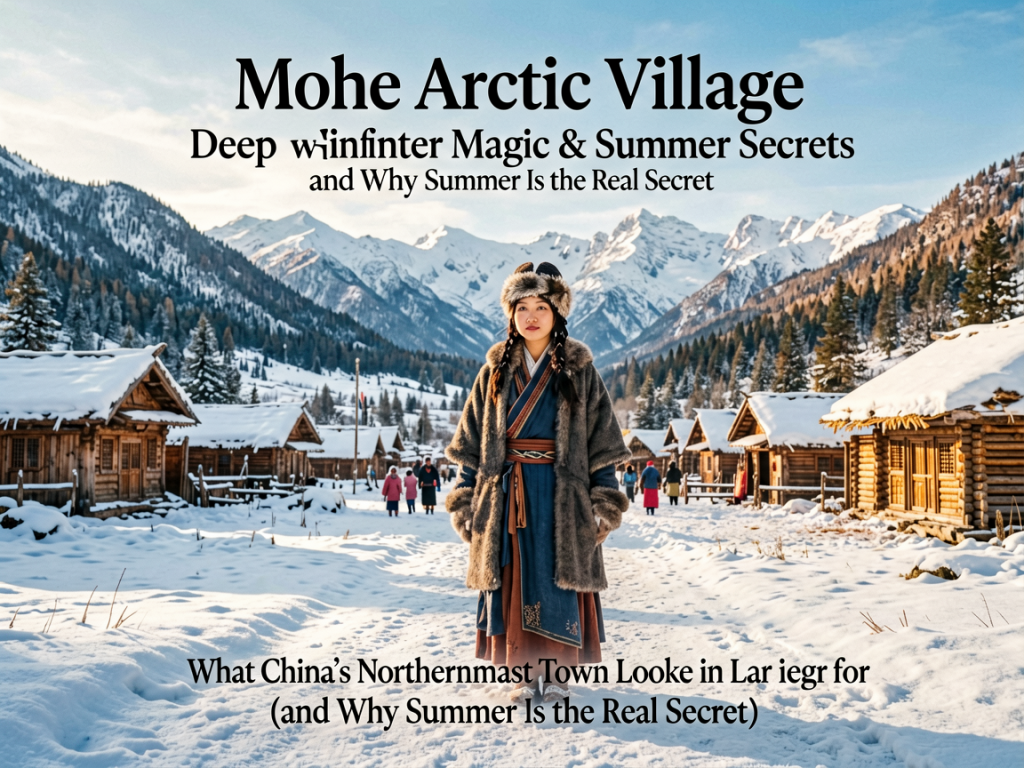
The Cold That Actually Bites
I’ll be honest, I was skeptical at first. Who wants to go to China’s absolute end of the line just to freeze their fingers off? It sounded like a punishment disguised as tourism.
But then I landed in Mohe. The air didn’t just feel cold. It felt heavy. It had weight.
You know that feeling when you step out of a warm house into a snowstorm and the wind hits your cheeks like a slap? That’s Mohe in January. Minus thirty degrees Celsius doesn’t seem real until your eyebrows frost over in seconds.
I’m talking about the kind of cold where if you leave your car running too long, the exhaust pipe freezes solid. The kind of cold where you have to drink tea through a straw just to keep your lips from sticking together.
It sounds miserable, right? Surprisingly, it’s not.
There’s a stark, violent beauty to it. The snow isn’t white here. It’s blue. A deep, electric indigo under the midday sun. The trees are bare skeletons coated in rime ice, looking like they’ve been dipped in sugar.
I spent my first evening shivering in a hotel room that somehow felt like a cave. Outside, the Aurora Borealis danced. Not much of it, but enough. Green ribbons flickering across the black sky.
My guide, a local guy named Wei who wore three layers of fur, laughed at my shock. He said this is the “Arctic Village.” We’ve got to live up to the name.
We did. And I loved every second of it.
Eating Your Way Through the Freeze
If you think Chinese food is just dumplings and stir-fry, you haven’t eaten in the Northeast. Mohe changes the game completely.
I remember walking into a small, dimly lit restaurant near the border. The windows were fogged up with condensation. Inside, it smelled like roasted meat and chili peppers.
We ordered a hot pot. But not the delicate, clear broth stuff you get in Shanghai. This was a fiery, oil-based red broth that could melt steel.
I threw in slices of frozen beef. They were hard as rocks when they arrived. But drop them in that boiling oil, and they softened in minutes. The texture was incredible. Rich. Gammy. Perfect.
We also tried the local specialty: smoked fish. It was dried so thoroughly it snapped when you broke it. But chew it long enough, and it’s sweet and smoky.
The locals don’t eat light here. You need calories. You need fuel. I watched an old man eating a massive bowl of noodles with pickled vegetables and minced pork. He didn’t even pause to breathe.
To be fair, I couldn’t finish half my plate. My stomach was busy trying to generate its own heat.
But that’s the charm. Food here feels honest. It’s not about presentation. It’s about warmth. It’s about survival.
I ended up craving it the next day. Weird, I know. But there’s something primal about eating hot, spicy food when it’s thirty degrees below zero outside.
The Border Town Vibe
Mohe sits right on the Amur River. On the other side is Russia.
In winter, the river freezes over. Completely. It turns into a massive highway of ice.
I remember standing on the bank, looking across at the Russian side. You could see the lights of villages on the other shore. It felt surreal. Two countries, separated by a sheet of ice.
They even drive across sometimes. I saw a truck rumbling over the ice bridge. It looked like it was driving on thin air.
The architecture here is different from the rest of China. There’s a Soviet influence you can’t ignore. Old brick buildings with red stars. Wooden houses that look like they belong in a Tim Burton movie.
We visited a small museum dedicated to the history of the border guards. It was quiet. Dusty. Full of stories about soldiers who stayed here for decades just to watch the horizon.
I spoke to one of the former guards. He told me about the nights when the temperature dropped to minus forty. The metal of his gun would stick to his gloves if he wasn’t careful.
“We don’t complain,” he said with a shrug. “The view pays us enough.”
He wasn’t lying. The silence here is deafening. No traffic noise. No city hum. Just the wind whistling through the pines.
It forces you to slow down. You can’t rush in Mohe. The roads are icy. The people are patient. Everything moves at the speed of breath.
Summer Is the Real Secret
Here’s the thing nobody tells you. Winter is the tourist season. Everyone wants to see the ice festival. Everyone wants to catch the aurora.
But if you ask me, summer is when Mohe really wakes up.
I went back in July. The transformation was shocking. The ice vanished. The river flowed again, brown and churning. The snow turned into lush green forests.
It’s still cool there. Even in summer, nights drop down to fifteen degrees Celsius. It’s perfect. No mosquitoes. No humidity.
The locals treat summer like a party. The days are incredibly long. In June, the sun doesn’t set until nearly midnight.
We stayed up till two in the morning, drinking beer on the riverbank. The sky was a bruised purple. Fireflies danced above the grass.
It felt like magic. Like we were living in a different timezone entirely. Which, technically, we were. Mohe is far east. We see the sunrise before Beijing.
I spent a day hiking in the nearby national forest park. The air was so clean it tasted sweet. I picked wild berries. They were tiny and tart, perfect for making jam.
The summer crowds are gone. You can walk along the border without seeing another tourist bus. It’s just you and the nature.
And the food changes too. Fresh fish from the Amur. Wild vegetables dug up from the hillsides. It’s simpler. Lighter.
I met a farmer who grew potatoes in the short summer. They were huge. Sweet. He said they’re the best in China because of the long daylight hours.
“The sun stays late,” he explained. “The plants don’t know when to sleep.”
That’s how I felt too. Refreshed. Alive. Not huddled under three blankets.
Why You Should Go Either Way
I’m no expert, but I’ve traveled a lot. Most places offer one good season. Mohe offers two completely different worlds.
Winter is dramatic. It’s harsh. It tests you. But it rewards you with snowscapes that look like other planets.
Summer is peaceful. It’s green. It’s quiet. It lets you appreciate the landscape without the distraction of the cold.
Getting there isn’t easy. You fly into Mohe Hegen Airport, which is tiny. Or you take a train for two days from Harbin. The train ride alone is an adventure. Sleeping in a hard-seat carriage while watching the taiga roll by.
I took the train. It was freezing inside, surprisingly. But I made friends with a local woman who taught me how to peel garlic quickly.
We laughed about our hands shaking from the cold. It was a genuine human connection. Rare these days.
So, should you go in winter or summer?
If you want photos of ice sculptures and auroras, go in winter. Bring thermal underwear. Lots of it. And don’t forget hand warmers.
If you want to hike, eat fresh food, and sleep under the midnight sun, go in summer. Bring a jacket for the evenings.
Personally, I think summer is the secret. Winter gets all the hype. Summer gets all the peace.
I’d rather sit on a wooden porch, watching the river flow, than stand in a queue for a photo op. Sure, the aurora is cool. But nothing beats a warm cup of tea at 2 AM while the sun still hangs low in the sky.
Mohe isn’t just a destination. It’s a feeling. It’s the edge of the map. It’s where the world feels big and you feel small.
I’ll be back. Probably in autumn. I hear the leaves turn gold against the dark green pines. Sounds like a new story waiting to happen.
Until then, I’ll just dream of that blue snow. And maybe, just maybe, a slice of that smoked fish.