The Water Isn’t the Only Way Down
You’ve probably seen the photos. Mist rolling over those jagged limestone peaks, a lone fisherman standing on a narrow boat with his birds. It’s iconic. It’s beautiful. And if you’re booking a three-hour luxury cruise down the Li River from Guilin to Yangshuo, you might be missing half the story.
I’ll be honest. When I first arrived in Yangshuo five years ago, I took that very cruise. The views were nice enough, sure. But the boat was loud, crowded, and completely detached from the actual rhythm of the place. It felt like watching a nature documentary through a thick window.
That’s when I realized the real magic happens when you slow down. Or when you get closer to the water. Or better yet, put two wheels under your feet and pedal along the Yulong River.
Yangshuo isn’t just a destination. It’s a playground for people who want to feel the landscape, not just pass through it. So, let’s talk about the three ways I’ve come to love exploring this corner of Guangxi province. We’re skipping the big ships. We’re looking at bamboo rafts, traditional cormorant fishing, and the ultimate freedom of a bicycle ride.
Rafting on the Yulong: Where Silence Speaks
If you want intimacy with the karst landscape, you need to hit the Yulong River. It’s a tributary of the Li River, but it’s smaller, calmer, and significantly more picturesque. This is where the bamboo rafting comes in.
Now, I know what you’re thinking. “Bamboo rafts? Aren’t they just tourist traps?” To be fair, the heavily commercialized sections can feel a bit cheesy. But here’s the thing: you have options. You can book a private raft, or you can join a small group that heads further upstream away from the main docks.
I spent an afternoon with a local rafter named Lao Li near Shili Gallery. We didn’t just float; we drifted. The poles are thick and sturdy, and Lao Li showed us how to use them to steer without rushing. It’s a skill, really. You gotta find the current.
The silence is what gets me. Up there, with just the sound of water lapping against the bamboo and the occasional cry of a bird, the world feels suspended. The limestone cliffs rise straight up from the emerald water, creating these perfect frames for photos. But don’t just take selfies. Look at the texture of the rock. Look at the reflections.
And yes, it’s cheaper than you’d expect. A standard two-person bamboo raft runs about 150 to 200 RMB per trip depending on the season and distance. That’s roughly $25-$30 USD. For four people? You’re splitting it cheap. Compared to the hundreds of dollars for a cruise cabin, this is a bargain for the experience.
One tip: go early. Like, sunrise early. The mist is thicker in the morning, and the light hits the peaks in that soft, golden way that makes you question why you ever left home. Plus, the locals start their day then. You’ll see farmers walking their cattle across shallow fords. It’s authentic, not staged.
The Fishermen and Their Feathered Friends
You can’t talk about Yangshuo without talking about the cormorant fishermen. It’s one of the oldest traditions in China, dating back over a thousand years. The image of a man standing on a raft, surrounded by dark birds, is etched into the cultural memory of the region.
But here’s the reality check. The days of catching fish purely for profit are mostly gone. It’s too hard, and the market has changed. Today, it’s largely a performance. Or rather, a preservation of heritage. Most fishermen now do this for tourists who want to buy a photo or see the process.
I’m no expert on ornithology, but I respect the bond these men have with their birds. It’s not just training; it’s partnership. The fishermen tie a string around the bird’s throat. This prevents them from swallowing the biggest fish, ensuring the catch goes to the owner. It sounds harsh to some, but it’s a sustainable practice that has kept the tradition alive.
Head to Xingping Ancient Town for the best sightings. It’s about an hour west of Yangshuo county center. The river widens there, and the backdrop of the famous twenty-yuan banknote view is right there. You’ll spot fishermen on wooden boats, whistling to call their birds out of the water.
I watched a master fisherman work for nearly an hour. He didn’t shout. He didn’t wave his arms frantically. Just low whistles and subtle movements. The birds dove in unison, surfaced with silver flashes in their beaks, and returned to the boat. It was hypnotic.
Don’t be afraid to engage. Ask to take a picture. Most fishermen are happy to pose for a small fee, usually 10 or 20 RMB. They appreciate the interest. Just remember to ask before snapping photos of people or animals. It’s basic courtesy, especially in rural areas.
There’s a museum nearby dedicated to this craft if you want to learn more before heading out. It adds context. You start to see it not just as a trick for tourists, but as a living history lesson. It’s slower, quieter, and more meaningful than the frantic pace of city life.
Pedal Power: The Best Way to See the Countryside
Okay, so you’ve seen the river. Now, get off the water and onto land. The absolute best way to explore the surrounding villages is by bicycle. I rented my first bike in 2016, and I haven’t looked back since.
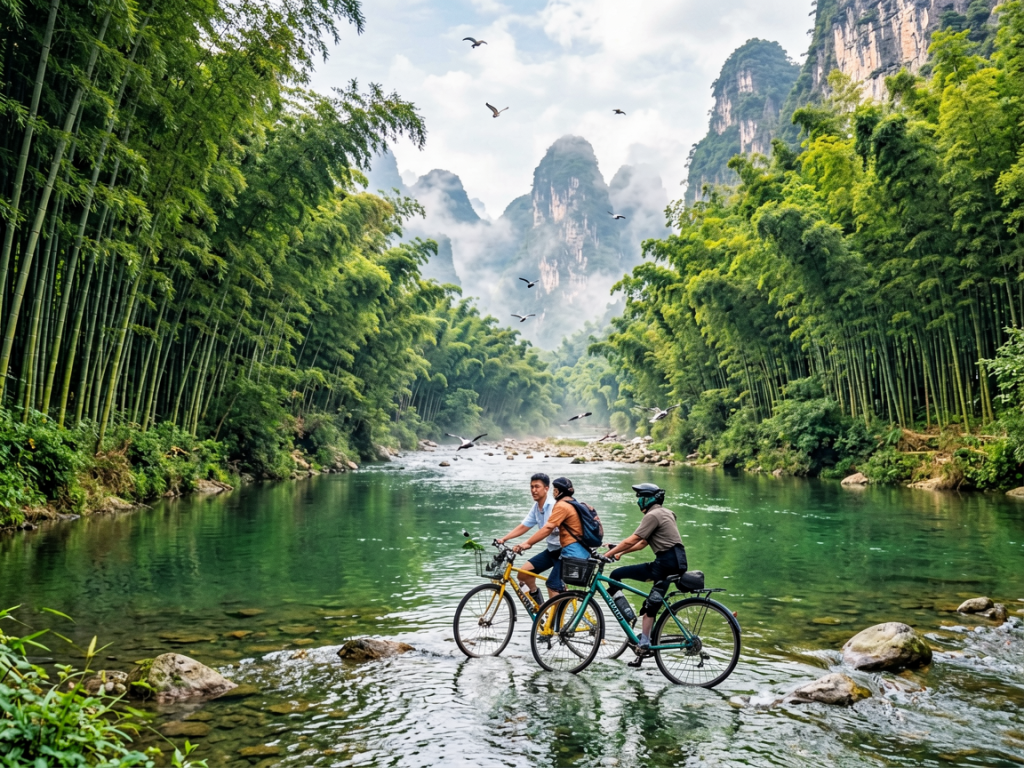
Yangshuo is flat in the valleys but surrounded by towering peaks. Cycling here feels like riding through a painting. The roads are well-paved, traffic is light (mostly tractors and scooters), and the scenery changes every few hundred meters.
Rentals are everywhere. You can find a decent mountain bike for 20-30 RMB a day at almost any guesthouse. Don’t bother with the fancy shops downtown unless you want to pay double. Just ask your host. They’ll hook you up.
I love the Ten-Mile Corridor. It’s a stretch of road along the Yulong River, dotted with rice paddies, stone bridges, and tiny hamlets. You can cycle for hours without seeing another foreigner. It’s peaceful. It’s green. It’s exactly what you imagine China to be, minus the smog and noise.
Here’s a pro tip: bring cash. Small vendors in the villages won’t take Alipay or WeChat. They want yuan coins for bottles of water or steamed buns. And pack snacks. The local tofu snacks are amazing, and the fruit stands sell fresh mangoes and bananas by the kilo for pennies.
I once got lost trying to find a specific temple recommended by a local. Turns out, I ended up in a village that wasn’t on any map. An old woman invited me in for tea. We didn’t speak the same language. She poured hot water over dried leaves, gestured for me to sit, and pointed at the mountains. That moment was better than any guided tour.
Cycling also gives you flexibility. If you see a cool bridge, stop. If you’re tired, hop on a passing truck (just kidding, don’t do that, but you can flag down a taxi easily). The freedom is intoxicating. You’re moving at the speed of the landscape, not the speed of a bus schedule.
Also, watch out for the scooters. Locals fly past you at breakneck speeds. Keep to the right side, wear a helmet if you’re nervous, and stay alert. The views are worth the adrenaline spike.
Why This Triad Works
When you combine these three elements–bamboo rafting, cormorant viewing, and cycling–you get a complete picture of Yangshuo. You see the water from below, you understand the human history tied to it, and you experience the land on your own terms.
It’s not about ticking boxes. It’s about immersion. I’ve taken friends here who swore they hated traveling. By the third day, they were renting bikes before breakfast and waking up at dawn to catch the mist on the river. Something shifts in your brain when you move slowly through a place like this.
You notice details. The way the light hits a mossy rock. The smell of wet earth after rain. The taste of freshly caught fish grilled over charcoal by the riverbank. These aren’t things you notice when you’re zooming past in a climate-controlled bus.
So, skip the luxury cruise. Book the bamboo raft. Find a fisherman in Xingping. Rent a bike and get lost in the Ten-Mile Corridor. Trust me, your memory will thank you. And honestly, you’ll leave with a story that’s actually yours, not just a souvenir photo from a crowded deck.
Yangshuo is waiting. But it’s only showing its true colors to those willing to paddle, pedal, and pause. Are you ready to slow down?