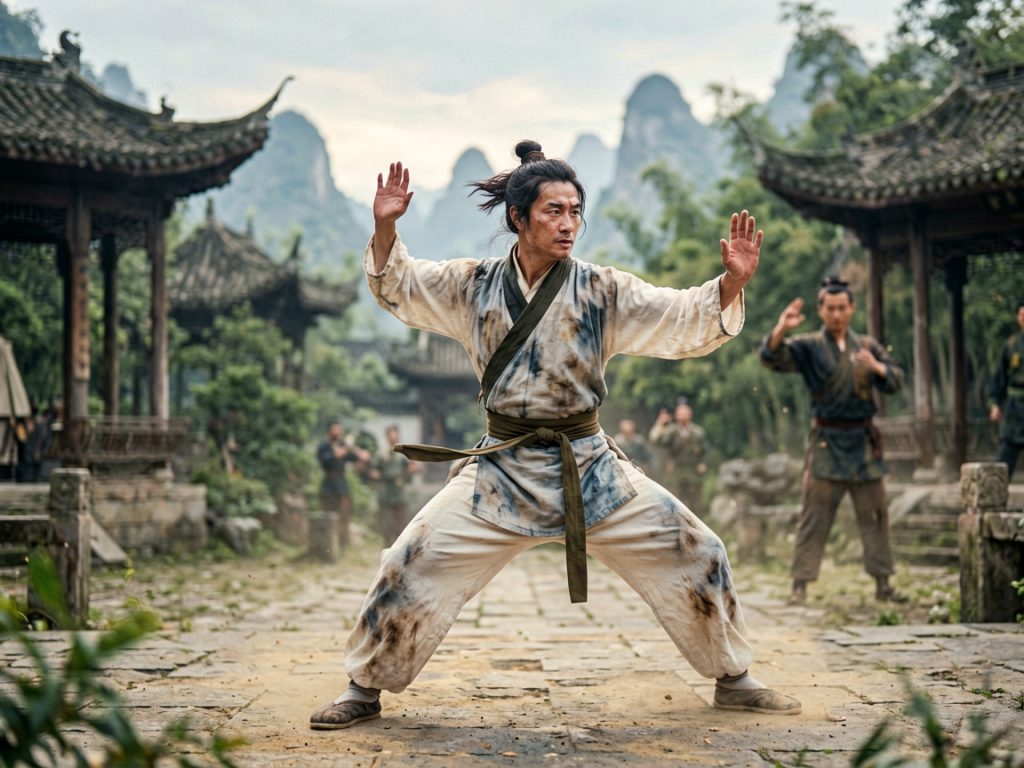
Honestly, I used to think kung fu was all about flying. I’m talking about those grainy VHS tapes my dad rented from the corner store. You know the ones. The hero would leap ten feet into the air, spin twice, and land perfectly on a thin wooden beam without bending his knees.
I believed in it. I bought the plastic nunchucks. I practiced in the mirror until my arm cramped. It felt like magic. It felt like power. But then I moved to China eight years ago.
I expected to find a secret society of masters hiding in misty mountains. Instead, I found gyms. I found sweat. And I found out that reality is far less cinematic, but infinitely more interesting.
If you’ve never stepped into a ring or sparred with a local practitioner, you’re probably still living in the fantasy. Let me save you some embarrassment. Or just some money on useless gear.
The Myth of the Silent Master
First off, let’s talk about the noise. In the movies, the fighter is always silent until the hit lands. Maybe a grunt. Sometimes a yell, but usually restrained and dignified. Like a gentleman warrior.
Real fighting? It’s loud. It’s ugly. And it’s breathless.
I remember my first sparring session at a small gym in Beijing. The coach, a guy named Lao Li, looked like he’d been chewed up and spat out by a truck. He was fifty, slightly overweight, and moved with terrifying efficiency. He didn’t shout. He panted.
He explained that breathing is the first thing to go when you’re tired. And you get tired fast. The cinematic kick requires you to hold your breath and maintain perfect posture. In reality, holding your breath while someone is trying to punch your ribs is a one-way ticket to passing out.
We spent the entire first month just learning how to breathe while moving. It wasn’t glamorous. It wasn’t cool. But it was necessary. Lao Li told me, “Quiet mouth, open lungs.” Sound interesting?
The masters in films don’t seem to need oxygen. They just float there, dodging blows with impossible grace. In real life, evasion is mostly about head movement and footwork. You’re constantly shifting weight. You’re sweaty. You’re tired. You’re not thinking about philosophy. You’re thinking about not getting hit.
Distance Isn’t What You Think It Is
One of the biggest misconceptions comes from the distance between fighters. In cinema, they often stand at arm’s length, trading blows with surgical precision. Every punch connects with a crisp *thwack* sound effect. The camera cuts are quick. The impact looks clean.
In reality, fighting is mostly about range management. It’s boring, repetitive, and incredibly stressful.
I trained under a Wushu instructor in Shanghai who specialized in Sanshou, which is Chinese kickboxing. She was tiny. Five-foot-two, maybe. But she owned the space.
She taught me that most fights are decided before the first punch is thrown. It’s about staying just outside your opponent’s reach while keeping them in yours. You’re feinting. You’re circling. You’re waiting for a mistake.
You don’t fly across the room to deliver a spinning back kick. That leaves you off balance for three seconds. In a real fight, three seconds is an eternity. You’ll be on the ground before you even complete the rotation.
The most common technique I learned wasn’t a complex hand strike. It was a simple front kick to the shin or thigh. Low cost, high reward. Hard to block, hard to counter. It’s not sexy. It doesn’t look good on film. But it works.
I saw a documentary where a champion described a fight as “chess at lightning speed.” That’s accurate. But it’s also messy. Clothes get pulled. Hair gets grabbed. People fall into ropes or corners. It’s not a dance floor. It’s a cage match, literally or metaphorically.
Pain Doesn’t Feel Heroic
Let’s address the elephant in the room. Pain.
In movies, when the hero gets punched in the face, they shake it off. They lick their lips, look at their opponent, and say something witty. Maybe they smile. The injury is temporary. It adds character.
Real pain is distracting. It’s overwhelming. It changes how you see.
I took a light jab to the nose during a seminar in Guangzhou. It didn’t break. But it swelled instantly. My vision blurred. My eyes watered uncontrollably. I couldn’t focus on my opponent’s feet. I couldn’t hear the coach’s instructions.
All I could think about was the throbbing in my sinuses. It ruined my rhythm. I became defensive. I stopped attacking. That’s what pain does. It makes you conservative. It makes you scared.
The cinematic hero uses pain as fuel. I used it as a reason to leave the mat. There’s nothing heroic about swelling. It’s just biology. Your body is screaming at you to stop because you’re damaging yourself.
This is why conditioning is so important. Real practitioners don’t just train techniques; they train tolerance. We hit pads. We spar lightly. We learn to move through discomfort. But even then, getting hit hurts. A lot.
You won’t wake up the next day feeling invincible. You’ll feel sore. Bruised. Maybe a bit humbled. That’s the reality of physical combat. It’s not a superpower. It’s a workout with higher stakes.
The “Magic” Move Doesn’t Exist
I need to kill this myth right now. There is no move that lets you knock someone out with two fingers.
I’ve seen videos online showing guys pressing on a pulse point and sending opponents flying. It’s physics-defying nonsense. If you press hard enough on anyone’s neck or wrist, they might flinch. They won’t launch into the air.
Real fighting relies on leverage, speed, and force. Those are measurable. They are grounded in Newtonian physics, not mysticism.
When I watched a master demonstrate a joint lock in Chengdu, it looked effortless. But that’s because he had trained that motion ten thousand times. It wasn’t magic. It was muscle memory.
He didn’t use chi. He used anatomy. He knew exactly where the joint bends and where it doesn’t. He applied pressure to the weak point. Simple. Effective. Brutal.
Don’t fall for the allure of the esoteric. The idea that ancient masters possessed secret knowledge that modern science hasn’t discovered yet is a nice story. It sells books and movie tickets. But it’s false.
The “secrets” are just fundamentals done better. Punching correctly. Kicking correctly. Moving correctly. Anyone can learn these skills. You don’t need a bloodline. You don’t need a mystical mountain temple.
You need a coach. You need time. And you need to accept that you will look silly at first. I looked ridiculous for months. My form was sloppy. My timing was off. I felt like a toddler trying to run a marathon.
Respect Over Reputation
Here’s the part that movies never show. The respect.
In films, fights are often about ego. Who is stronger? Who is faster? Who can brag the loudest afterward? Real martial arts in China are deeply tied to humility.
The concept of *Shifu* (teacher) isn’t just a job title. It’s a lifelong relationship. When you bow to your teacher, or to your sparring partner, it’s not a performance. It’s acknowledgment.
Acknowledgment of risk. Acknowledgment of skill. Acknowledgment that today, you might lose. And that’s okay.
I’ve seen arguments flare up over trivial matters in street fights. A shove here. A insult there. Things escalate quickly. But in the gym, there’s a code. You tap out. You yield. You protect your partner.
This discipline carries over into life. The people I’ve met who practice traditional styles aren’t aggressive. They’re calm. They’re observant. They don’t need to prove anything to anyone.
This is the real takeaway from my years in China. Kung fu isn’t about fighting. It’s about controlling yourself. It’s about knowing your limits. It’s about understanding that violence is a last resort, not a first option.
When you see a master in a movie throw a hundred enemies, you’re seeing fantasy. When you see a real practitioner stand still and wait, you’re seeing confidence.
Confidence doesn’t need to shout. It doesn’t need to spin. It just needs to be there.
So, What Should You Do?
If you’re inspired by the movies, that’s great. Use that as a gateway. Go find a local gym. Try a class. Don’t expect to be a master overnight. Expect to be confused.
Expect to be tired. Expect to hurt a little. But also expect to learn something profound about your own body and mind.
The techniques might not be flashy. The kicks won’t go over your head. But they will work. And that’s worth more than any special effect.
I still watch the old films sometimes. They’re fun. They’re entertaining. They’re art. But I don’t believe them. Not really.
Believe the sweat. Believe the bruise. Believe the friend who pulled you up off the mat after you failed.
That’s the real culture. That’s the real fight. And it’s way more compelling than anything on the silver screen.
Trust me. I know.