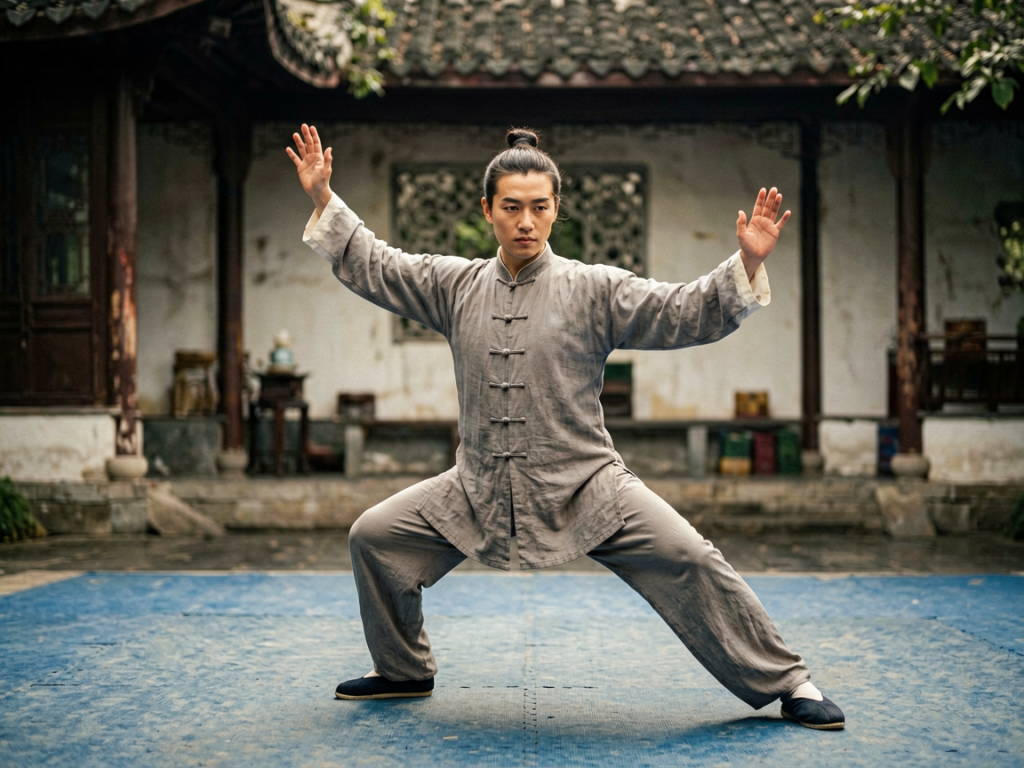
Remember when I first arrived in Beijing five years ago? I walked past this tiny alleyway near Dongzhimen. There was an old man in a white silk uniform, holding a wooden staff, staring at the traffic with intense focus. Next to him, a faded poster advertised “Shaolin Self-Defense Classes.” I thought I’d stumbled into a movie set.
I’m no expert on martial arts history, but that scene felt like a relic from another era. Fast forward to today, and those posters are gone. The alley’s been renovated into a trendy cafe selling $8 oat milk lattes. The old master? Maybe he retired. Maybe he moved to a rural village where rent doesn’t eat his pension. Or maybe he finally figured out that young people in Shanghai and Shenzhen aren’t interested in sweeping the floor and memorizing forms before they’ll ever throw a punch.
The decline of traditional kung fu schools in China isn’t loud. There are no protests, no headlines screaming about the death of a cultural icon. It’s quiet. It’s subtle. And it’s happening right under our noses while we’re too busy optimizing our schedules for work and Wi-Fi.
Why the Old Masters Are Losing the Battle
Let’s be honest here. The traditional model of kung fu schooling just doesn’t fit modern life anymore. In the past, apprenticeship meant living with a master, eating simple meals, and drilling the same movement for three years until your body moved without thinking. That level of dedication requires time, money, and a whole lot of patience.
Most urban Chinese professionals don’t have that kind of spare time. They work 9-to-9, or even 9-to-10, six days a week. By the time they get home, they’re exhausted. The idea of waking up at 5 AM to practice Tai Chi in a park sounds noble, sure. But does it feel like a priority after a day of Zoom calls?
I tried a traditional Wing Chun class in Guangzhou once. The sifu was genuine, skilled, and kind. But the lesson lasted two hours. We spent forty-five minutes just standing in a static posture called ‘Yee Jee Kim Yeung Ma.’ My legs shook. I wanted to sit down. I didn’t complain, but I left thinking, “Can’t I just go to the gym and lift weights?”
It’s not that kung fu is useless. It’s that the value proposition has shifted. Modern life demands efficiency. Traditional martial arts demand immersion. Those two goals rarely align.
MMA and Fitness Clubs Stealing the Spotlight
If you walk into any decent gym in Chengdu or Hangzhou now, you won’t see guys practicing sword forms. You’ll see people grappling, boxing, or lifting heavy iron. Mixed Martial Arts (MMA) has taken over the spot that kung fu used to occupy in the public imagination.
I’ve seen the change firsthand. A few years back, everyone wanted to learn Bruce Lee-style moves. Now, everyone wants to learn BJJ (Brazilian Jiu-Jitsu) or Muay Thai. Why? Because it works. You can test it. You can spar safely and see immediate results. With traditional kung fu, how do you know if your technique is good? You have to trust the master. That’s a hard sell in a skeptical, digital-first society.
Fitness clubs also offer something traditional schools can’t: community and aesthetics. Go to a CrossFit box in Shanghai. It’s loud, it’s social, and you look good doing it. Post your progress on Xiaohongshu (Little Red Book). Get likes. Feel validated. Contrast that with sitting in a dusty courtyard memorizing hand forms while your friends are out at a bar.
It’s easier to justify spending 2000 yuan a month on a premium fitness membership than on a vague promise of self-defense. The ROI (Return on Investment) is clearer. Plus, the coaches in these new gyms are often younger, more energetic, and fluent in English. That matters to the expat crowd and the cosmopolitan locals alike.
The Digital Distraction Factor
We can’t ignore the elephant in the room: smartphones. Douyin (the Chinese version of TikTok) has fundamentally changed how we consume martial arts content. And it hasn’t helped traditional schools one bit.
Scroll through Douyin for ten minutes. You’ll see flashy, edited clips of kung fu masters jumping through the air, breaking bricks, or fighting off multiple attackers. These videos are entertaining. They’re visceral. But they’re also largely performative. Real martial arts is boring. It’s repetitive. It’s sweat and bruises and waiting.
Young people grow up watching these highlights. They expect instant gratification. When they sign up for a class and spend the first hour just tying their belt and breathing, they bounce. They don’t stick around for the long haul that traditional arts require.
I spoke to a former Shaolin monk who now runs a small studio in Xi’an. He told me his enrollment dropped by 60% in the last three years. “Kids want to fight,” he said, shrugging. “They don’t want to cultivate Qi. They want to win a round in a cage. And honestly? Who am I to blame them?”
He wasn’t bitter. Just realistic. The market has spoken. And the market prefers quick hits of adrenaline over slow-burning discipline.
What’s Replacing the Traditional School?
So, if traditional kung fu schools are fading, what’s taking their place? It’s a mix of things, really. Wushu, for one, has evolved into a sport rather than a combat system. It’s gymnastics with weapons. Beautiful to watch, but not exactly practical for self-defense.
Then there’s the rise of “health kung fu.” I see Tai Chi classes popping up in parks everywhere, but they’re less about fighting and more about balance and stress relief. It’s great for seniors, sure. But it’s not attracting the 25-year-old tech worker in Shenzhen looking for an edge.
Self-defense workshops for women are also gaining traction. These are usually hybrid classes, mixing Krav Maga principles with some traditional Chinese techniques. They’re marketed heavily online. They promise practical skills for real-world scenarios. They’re short, intensive, and focused on survival. That’s a much clearer pitch than “learn the Way of the Fist.”
I attended one such workshop in Beijing last year. The instructor was a woman who had trained in both judo and Baguazhang. She didn’t waste time with philosophy. She taught us how to break a wrist grab, how to create space, and how to escape. It was empowering. It was fast. And it was effective.
Traditional schools that adapt are surviving, of course. Some masters have started offering online courses. Others partner with fitness studios to add a “martial arts” flavor to their packages. But these are exceptions. The golden age of the independent kung fu master is definitely over.
A Personal Reflection on Change
I’ll be honest. When I first heard about this decline, I felt a pang of sadness. I love the romance of the traditional school. The incense, the calligraphy on the walls, the respect between student and teacher. It feels authentic in a way that modern gyms sometimes don’t.
But then I think about my own routine. I don’t have the discipline to wake up at dawn. I don’t have the patience to stand in one stance for an hour. I’d probably quit within a week.
Does that mean traditional kung fu is dead? No. It just means it’s niche now. It’s for the dedicated few, not the masses. It’s becoming like calligraphy or guqin music: beautiful, historical, but not central to daily life.
And maybe that’s okay. Culture evolves. We shouldn’t cling to the past just because it’s familiar. The fact that Chinese youth are choosing MMA, fitness, or self-defense workshops shows they’re active participants in their health and safety. They’re not passive learners waiting for a master to dictate their path.
I still visit my old friend’s Wushu school in Guangzhou occasionally. We drink tea. He shows me a new form he’s learned. It’s graceful. It’s powerful. But it’s also just a hobby for us now, not a lifestyle. That shift is profound.
The Future Is Hybrid, Not Historical
Looking ahead, I think we’ll see more hybridization. Traditional masters will need to incorporate modern training methods to stay relevant. Think nutrition plans, sports psychology, and video analysis alongside hand-to-hand combat drills.
Schools that refuse to change will likely close down. That’s harsh, but it’s true. The market doesn’t care about tradition. It cares about results.
For travelers and expats, this is good news. It means if you want to learn martial arts in China, you’ll find options that suit your schedule and goals. You won’t have to commit to a five-year apprenticeship. You can take a drop-in class. You can train alongside locals who are also seeking improvement, not just heritage.
I tried a mixed bag of classes over my eight years here. Boxing in Beijing. Tai Chi in Hangzhou. Muay Thai in Chiang Mai (just kidding, staying in China!). The ones I stuck with were the ones that felt practical. The ones that made me sweat and smile, not just stand and stare.
Traditional kungfu isn’t disappearing entirely. It’s moving underground, so to speak. It’s in the museums, the documentaries, and the rare, dedicated schools. But the mainstream? It’s gone.
Is it a loss? For some, yes. For others, it’s an opportunity to redefine what martial arts mean in a modern context. To strip away the mysticism and keep the mechanics.
I think I’m okay with that. Life’s too short to stand in one pose for three hours. Unless you’re really, really good at it. Then, maybe, just maybe, I’ll reconsider.
But until then, I’ll stick to my dumbbells and my occasional sparring session. And I’ll raise a glass of baijiu to the old masters, wherever they are now. Resting? Teaching a small private group? Or maybe just enjoying a coffee in that renovated alley, watching the world go by without a care in the world.
That’s the quiet decline. And honestly? It’s kind of peaceful.