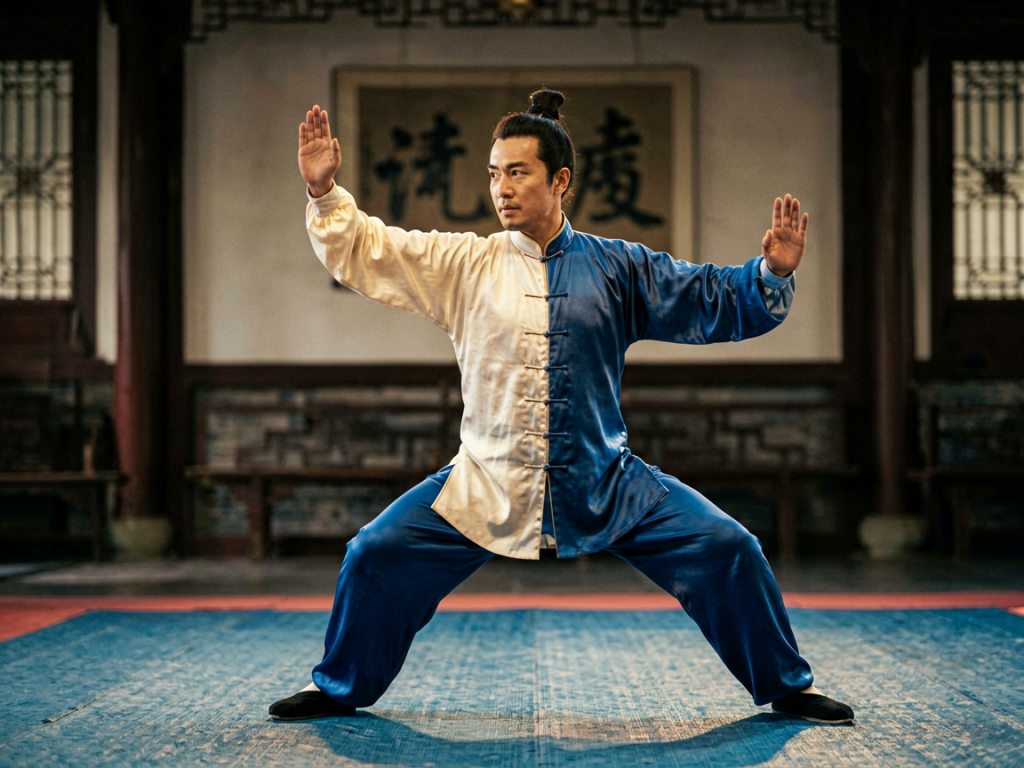
I’ll be honest, I had it wrong for years.
When I first moved to Beijing eight years ago, I pictured martial artists as these serene, slow-moving monks. You know the vibe. They float around parks in the morning, moving like smoke in a breeze. It looked peaceful. It looked soft. It looked like something you’d do if you wanted to stretch before a long flight.
That’s what I thought until I stepped into a cramped basement studio in Dongcheng District.
The master there wasn’t floating. He was vibrating with tension. And when he hit the heavy bag, the sound wasn’t a dull thud. It was a crack. Like a whip snapping or a tree branch breaking in winter. That was my first taste of Xingyiquan.
If you’re looking for flowery movements and spiritual enlightenment through gentle breathing, this isn’t it. But if you want to understand how Chinese philosophy translates into raw, devastating physical power, you need to pay attention.
The Myth of Softness
There’s a persistent myth in the West that “internal” martial arts are inherently weak or defensive. People confuse *neijia* with fragility. They think internal means doing nothing.
In reality, internal just means the power originates from inside your structure, not from your muscles twitching on the outside.
External styles rely on speed and muscle contraction. Think of a boxer’s jab. It’s fast, yes, but it requires wind-up time. Xingyiquan doesn’t have wind-up time. It eliminates the gap between intention and action.
I remember watching a senior student, Lao Li, demonstrate the “Five Elements.” He wasn’t trying to look cool. He was trying to be efficient. He moved from a standing position to a striking position in one fluid, explosive motion.
His fist didn’t travel far. It didn’t have to. The force came from his feet pushing against the floor, rotating through his hips, and shooting out his arm in a straight line. It was simple. Brutally simple.
Sound interesting? It’s actually terrifying when you’re on the receiving end.
One Step, One Strike
The core philosophy of Xingyiquan is summarized in a famous saying: “Yi bu dao, li bu dao.” Which roughly translates to, “If the foot doesn’t arrive, the power doesn’t arrive.”
This isn’t about dancing around an opponent. It’s about intercepting them. You close the distance so fast that by the time they realize you’ve moved, you’re already inside their guard.
We practiced this for months. Just the lead step. The *Bu Fa*. It looks like a lunge, but it’s more like a spring uncoiling. You plant your back foot, drive forward, and let your body weight collapse onto your front leg.
At first, I felt clumsy. My knees hurt. My balance felt off. I kept wanting to pull my punches, to keep my hands high like a Western boxer.
My teacher, Master Chen, would tap my elbow. “Drop it,” he’d say. “Let the hand go back so the fist can come forward. Physics, not magic.”
He was right. When I stopped trying to muscle the punch and started using my skeletal structure to align the force, everything changed. The punch became heavy. Dense. It didn’t feel like I was hitting; it felt like I was driving a pile into the ground.
This is why Xingyiquan hits harder than most external styles. External styles often waste energy on wide arcs. Xingyiquan uses direct lines. The shortest distance between two points is a straight line, and in a fight, a straight line is also the fastest path to your opponent’s center mass.
The Five Animals Are Not What You Think
You’ve probably heard of the Monkey, the Tiger, the Dragon, etc. In popular culture, these are treated like costumes or role-play exercises.
That’s a huge misunderstanding.
Each animal form in Xingyiquan represents a specific mechanical principle and a specific type of intent. They aren’t about mimicking the animal’s appearance. They’re about borrowing its efficiency.
The Tiger form isn’t about growling. It’s about downward crushing force. It’s the feeling of dropping your entire body weight directly onto your opponent’s shoulders or collarbone. I tried this on a partner once, and he dropped to his knees. Not because I hit him hard, but because I hit him down.
The Dragon form is about twisting power. It’s not a straight punch. It’s a spiral. Imagine drilling into wood. The rotation of the forearm creates torque that is much harder to block than a linear punch. You can’t parry a drill bit. You can only get out of the way.
I loved the Horse form. It’s deceptively simple. It’s all about horizontal tearing force. You grab (or strike) and then rip your hands apart horizontally. It breaks structure. If someone tries to hold your wrists, the Horse form tears them apart.
Learning these forms took years. But the breakthrough moment comes when you stop thinking about the shape and start feeling the mechanic. It’s like learning to ride a bike. At some point, you just stop pedaling mentally and let the physics take over.
The Psychology of the Spear
Xingyiquan claims its roots in the military spear techniques of General Yue Fei. You can still see the influence in every movement.
There is no hesitation in a spear thrust. You commit fully. There’s no “maybe I’ll hit him,” no “let me check if he’s blocking.” It’s either in, or it’s out.
This mental state is crucial. In a real confrontation, fear makes you tighten up. You freeze. You pull your punches. Xingyiquan trains you to bypass that fear response through repetition.
We drilled the *Pi Quan*, or splitting fist, thousands of times. It’s an upward diagonal strike that opens the opponent’s defense. Up, down, split, drive. Over and over.
Eventually, the movement becomes subconscious. You don’t think about the angle anymore. You just move. And in that split second where your brain stops processing and your body reacts, you gain the advantage.
To be fair, this isn’t easy. It requires a level of mental discipline that most people don’t want to work for. You have to be willing to stand in a horse stance until your legs shake. You have to be willing to throw a punch that feels completely unnatural until your body accepts it.
I’ve seen students quit because it’s boring. It’s repetitive. It lacks the flashy spinning kicks of Wushu. It lacks the complex combinations of Karate.
But that boredom is the point. Real combat isn’t pretty. It’s ugly, fast, and direct. Xingyiquan prepares you for the ugliness by stripping away everything unnecessary.
Why It Matters Today
I live in Shanghai now, teaching English and practicing martial arts in my free time. The city is chaotic. It’s loud. It’s fast.
There’s a reason Xingyiquan resonates with me. It mirrors the efficiency we crave in modern life. We don’t have time for fluff. We don’t have time for wasted motion.
Whether you’re dealing with a stressful job or a physical threat, the principle is the same. Find the direct path. Use your whole body. Don’t resist; redirect.
And yes, it works in the ring. I’ve sparred with guys who train in Muay Thai and Boxing. They’re tough. They’re skilled. But when they try to grapple with me or absorb a clean Xingyiquan strike, they often stumble. They expect a swing. They get a hammer drop.
It’s not about being stronger. It’s about being denser. A feather weighs nothing. A stone weighs a lot. Xingyiquan turns you into a stone for a split second, right when impact happens.
I’m no expert. I’ve been practicing for less than five years. My masters are still miles ahead of me. But I can tell you this: if you’ve ever dismissed internal martial arts as just old people’s exercise, you’re missing out on one of the most effective fighting systems ever created.
Go find a legitimate school. Not a touristic demo class. A real dojo. Ask to see the basics. Watch the students move.
Listen to the sound of their feet hitting the floor. Listen to the silence before they strike.
Then try it yourself. You might just find that the hardest hits come from the quietest minds.