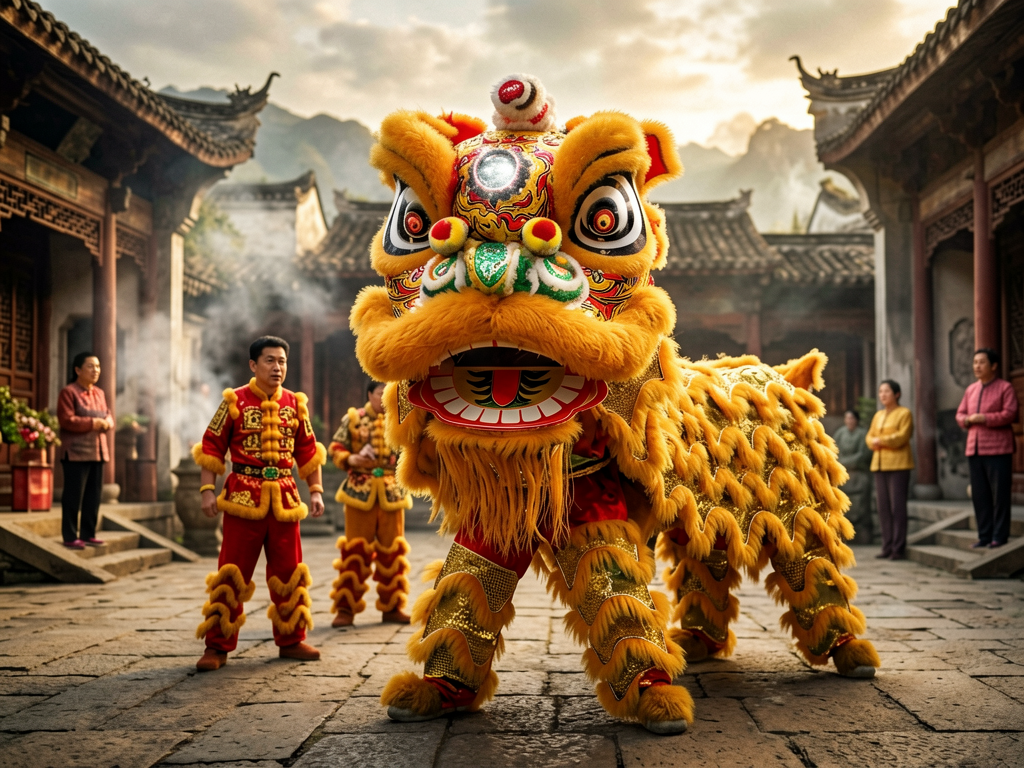
I still remember the first time I saw a lion dance in person. It wasn’t in some touristy spot in Shanghai or Beijing where they perform for photos. It was in a small, humid alleyway in Guangzhou during the Spring Festival. The air smelled like sulfur from firecrackers and roasted duck from the street vendor next door.
The drums started. Dong. Dong-dong-dong. Then the beast appeared. It was huge. Bright green scales, flashing eyes, and ears that twitched independently. I blinked, confused. Where was the lion? I was looking for a big cat, a predator. What I got was this mythical, dragon-like creature that looked like it had been stitched together by a madman with a color wheel obsession.
If you’ve never been to China during Lunar New Year, you might assume the “Lion” is just poorly designed. Trust me, I thought the same thing initially. I’m no art historian, but I know what a lion looks like. And that costume? That was definitely not a lion. But that’s kind of the point. The design tells a deeper story than any realistic animal mask ever could.
Why the Beast Looks Like a Dragon, Not a Cat
Here’s the thing nobody tells you: the Chinese lion isn’t a biological animal. It’s a mythological construct. Historically, lions don’t live in China. They aren’t native to the region. So how did people choreograph a dance about an animal they’d never seen?
The answer lies in trade routes. Ancient merchants brought back stories, and maybe some sketches, of lions from Persia and India. But without actual reference material, the imagination filled in the gaps. They blended the lion’s mane with a dragon’s snout, a bear’s ears, and a ox’s horns. The result is the “Southern Lion,” which is the version you see most often in Guangdong and Southeast Asia.
I once asked a master performer in Foshan why the snout is so long and curved. He laughed and said, “We don’t hunt like tigers. We play.” The exaggerated features allow for massive range of motion. A short, realistic snout would limit the dancer’s ability to blink, chew, and express emotion through the face.
The costume is essentially a puppet operated by two people. The front dancer controls the head, eyes, and mouth. The back dancer controls the body and tail. Because the head is so heavy and complex, it needs to be lightweight yet expressive. Hence, the dragon-like snout. It’s aerodynamic for the dance moves and allows for those hilarious expressions where the lion looks skeptical, shy, or hungry.
Red Lions, Green Lions, and Black Lions: What’s the Deal?
You’ll see lions of every color imaginable. Red, green, black, gold, even white. It’s not random. Each color carries a specific symbolic weight, usually tied to martial arts lineage or the occasion of the performance. If you’re watching a show, pay attention to the color. It tells you everything about the context before the first drumbeat hits.
Red is the most common. It represents luck, joy, and celebration. You’ll see red lions at weddings, grand openings, and the biggest festivals. It’s safe, it’s festive, and it’s universally understood. I’ve attended enough Chinese weddings to know that a red lion arriving at the ceremony is non-negotiable. It brings fortune to the couple. If you skip it, you’re basically asking for bad luck.
Then there’s the green lion. This one is trickier. In Cantonese opera and martial arts lore, green often symbolizes jealousy or anger, but in the context of the lion dance, it usually represents a young, inexperienced lion learning the ropes. It’s also associated with the Liu family or specific martial arts branches. I once saw a green lion at a temple fair in Taipei. The crowd went wild. It felt more intense than the red one. Less party, more ritual.
Black and gold lions are rarer. Black often symbolizes integrity or a fierce, serious demeanor. Gold represents wealth and nobility. You’ll mostly see these in high-level competitions or performances by prestigious martial arts schools. They don’t just want to bring luck; they want to show off their skill. These costumes are heavier, more elaborate, and the dancers train for years just to handle the weight.
There’s also the “Mei Hua” or Plum Blossom lion. It’s colorful, with patches of red, blue, yellow, and green. This one is strictly for entertainment and charity events. It doesn’t belong to a specific martial arts school. It’s the clown of the group. It’s playful, unpredictable, and always the favorite among kids. I’ve chased a Mei Hua lion around a market square in Shenzhen just to catch a glimpse of its tongue sticking out. It’s pure charm.
The Northern Style: A Whole Different Beast
If you think the Southern Lion is strange, wait until you see the Northern Lion. It’s completely different. Geographically separated by the Yangtze River, the styles diverged centuries ago. The Northern lion looks much more like a traditional lion. It has a rounder head, shorter snout, and often includes a calf or dog under its belly. Yes, a calf. I know. Sounds weird. But it’s part of the legend.
The legend says the lion is a divine beast that protects against evil spirits. The calf represents the soul of the person who raised it. When the lion dances, it’s playing with its companion. It’s a story of loyalty and friendship. The Northern lion also has bells attached to its body. The sound is crucial. It guides the drummer and keeps the rhythm tight.
I tried learning a few basic steps of the Northern style with a group in Beijing. The costume is lighter but requires different agility. The Southern lion relies on low stances and powerful legwork. The Northern lion is all about jumping, rolling, and balancing on high poles. Watching a Northern lion balance on a single pole while spinning its head is terrifying. My heart was pounding just watching it. The noise from the bells was deafening. It felt less like a dance and more like an acrobatic stunt.
The differences go beyond aesthetics. The Southern lion uses “high pillar” sets for competitions. The Northern lion uses “mound” sets or street performances. The music is different too. Southern drumming is slow, deliberate, and heavy. Northern drumming is fast, frantic, and intricate. You can’t mix them up. It’s like comparing jazz to classical music. Both are beautiful, but they require totally different approaches.
More Than Just a Show: The Spiritual Weight
For years, I treated the lion dance as background noise. Just another colorful event in a sea of festivals. I was wrong. To many older Chinese folks, the lion dance is sacred. It’s not just a performance; it’s a ritual. The “Eye Dotting Ceremony” before the dance is serious business. A master priest or senior master uses a brush dipped in cinnabar to paint the lion’s eyes.
Once the eyes are dotted, the lion wakes up. It gains spirit. It becomes a living entity. If you disrespect the lion during the performance–by touching it casually or laughing inappropriately–you’re insulting the deity within. I learned this the hard way. Early on, I tried to pet a resting lion. The master stopped me immediately. His face was stone cold. He didn’t yell, but his silence was louder than any shout. From then on, I kept my distance unless invited.
The lion also “eats greens” before the show. This is a ritual where the lion plucks a bunch of lettuce, often with a red envelope (hongbao) hidden inside, and “chews” it before spitting it out. The lettuce symbolizes prosperity (“lettuce” sounds like “wealth” in Cantonese). The hongbao is passed to the host as a gift of good fortune. It’s a beautiful exchange of energy. Money for blessings. It feels transactional, sure, but it’s rooted in generosity.
I’ve seen lions refuse to eat the greens if the atmosphere is off. If the crowd is rowdy or disrespectful, the lion will act moody. It might hide its head or stumble intentionally. The dancers are highly trained to read the room. It’s a feedback loop. The audience’s energy affects the lion, and the lion’s performance affects the audience. It’s a psychological game as much as a physical one.
Why You Should Care About the Details
Next time you see a lion dance, don’t just watch the acrobatics. Look at the costume. Is it red or green? Does it have a snout or a round head? Listen to the drums. Are they slow and heavy or fast and frantic?
Understanding these details changes the experience. It stops being just a loud, noisy spectacle and becomes a rich cultural narrative. You start seeing the history in every stitch. You feel the weight of tradition in every jump. It’s a reminder that in China, nothing is superficial. Even a party animal has a soul.
I still love the chaos of the festival. The noise, the smoke, the crowds. But now, when I see that green-eyed, dragon-snouted beast bounce down the street, I smile. I know it’s not a lion. And that’s exactly why it’s perfect.