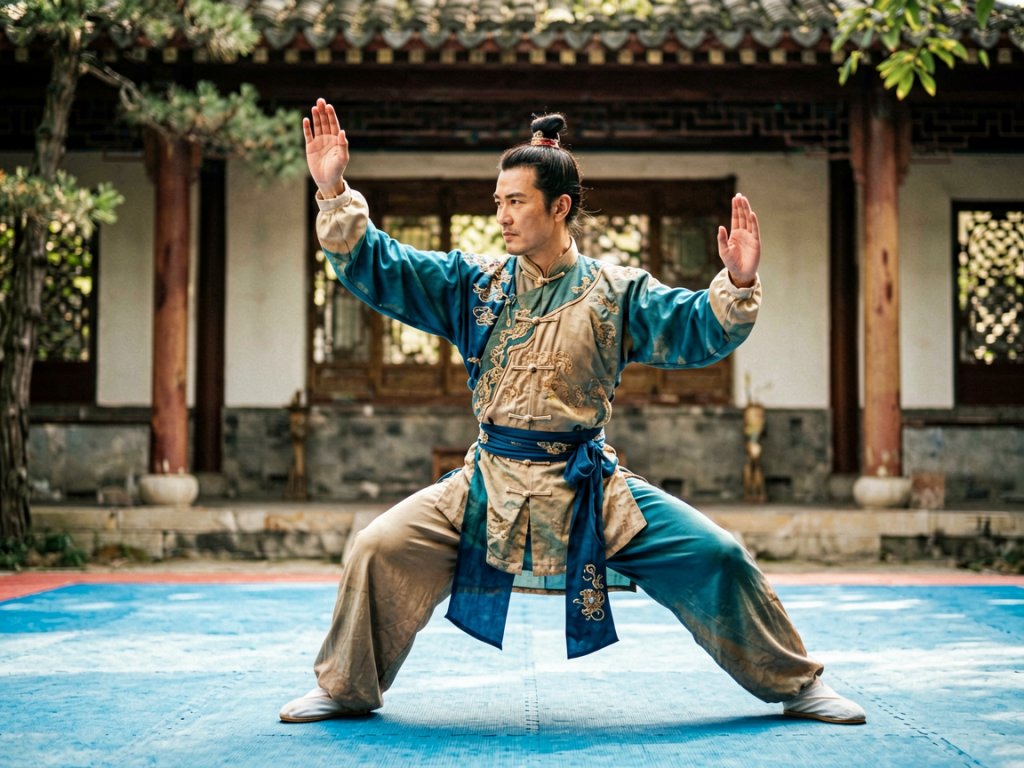
I remember standing in a damp courtyard in Foshan, Guangdong, sweating through my shirt. The air smelled of old stone, incense, and wet earth. Across from me stood Master Chen, a man whose legs looked like they were carved from iron wood. He wasn’t big. He was compact. Dense.
He told me to punch him. Just a simple jab. I swung. He didn’t block it. He just stepped inside my guard, grabbed my wrist, and twisted. It happened so fast I didn’t even feel pain until I was already on my back.
“Too much wind,” he said, pointing at my extended arm. “Northern styles swing like the wind. Southern styles strike like lightning.” That sentence stuck with me for years. It’s the difference between where you’re from and how you fight.
The Great Divide
If you’ve ever watched kung fu movies, you know the visual shorthand. You see actors flying through the air, doing spinning kicks that would leave any normal person dizzy. That’s northern Chinese martial arts. It’s flashy. It’s athletic. It’s born in the cold, open plains of Hebei and Shanxi provinces.
Then you look south, to Guangdong, Guangxi, and Fujian. The styles here are different. They’re lower to the ground. They rely on strong stances, rigid structures, and short-range power. There’s very little kicking. And if there is, it’s usually a low chop aimed at the knee or shin.
Why such a stark contrast? It’s not just tradition. It’s geography. It’s climate. And honestly, it’s what people ate for breakfast.
I grew up thinking these were just two flavors of the same cuisine. But living here for eight years, I’ve realized they’re practically alien worlds. The north is vast, flat, and cold. The south is mountainous, humid, and lush. You adapt your body to survive the terrain.
Legs vs. Hands
In the north, the ground is flat. You have room to move. You can spin, jump, and kick high because there’s nowhere to hit your leg against. Northern styles like Changquan (Long Fist) emphasize long, flowing movements. It’s beautiful to watch. It’s also incredibly exhausting to practice.
But try doing a high roundhouse kick in a narrow alleyway in Guangzhou. You’ll hit a wall. Or a basket. Or someone’s head. The southern environment is cramped. Streets are tight. Farms are small. You don’t have space for big, sweeping kicks.
So southern martial artists adapted. They kept their legs low. They used them for stability, not for flair. This gave rise to the famous “horse stance.” I’ve spent hours holding that squat. My thighs burned. I wanted to cry. But it taught me one thing: power comes from the base.
Master Chen used to say, “If your root is weak, your fist is empty.” In the north, they might say, “If your speed is slow, you get hit.” Both are true. But the southern style prioritizes being unmovable. The northern style prioritizes being untouchable.
I tried learning both. I’m still terrible at both, by the way. But I can tell you this: the northern kicks require flexibility. The southern punches require tension. You can’t fake either. I felt foolish trying to punch a brick with soft hands. It doesn’t work.
The Food Factor
Here’s the part no one talks about in textbooks: diet. Nutrition changes how your body moves. It changes your muscle mass. It changes your energy levels.
Southern Chinese food is light. It’s fresh. It’s steamed. Think dim sum, congee, and delicate seafood dishes. There’s a lot of soup. Lots of greens. The southern fighter tends to be leaner, faster, and more agile in short bursts. Their bodies aren’t weighed down by heavy, dense meals.
Northern food? Oh, boy. We’re talking dumplings, noodles, buns, and heavy stews. The climate is colder, so you need calories. You need warmth. Northerners tend to build larger frames. They’re taller on average. They have more mass to throw around.
This explains why northern styles favor long strikes. More mass behind a long punch means more impact. Southern styles favor short, crisp strikes. Less mass, but higher velocity. It’s physics meeting physiology.
I remember eating a giant bowl of beef lamian in Xi’an. I felt heavy for two days. Then I went to a training session in Guangzhou after a meal of steamed fish and bok choy. I felt light. I felt ready to snap.
Does food make you a better fighter? Maybe not directly. But it shapes the culture. It shapes the body type. And over centuries, those bodies developed techniques that suited them best. It’s not a coincidence. It’s adaptation.
Anecdotes from the Dojo
Let me tell you about a sparring match I witnessed in Shanghai. Two students faced off. One was a northern stylist, tall and lanky. The other was southern, stocky and solid. The northerner kicked high, trying to keep distance. The southerner walked forward, ignoring the kicks, closing the gap.
When the southerner got close, he threw a chain of punches. Left-right-left. Fast. Accurate. The northerner couldn’t retreat fast enough. He got clipped on the nose. Game over.
The teacher laughed. “See?” he said. “You can’t kick someone if they’re already in your pants.” It’s crude, but it’s accurate. Southern styles thrive in clinch range. Northern styles die there.
Another time, I watched a Wing Chun practitioner demonstrate centerline theory. He didn’t move his feet much. He just redirected force. It looked boring at first. But then he stopped a powerful Muay Thai kick without blocking it. He just shifted his angle slightly and tapped the attacker’s balance point.
That’s southern efficiency. No wasted motion. No theatrical spins. Just straight lines and direct attacks. It’s not pretty. It’s effective. And sometimes, effective is better than pretty.
Philosophy in Motion
Beyond the physical differences, there’s a philosophical split. Northern styles often draw from Buddhist and Daoist ideals of flow and emptiness. You go with the momentum. You yield to overcome.
Southern styles are more practical. They’re influenced by Confucian values of structure and discipline. You hold your ground. You maintain your form. You don’t bend unless you have to.
I prefer the northern aesthetic. It looks like dance. It looks like art. But I respect the southern pragmatism. When you’re fighting for survival in a crowded market, you don’t want to spin. You want to strike.
Both have merit. Neither is superior. But they reflect different ways of seeing the world. The north sees space as an opportunity. The south sees space as a constraint.
Which Should You Learn?
If you’re in China and want to start training, don’t pick a style because it looks cool in a movie. Pick one that fits your body and your location.
If you live in Beijing, join a northern club. You’ll find more partners who understand your frame. If you’re in Shenzhen, look for Wing Chun or Hung Gar. The culture there supports shorter, tighter movements.
I tried Tai Chi in Hangzhou. It was peaceful. But it wasn’t for me. I’m too restless. I need to hit something. So I switched to Baguazhang. The circle walking made sense. It felt natural.
Find what feels right. Don’t force a square peg into a round hole. Martial arts are personal. They’re an extension of who you are. Your background, your diet, your home–they all matter.
Final Thoughts
China is huge. It’s complex. And its martial arts are no exception. To understand the difference between north and south, you have to look beyond the technique. Look at the land. Look at the food. Look at the people.
I’m still learning. I’ll probably never be a master. But every time I step onto the mat, I appreciate the depth of this history. It’s not just about fighting. It’s about living.
Next time you see a kung fu film, ask yourself: where did this come from? Was it born in the snow or the rain? The answer might surprise you.