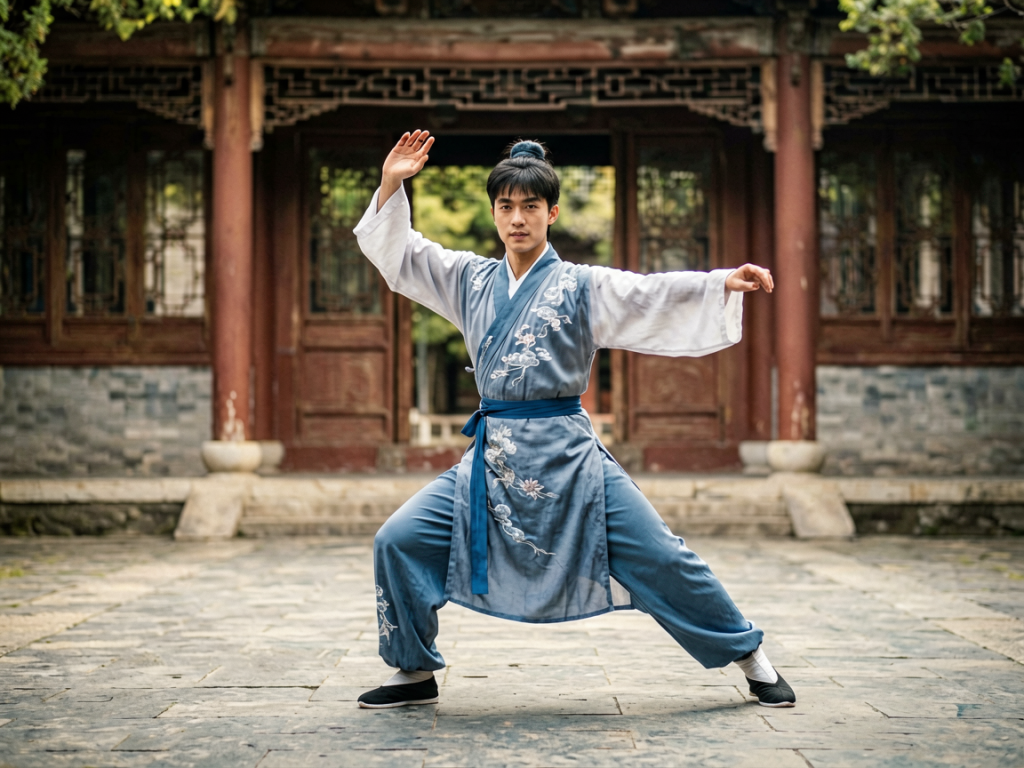
The Humdrum of the Hangzhou Morning
I still remember the first time I saw it. It was early autumn in Hangzhou, around 6 AM. The air was thick with that distinct, humid mist that clings to the West Lake area. I was sitting on a stone bench, nursing a baozi that was slightly too hot to handle, watching the locals go through their morning rituals.
Most people were jogging or doing tai chi in small, stationary groups. But then there was this one old man in the corner of the park. He wasn’t standing still. He wasn’t punching the air. He was walking. Just walking. But he was walking in a perfect, continuous circle.
His hands were held close to his chest, palms flat, fingers relaxed. His head turned sharply every few steps, eyes fixed on one direction while his body spun around. It looked less like exercise and more like a slow-motion vortex. I couldn’t look away. There was something hypnotic about the rhythm of it. It didn’t look like he was fighting anyone. It looked like he was dancing with the space itself.
That was my introduction to Baguazhang, specifically the circle walking form known as *Zhuan Gong*. At the time, I thought it was just a weird warm-up. I had no idea that those slow, repetitive steps were about to dismantle my anxiety brick by brick.
Why My Brain Kept Racing
To understand why circle walking helps, you have to understand what my brain was like before I started. Living in China for eight years is exhausting in its own way. The sensory overload is real. The constant notifications on WeChat, the noise of construction sites, the sheer volume of people everywhere–it all adds up.
I was suffering from that modern, low-grade panic that never quite lets go. My mind was always three steps ahead, worrying about emails I hadn’t sent yet or conversations I hadn’t had. I was physically present in Hangzhou, but mentally, I was usually in New York or London.
I stumbled into a martial arts studio near Wuchang Street because I wanted to learn something “authentic.” The instructor, Master Chen, didn’t ask me to punch anything. He didn’t even teach me a form. He just pointed to a empty space in the courtyard and told me to walk.
“Keep your knees bent,” he said, his voice dry and matter-of-fact. “Keep your waist loose. Look over your left shoulder. Walk until you forget where you started.”
I was skeptical. Seriously? That was it? I spent the first ten minutes thinking about my grocery list. Then I started thinking about whether I remembered to turn off my stove. By minute twenty, I was annoyed. My legs burned. My neck hurt from keeping my head twisted. I felt ridiculous, spinning in circles like a top that wouldn’t fall down.
But then, something shifted. Around the forty-minute mark, the noise in my head started to quiet down. It wasn’t gone, but it moved further away. I stopped thinking about the grocery list. I stopped thinking about the future. All that existed was the next step, the bend of the knee, the turn of the wrist.
It’s easier to explain if you think of your brain as a browser with too many tabs open. Circle walking forces you to close them one by one. You can’t worry about your job when you’re trying to maintain your balance on the curve. You can’t plan your dinner when you’re focusing on keeping your center of gravity low.
The Physics of Mental Clarity
There’s a technical term for this state in martial arts philosophy. They call it *Wu Wei*, or effortless action. It sounds pretentious until you feel it. It’s that moment when your conscious mind gets bored of micromanaging everything and steps back, letting your subconscious take over.
Baguazhang is built on the concept of change and circulation. In traditional Chinese medicine and philosophy, stagnation is the root of all sickness–both physical and mental. When energy, or *Qi*, gets stuck, you get tension. You get anger. You get stress.
Walking in circles mimics the movement of the universe. It’s not linear. Life doesn’t move in straight lines, even though our modern minds try to force it into straight lines. Goals, deadlines, linear progress charts. It’s exhausting.
Circle walking accepts the spiral. You keep moving, but you’re also turning. You’re changing direction without stopping. This visual and physical metaphor actually reprograms how you react to problems. When things go wrong in your life–and they will–you don’t stop. You don’t break. You just adjust your angle and keep moving forward.
I noticed this shift in my daily life within a month. Usually, when I face a sudden problem, my heart rate spikes. I get defensive. I shut down. But after weeks of spinning in that courtyard, I found myself pausing. I’d take a breath. I’d look at the problem from a different angle. I realized I wasn’t trapped. I was just on a different part of the circle.
It’s not magic. It’s mechanics. By engaging the large muscle groups of the legs and hips in a sustained, rhythmic motion, you calm the sympathetic nervous system. You lower your cortisol levels. You literally sweat out the stress. But the mental component is what sticks.
The Discipline of Doing Nothing Special
One of the hardest parts of learning Baguazhang isn’t the physical difficulty. It’s the boredom. And I mean that literally. You are walking in a circle. Over and over again. For an hour. Sometimes two hours.
In a world obsessed with novelty, this is radical. We scroll through TikTok feeds because we’re afraid of being bored for even three seconds. But circle walking demands that you sit with the boredom. You have to watch the clouds. You have to listen to the birds. You have to feel the texture of the ground beneath your feet.
I remember one rainy Tuesday. The courtyard was slick with water. I was frustrated. I had had a bad day at work. A client had canceled a huge contract. I walked faster. I tried to rush through the movements. Master Chen stopped me immediately.
“You cannot rush the circle,” he said. “The circle waits for no one, but it accepts all speeds. But if you rush, you lose your root. If you lose your root, you fall.”
He made me stand still for five minutes. Just stand. Feel the rain on my face. Stop trying to fix my mood. Stop trying to analyze the contract loss. Just be wet. Just be cold. Just be alive.
That five minutes of stillness within the movement taught me more about emotional regulation than ten years of therapy. It taught me that emotions are like weather. They come, and they go. You don’t fight the rain. You just adjust your umbrella.
This practice builds a mental resilience that is incredibly practical. When you’re used to maintaining focus while your body is under mild stress, everyday stressors feel smaller. A rude comment from a colleague doesn’t knock you off balance. A missed train doesn’t ruin your week. You’ve already practiced falling and getting back up, hundreds of times, in that circle.
How to Start Without Looking Ridiculous
If you’re living in China or visiting, you might be curious about trying this. Don’t let the awkwardness stop you. Everyone starts out looking ridiculous. Even Master Chen looked funny when he first started.
You don’t need special gear. Just comfortable shoes with good grip. Sneakers work fine. Avoid slippery soles. You’ll be turning on your balls of your feet, so traction is key.
Find a safe, open space. A park is ideal. If you live in an apartment complex, maybe a wide hallway or a empty parking garage works, though the fresh air helps immensely. Start small. Ten minutes a day is enough. Don’t try to go for an hour right away.
Here’s the basic posture. Bend your knees slightly. Keep your back straight, but not rigid. Imagine a string pulling the top of your head toward the sky. Hold your arms in front of your chest, elbows bent, hands open like you’re holding a beach ball. Or, try the classic “Bagua Palm” position, where your palms are flat and facing each other.
The most important part is your head. Pick a point in the distance, say ten meters ahead. Turn your head to look at that point as you walk. As you complete the circle, bring your head around with you, keeping that gaze fixed. This creates the twist in your spine that is so crucial for the internal feeling of the practice.
Don’t worry about being perfect. Your circle won’t be round at first. It will probably look like a lopsided egg. That’s fine. The goal isn’t geometric perfection. The goal is presence. Are you here? Are you moving? Are you breathing?
I’ve tried meditation apps. I’ve tried mindfulness courses. They’re helpful, sure. But nothing beats the visceral experience of moving your body in a way that forces your mind to wake up. Baguazhang circle walking isn’t just a martial art drill. It’s a mobile meditation. It’s a moving mantra.
So, the next time you’re feeling overwhelmed, stressed, or just plain stuck, try stepping into the circle. Leave your linear problems outside the ring. Spin for a while. See what happens. You might find that the answers you’re looking for aren’t in front of you. They’re inside you, waiting for you to catch up.
And hey, if anyone asks why you’re walking in circles in the park, just tell them you’re working on your root. They’ll probably just nod and walk away. But you’ll know the truth. You’re building a mind that’s as flexible and strong as your body.