The Sweat-Stained Truth
It was humid enough to drink in Guangzhou that Tuesday afternoon. I was standing in a cramped basement studio in Haizhu District, staring at a piece of timber that looked like it had survived a war.
The instructor, Uncle Lin, hit it with a knuckle. Thwack. The sound was sharp, satisfying, and surprisingly painful. I rubbed my hand for a second, wincing, then went back to it.
I’m no martial arts expert. I’ve never fought a street brawl. But I’ve lived in China for eight years, and I’ve realized something about the wooden dummy, or mook jong.
People think it’s just a fancy punching bag. It’s not. It’s a teacher. And if you’re into self-defense, it’s teaching you the most uncomfortable truth about fighting: speed kills, but structure saves lives.
Sound interesting? Stick with me.
It’s Not About Hitting Harder
When I first started Wing Chun, I wanted to hit like Bruce Lee. I wanted to crack ribs. I swung with everything I had, thinking power was the answer.
Uncle Lin stopped me after three seconds. He didn’t yell. He just corrected my elbow.
“You’re swinging,” he said. “You’re not connecting.”
That was my first lesson. The wooden dummy isn’t there to test your strength. It’s there to test your alignment. If your elbow is out, you lose power. If your structure is wrong, you break your wrist before you even touch the opponent.
This is huge for real self-defense. In a real fight, you’re probably scared. You’re adrenaline-dumped. Your fine motor skills go out the window.
If you rely on big, flashy swings, you’ll miss. And if you miss, you’re done. The dummy teaches you to keep your centerline tight. It forces you to trust your bones, not your muscles.
It’s counterintuitive. We’re taught to “throw a punch.” In Wing Chun, you “push” the punch. It’s a subtle difference, but it changes everything.
The Three Arms Are Your Reality
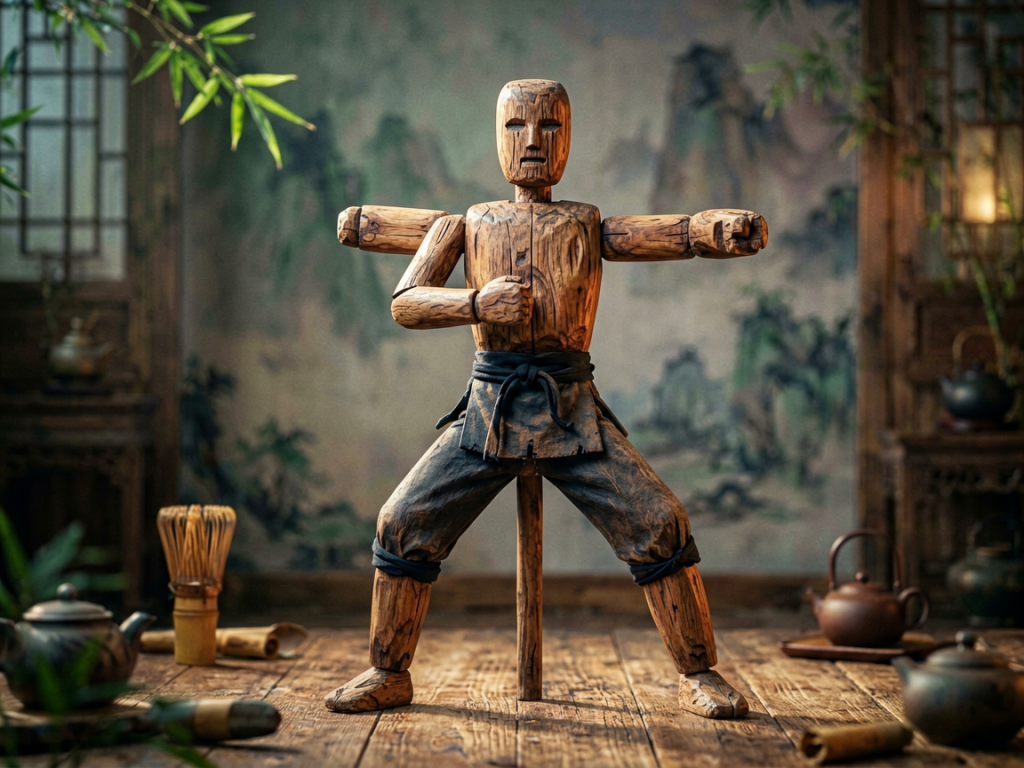
Look at the dummy. It has three arms and a leg. Top arm, bottom arm, and the horizontal arm. Plus the leg support.
At first glance, it looks like a torture device. But really, it’s a map of a fight.
The top arm is high. That’s your head or your guard. The bottom arm is low. That’s your solar plexus or your hips. The horizontal arm is the middle. That’s your sternum.
I remember practicing tan sao (palma block) against the horizontal arm. I kept slipping off. It felt slippery and wrong. Uncle Lin laughed. “You’re trying to stop it,” he said. “You’re not redirecting it.”
That’s the secret sauce. In a real altercation, someone is coming at you with intent. You can’t just block. You have to deflect and counter simultaneously.
The dummy doesn’t let you pause. You hit, you deflect, you hit again. It’s a flow. It teaches you that defense and offense aren’t separate. They’re the same movement.
Think about a bar fight. Someone grabs your shirt. You don’t step back. You don’t argue. You control their arm, break their balance, and move in. The dummy simulates that chaotic contact.
It forces you to deal with multiple angles at once. That’s terrifying at first. But once you get it, it’s empowering.
The Pain Is The Point
Let’s be honest. Hitting the wooden dummy hurts. My hands were bruised for weeks when I started.
I complained about it. I told Uncle Lin my knuckles were throbbing. He just handed me some herbal oil and told me to keep going.
“Pain is information,” he said.
This is where the rubber meets the road. In a real self-defense scenario, you will get hit. You will feel pain. If you flinch, you lose.
The dummy trains you to hit through the pain. It builds calluses, sure. But more importantly, it builds mental toughness.
I learned to stop fearing the impact. I started enjoying the connection. There’s a specific feeling when your bone structure aligns perfectly with the wood. It’s solid. It’s unshakeable.
That’s what you need in a fight. You need to be unshakeable. Not because you’re strong, but because you’re rooted.
Most people fight with their hands. Wing Chun fighters fight with their structure. The dummy teaches you to find that root.
It’s a physical meditation. You stop thinking about your day. You stop worrying about your email. You’re just there, hitting wood.
It clears the mind. And a clear mind is your best weapon.
Why The Dummy Beats The Heavy Bag
I’ve trained at gyms with heavy bags, speed bags, and even tech-enabled VR fight trainers.
None of them compare to the wooden dummy. Here’s why.
A heavy bag swings away from you. It doesn’t fight back. It doesn’t challenge your structure. You can hit it all day and still have bad habits.
The dummy is static. It doesn’t move. But it forces you to move correctly. If you’re off by an inch, you feel it immediately.
It’s honest. You can’t fake your way through a dummy drill. You either have the technique, or you don’t.
I tried a VR simulator once. It was cool, sure. But it didn’t teach me anything about body mechanics. It just taught me how to press buttons.
The dummy teaches you how to move your body in space. That’s crucial for self-defense. You need to know where your limbs are without looking.
Proprioception. That’s the fancy word. The dummy builds it. It makes your body aware of itself.
When you’re in a dark alley, or a crowded subway, you need to know exactly where your hands are. The dummy makes that knowledge automatic.
It’s A Partner, Not A Tool
Here’s the thing about the wooden dummy. It’s not a tool. It’s a partner.
You spend years with it. You learn its quirks. Some dummies are tighter. Some are looser. You adjust your technique to fit the wood.
This mirrors real life. No two fights are the same. No two attackers are the same. You can’t have a rigid plan.
You need to adapt. You need to feel. The dummy teaches you to feel.
I’ve seen students who only practice on the dummy struggle in sparring. And I’ve seen students who use the dummy as a guide excel in sparring.
The difference? Understanding. The dummy isn’t about repetition. It’s about refinement.
Every hit should teach you something. If you’re just swinging, you’re wasting time.
Slow down. Feel the wood. Listen to the sound. Thwack means you’re off. Thud means you’re in.
It’s a conversation. And if you listen, it will tell you everything you need to know.
Real World Application
So, does this actually help in a real fight? I’m no expert, but I’ve seen it work.
I was in a situation once in a taxi in Chengdu. The driver got aggressive over a route dispute. He stepped out, shouting, getting close.
I didn’t fight. But I stood differently. My center was low. My hands were up, relaxed. I wasn’t swinging. I was ready.
The driver saw that. He backed off. He didn’t like what he saw. He saw someone who wasn’t afraid to use force.
That’s the goal. De-escalation through presence.
The wooden dummy teaches you that presence. It teaches you confidence. Not arrogance, but confidence.
You know your structure holds. You know your hands are fast. You know you can handle yourself.
That confidence changes how people treat you. It’s subtle, but it’s real.
I love that about Wing Chun. It’s not just about violence. It’s about control.
The dummy is the best teacher of control I’ve ever found.
Give It A Shot
If you’re in China, find a Wing Chun school. Don’t just watch. Hit the dummy.
It’s hard. It’s painful. It’s boring at first.
But keep going. The breakthrough comes. And when it does, it’s magical.
You’ll stand there, hitting wood, and you’ll feel like you’re made of steel. You’ll feel connected to the earth. You’ll feel powerful.
And you’ll realize that real self-defense isn’t about being the biggest guy in the room.
It’s about being the most centered.
Trust me, it’s worth the bruised knuckles.