The morning mist hadn’t even lifted off the Songshan Mountains when I arrived. It was 4:30 AM. My alarm had gone off at 4:00, but I was already sweating. The air was crisp, carrying that distinct scent of pine needles and damp earth that defines the Henan province. I wasn’t alone. Around me, hundreds of other students–some kids as young as six, others grizzled veterans in their thirties–were already moving through their warm-ups.
I’m no stranger to exercise. I’ve done CrossFit, I’ve run marathons, and I’ve lifted heavy weights in Berlin and New York. But nothing prepared me for the sheer, unadulterated misery of a morning session at the Shaolin Temple. This isn’t the Kung Fu you see in the movies with slow-motion kicks and flowing robes. This is brutal, repetitive, bone-jarring conditioning.
Here’s the thing about Shaolin. People think it’s about spiritual enlightenment first. It’s not. It’s about breaking your body down until you forget it exists. Only then can you start building something new.
The 4:30 AM Wake-Up Call
My host, Master Wei, didn’t say much when I arrived. He just handed me a pair of worn canvas shoes and pointed to the courtyard. The ground was cold concrete, cracked in places where weeds had pushed through over decades. We stood in formation, fifty of us, in a square that seemed to stretch on forever.
“Stance,” he said. Just one word.
I assumed he meant horse stance. It’s the most famous one. You know the one–legs wide, knees bent, back straight. I got into position. My legs shook immediately. I held it. Ten seconds. Twenty. Then my quads started burning like they’d been injected with acid.
Master Wei walked the lines. He didn’t yell. He just tapped your back if it slumped or your knee if it bent too far. When he got to me, he tapped my lower back hard. “Relax,” he said. “Don’t fight the pain. Accept it.”
I tried. I really did. But by minute five, my vision was tunneling. I wanted to stand up. I wanted to stretch. But everyone else was still there. If I moved, I’d be the weak one. And in a place like this, being weak is a social sin.
I lasted eight minutes before my legs gave out. I collapsed onto the cold concrete, gasping for air. Master Wei looked down at me, unimpressed. “Again,” he said. Then he walked away.
I’ve done high-intensity interval training. I’ve done yoga. But holding a static position while your muscles scream in unison? That’s a different kind of hell. It’s mental as much as it is physical. You have to quiet your mind while your body is in crisis. I’m no expert, but I’d say that’s harder than running a mile in the heat.
Forms and the Art of Repetition
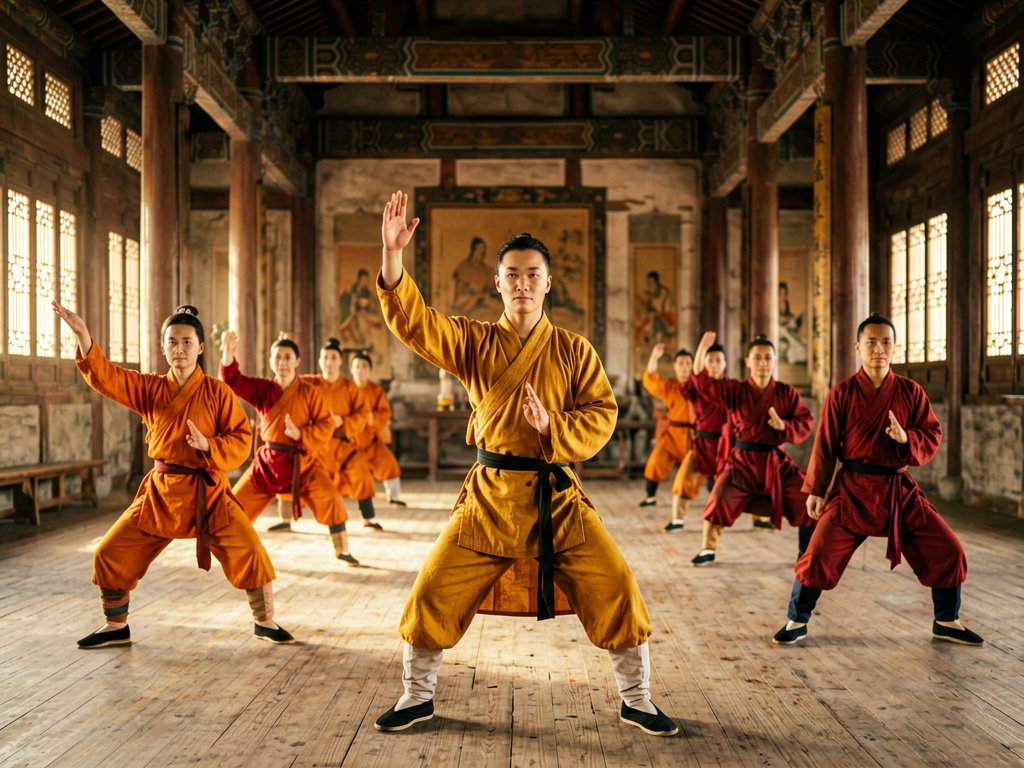
After breakfast–which was simple: congee, pickled vegetables, and weak tea–we headed to the main practice hall. The roof was high, supported by thick wooden pillars that smelled of old varnish and sweat. Sunlight streamed through the windows, illuminating dust motes dancing in the air. It looked peaceful. It wasn’t.
We spent the next three hours learning a basic form. It’s called *Yi Jin Jing*, or Muscle Change. It’s not flashy. There are no spinning kicks or acrobatic flips. It’s all about tension and release, stretching the tendons and aligning the joints.
I’ve watched YouTube tutorials on this. I thought I knew the moves. I was wrong. Doing it alone in my living room in Shanghai is one thing. Doing it with fifty people watching, while your arms feel like lead, is another.
Every movement has to be precise. If your elbow is two inches too high, the flow breaks. If your breath is out of sync, the energy doesn’t circulate. Master Wei corrected me at least twenty times in an hour. He didn’t use fancy terminology. He just said, “Too tight,” or “Let go,” or “Breathe into the feet.”
By noon, my shoulders felt like they’d been replaced with concrete blocks. My fingers were stiff. I couldn’t straighten them properly. I sat on the steps outside, rubbing my hands together, trying to get the circulation back.
A young boy from the monastery sat next to me. He looked to be about ten. His face was calm, serene even. I asked him if it hurt.
He shrugged. “It’s just practice,” he said. “When you’re tired, you’re training.”
I laughed, but he wasn’t joking. That’s the mindset here. Pain isn’t a signal to stop. It’s a signal that you’re working. I’ve never encountered a culture that embraces discomfort so completely. In the West, we try to avoid pain at all costs. We take ibuprofen for everything. Here, pain is a teacher.
The Afternoon Grind
Lunch was quick. Noodles, again. Then we were back on the mats. This time, it was partner drills. Sparring, but controlled. You don’t hit hard. You hit with intent. You learn to sense your opponent’s movement before they make it.
I was paired with a guy named Li. He’s from Sichuan. He’s small but incredibly fast. We went through the basic strikes: punch, block, step, turn. It sounds simple. But when someone is trying to stop you, it’s chaotic.
I kept getting caught off guard. Li would feint left and go right. I’d block the left, and there’d be a punch to my ribs. It hurt. A lot.
“Stop thinking,” Li said between rounds. “Just feel.”
I tried. I really did. But my brain was still racing. *What’s he going to do next? Where is my guard?* I couldn’t shut it off. Li saw it. He smiled. “You’re fighting the air,” he said. “Fight me.”
We went at it for another two hours. By the end, I was bruised. I had a purple mark on my left rib and a scraped knee. I was exhausted, drained, and utterly miserable. And yet, I couldn’t wait to do it again.
There’s a weird high that comes from physical exhaustion. Your ego gets stripped away. You can’t pretend to be cool or smart or important when you’re lying on the floor gasping for air. You’re just a body. And that’s liberating.
Evening Meditation and Reflection
Dinner was the last meal of the day. Again, simple. Rice, tofu, and green vegetables. No meat. The monks don’t eat meat. I’m not a vegetarian, but I have to admit, after a day of such intense physical exertion, the light meal sat well with me. Heavy food would have just made me sluggish.
After dinner, we sat in the meditation hall. It was dim, lit only by candles. The silence was heavy. We sat in lotus position for an hour. Just sitting. Watching the breath.
This is where the real work happens. The day’s training breaks the body down. The meditation rebuilds the mind. If you skip this part, the training is just exercise. With the meditation, it becomes a practice.
I struggled. My mind wandered. I thought about my email. I thought about the coffee I missed. I thought about how much my legs hurt. Master Wei walked around, ringing a small bell. The sound was sharp, cutting through the noise in my head. Every time I drifted, the bell rang. It was a gentle reminder to come back.
To be fair, I’m not good at meditation. I’ve tried apps. I’ve tried courses. But sitting in that hall, surrounded by people who have dedicated their lives to this discipline, it felt different. It wasn’t about achieving a state of nothingness. It was about presence. Being here. Now.
As the night deepened, the pain in my body faded into a dull ache. My mind, however, was quiet. For the first time in years, I wasn’t planning tomorrow or regretting yesterday. I was just sitting. It was peaceful. It was strange. It was powerful.
Why Most People Quit
I talked to a few other foreigners who had tried the training program. Most of them lasted three days. Some lasted a week. A few stayed for a month. But the vast majority quit within the first week.
Why? Is it the food? No. It’s bland, but it’s nutritious. Is it the sleep? No. It’s comfortable. Is it the cost? Maybe. It’s not cheap. But money isn’t the main barrier.
It’s the mind.
Most people aren’t ready to give up control. They aren’t ready to be vulnerable. They aren’t ready to fail in front of others. Shaolin training strips all that away. It’s humbling. It’s terrifying. It’s beautiful.
I asked Master Wei why so many people quit. He smiled. “Because they want the result,” he said. “They don’t want the process.”
He’s right. We live in a world of instant gratification. We want the six-pack without the gym. We want the fluency without the study. We want the peace without the pain. Shaolin offers none of that. It offers the process. All of it.
My Takeaway
I left the temple after five days. I couldn’t do more. My body was screaming. My mind was fried. But I felt lighter. Not physically, but mentally.
The trip changed me. Not in a dramatic, cinematic way. But in small, subtle shifts. I’m more patient. I’m more aware of my breath. I’m less afraid of discomfort.
I tried to explain this to my friends back home. They looked at me like I was crazy. “You went to China to get beaten up?” they asked.
Sort of. But also, no. I went to learn how to stand still in a chaotic world. I went to learn that pain is temporary, but the lessons are permanent.
If you’re thinking about going, don’t do it for the Instagram photos. Don’t do it because you want to look like Bruce Lee. Do it because you’re tired of running from your own mind. Do it because you want to see what you’re capable of when you push past the point of quitting.
It’s hard. Really hard. It’s boring. It’s painful.
And it’s worth it.
I’m still sore. My knees click when I walk. My back aches. But I sleep better. I eat better. I think clearer. That’s the real Kung Fu. Not the kicks. Not the punches. The life.
So, are you ready? Or are you just looking for another workout? Because this isn’t a workout. This is a transformation. And it starts with standing still at 4:30 in the morning.