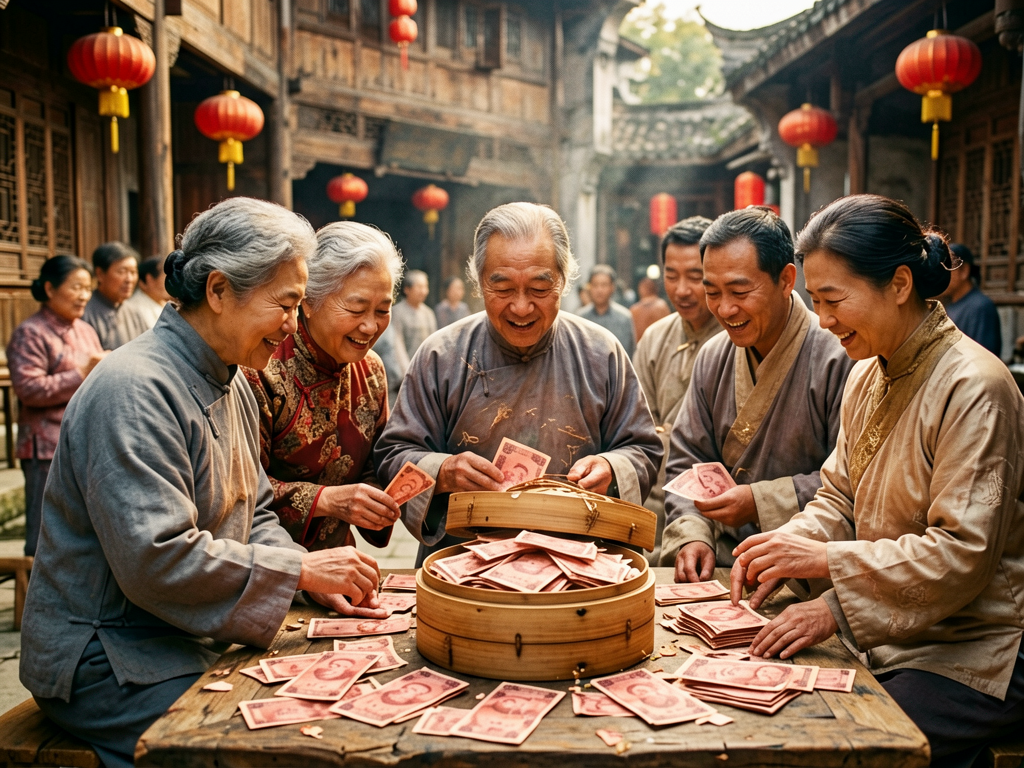
It was 2018, and the air in my Beijing courtyard smelled like sulfur and burnt paper. I stood there, shivering in the late autumn chill, watching my grandmother toss a stack of glossy, golden rectangles into a metal trash can. The flames licked up, hungry and bright, turning the fake billions into ash in seconds.
I was twenty-four then, fresh out of university and still carrying that arrogant Western belief that “money doesn’t grow on trees” applied everywhere, even in the afterlife. I thought it was weird. I thought it was wasteful. I definitely didn’t get it.
But here’s the thing. I didn’t just observe that scene. I participated in it. And over the last eight years living in China, I’ve learned that burning joss paper isn’t about superstition in the scary, Halloween sense. It’s about love. It’s about logistics. It’s about the most practical form of grief I’ve ever seen.
If you’ve never seen a Chinese funeral or a Qingming Festival tribute, you might think we’re lighting money on fire for no reason. You’re not wrong. But the “reason” is deeper than you’d expect. Let me walk you through it.
The Great Inflation of the Underworld
First, you have to understand the economics of the spirit world. In Chinese folk religion, the afterlife isn’t a magical cloud where you float on harps. It’s a society. It has bureaucracy. It has rent. It has taxes.
My grandfather, who has been gone for ten years, is still a working-class man in my family’s eyes. He doesn’t need gold bars. He needs cash. But not just any cash. He needs the high-denomination bills.
You’ve seen them. Those big, fake hundred-dollar bills with the face of the Yellow Emperor or some ancient deity on them. They’re printed on cheap, thin paper. They look ridiculous to the untrained eye. But to the spirits, they’re currency.
I remember asking my dad why we couldn’t just buy real money to burn. He looked at me like I’d suggested we burn US dollars to buy bread in Peking. “The exchange rate is bad,” he said simply. “Real money has no value there. This paper? This is legal tender.”
It’s a fascinating concept. The underworld suffers from hyperinflation. That’s why you see stacks of these bills. A single bill isn’t enough. You need a bundle. You need a brick of it. It’s like trying to buy a house with a single penny in the real world, except the house is a spirit villa and the penny is a real dollar.
So, we burn the fake money because it’s the only thing that spends. It’s practical. It’s honest. And honestly? It makes more sense than leaving a credit card with no limit on a tombstone.
It’s Not Just Money
Here’s where it gets interesting. You think we only burn paper cash? Think again. I was in Shanghai a few years ago, visiting a friend’s grandfather. We bought a whole set of gifts.
We burned paper iPhones. Paper cars. Paper houses. I’m not joking. I held a paper Ferrari in my hands. It was flimsy. The wheels were cardboard. But we lit it up anyway.
Why? Because we want our ancestors to be comfortable. If your dad loved driving, send him a paper car. If your mom liked gadgets, send her a paper tablet. It’s the ultimate gift-giving culture, translated into ash.
I tried to explain this to a colleague from New York once. She looked horrified. She asked if we were encouraging materialism in death. I laughed until I cried. It’s not materialism. It’s care.
When someone dies, you stop buying them coffee. You stop asking how their knee pain is. You stop sending them WeChat messages. Burning paper goods is the last way you can “send” something to them. It’s the final delivery.
It’s better than most alternatives because it’s tangible. You can hold the gift. You can light it. You can watch it transform. That visual of the smoke rising is the delivery notification. *Package delivered.*
The Social Contract of Grief
But there’s another layer. A social one. You can’t talk about burning joss paper without talking about face, or *mianzi*.
In China, funerals are public events. They’re not private affairs. The whole neighborhood comes. The whole company sends flowers. And everyone brings red envelopes with cash for the family.
This isn’t just about helping with funeral costs. It’s about reciprocity. When you burn the paper money, you’re also acknowledging the support of the living. It’s a communal act of mourning.
I remember a funeral in Xi’an. The courtyard was full of smoke. People were shouting names of the deceased. “Grandpa Li! Grandpa Li! Take this money!”
It sounded chaotic. It was messy. But it was also incredibly supportive. No one sat alone. No one felt isolated in their grief. Everyone was burning paper together. Everyone was sending goods together.
To be fair, this can feel overwhelming if you’re introverted. I struggled with the noise. But I’ve grown to love it. It forces you to engage. You can’t hide your sadness in China. You have to burn the paper. You have to accept the envelope. You have to smile through the tears.
It’s a pressure, sure. But it’s also a safety net. The smoke binds the community.
Why Real Money Doesn’t Work
Let’s address the elephant in the room. Why not just burn real banknotes?
Okay, first, it’s illegal. The People’s Bank of China has strict rules about defacing currency. So you can’t legally burn RMB. But even if you could, it wouldn’t work spiritually.
The belief is that the underworld has its own economy. Real money is foreign currency to them. Like trying to use Euros in a market that only accepts Yen. It’s useless.
Plus, think about the symbolism. Burning real money feels like destruction. It feels like loss. Burning paper money feels like creation. You’re making something new for them. It’s an act of generation, not destruction.
I saw a tourist in Guilin once try to burn a stack of 100-yuan bills. The local vendor stopped him. “Hey, hey,” he said, waving his hand. “No no. Use this.” He pointed to the colorful, fake bills on the stall next door.
The tourist looked confused. The vendor explained it patiently. “That’s for them. This is for you. Don’t mix them up.”
It was a perfect metaphor. The living keep the real value. The dead get the symbolic value. Both are necessary. Both have their place.
A Modern Twist
Now, things are changing. I’ve noticed that younger people in China are getting creative. The traditional paper money is still there, but so are new items.
I bought a paper PS5 for my cousin’s brother last year. We also burned paper WeChat accounts. Yes, really. A paper phone with a printed QR code. It didn’t scan, obviously. But the intent was clear.
“Keep your connection open,” my cousin said. “Even if you’re offline.”
It blew me away. It’s adapting. It’s not stuck in the past. The core idea remains the same: provide for your loved ones. But the items change with the times.
This flexibility is why the tradition survives. It’s not a rigid dogma. It’s a living practice. It evolves. And that’s why it feels so real to me.
What It Means to Me
So, why do Chinese people burn fake money?
I’m no anthropologist. I’m just a guy who’s lived here for eight years. But I think it’s because it makes the abstract concrete. Death is intangible. Grief is heavy and shapeless.
But a stack of paper bills? That’s something you can hold. You can count it. You can light it. You can watch it turn to smoke and rise into the sky.
It gives grief a direction. It gives love a vehicle.
I used to think it was silly. I thought it was backward. Now, when I lose someone, I don’t just cry. I buy the paper. I go to the corner, or the park, or the designated burning area. And I send it up.
I talk to them. I tell them I’m okay. I tell them I miss them. And I watch the smoke rise.
It’s not magic. It’s not superstition. It’s a conversation. And sometimes, you need to shout your love into the fire to believe it was heard.
If you’re ever in China during Qingming or a funeral, don’t judge the smoke. Join them. Buy a bundle. Light a match. Say hello to someone you’ve lost.
You might be surprised by how light you feel when the ash falls.