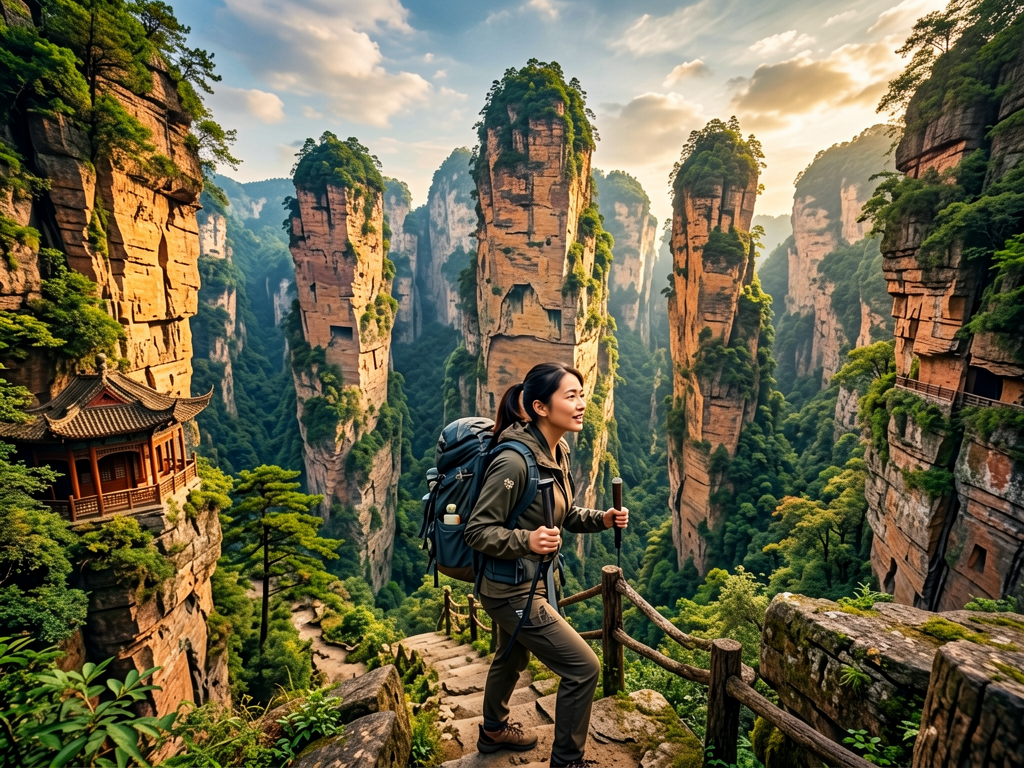
Look, I get it. When I first booked a flight to Hunan province, I was basically thinking, “Let me see the floating mountains from James Cameron’s blockbuster.” I had my GoPro ready. I had my outfit planned. I even bought the wrong kind of hiking boots because I thought I’d be scaling cliffs for three days straight.
I was wrong. So, so wrong.
But here’s the thing about Zhangjiajie. It’s not just a movie set. It’s a chaotic, sweaty, awe-inspiring beast that eats tourists for breakfast and spits them out with a story they’ll tell for the rest of their lives. The movie got the quartz-sandstone pillars right, sure. But it got the vibe totally wrong. There are no Na’vi warriors here. Just thousands of Chinese tourists, steep elevators, and a level of humidity that feels like you’re walking through warm soup.
Trust me, though. You still need to go. Just don’t go in. Well, go, but go prepared. Let me walk you through what actually happens when you hike Zhangjiajie, minus the CGI filters.
The Glass Walkway That Makes Your Knees Weak
We’ve gotta talk about the glass skywalk. It’s the first thing most folks think of when they imagine visiting Yuanjiajie. And honestly? It’s terrifying in the best way possible.
I remember standing there, looking down through three inches of tempered glass at a 300-meter drop. My stomach did a little flip. Not from fear, exactly, but from the sheer absurdity of it. You’re walking on air. Or at least, on a transparent platform suspended in mid-air.
The best part? It’s not just for show. You can actually walk out onto the edge. The railing is low. I kept glancing down between my legs, trying to convince my brain that I wasn’t going to fall through. I’m not an adrenaline junkie, but I found myself leaning out anyway. Just a little. Just enough to feel the wind hit my face.
It’s better than most theme park rides because it’s real. The mountain is real. The drop is real. The only fake thing is the floor. And that’s what makes it so memorable. You’re not just looking at a view; you’re confronting your own vertigo in the middle of nowhere.
Just wear pants with pockets. You’ll want to keep your phone secure. And maybe don’t eat a heavy lunch before you try it. I learned that the hard way when my stomach did a somersault during the walk.
Up, Up, and Away on the Bailong Elevator
If you’re expecting to hike up to the main viewing platforms in Wulingyuan, think again. You’ll walk for hours, get exhausted, and miss half the scenery. The smart move? Take the Bailong Elevator.
It’s the world’s tallest outdoor elevator. Yes, really. It goes up 326 meters in about two minutes. I was skeptical. I thought it would feel like a cheesy tourist trap. But when the doors opened and we started rising, I was genuinely blown away.
You’re suspended in mid-air, climbing up the side of a cliff face. The trees get smaller. The clouds get closer. It’s like being inside a video game loading screen. I saw a group of elderly Chinese ladies chatting calmly about their grocery lists while the elevator shot upward. I was gripping the handrail, knuckles white. We’ve got that going for us, apparently.
The ride is smooth. Too smooth, maybe. You don’t feel the ascent. One moment you’re at the base, the next you’re looking down on the forest canopy. It’s disorienting in a good way. It sets the tone for the whole trip: you’re entering a different world, one where gravity is more of a suggestion.
After the elevator, you hop on a shuttle bus and head to the viewing platforms. That’s where the real magic happens. The pillars here are called the “Avatar Hallelujah Mountains,” but locals just call them the peaks. They stick up from the ground like fingers reaching for the sky. And they’re covered in green. Thick, lush, tropical green.
I stood there for an hour, just watching the mist roll through the valleys. It’s hard to capture that on camera. The depth is unreal. You feel small. Tiny, actually. And that’s a feeling I love to have when I travel.
The Golden Whip Stream: Where Things Get Quiet
Most people rush through Yuanjiajie. They take the photos, nod in awe, and hop on the next bus. But if you want to truly understand Zhangjiajie, you need to go to Golden Whip Stream.
It’s a flat, paved path that runs along a river at the bottom of the valley. No elevators. No glass floors. Just walking. And it’s my favorite part of the entire trip.
The air is cooler here. The noise of the crowds fades away, replaced by the sound of rushing water and chirping birds. I walked for about two hours, stopping every few minutes to take photos or just sit on a rock and eat a banana.
It’s peaceful. Serene, even. And it’s free, if you have your entrance ticket. The path is well-maintained, but it’s not easy. There are steps. Lots of them. But they’re gentle. You’re walking at the speed of nature, not the speed of a tour group.
I saw monkeys there. Real ones. Not the tame zoo animals you see in parks. These guys were wild. One of them jumped onto a fence and stared me down. I didn’t move. He didn’t move. We had a standoff. He eventually lost interest and scampered away. I’m still not sure who won.
The water is crystal clear. I dipped my hand in. It was cold. Refreshing. It washed away the sweat and the dust of the day. This is where I felt most connected to the place. Not because I was high up on a mountain, but because I was down low, grounded, listening to the mountain breathe.
Eating Your Way Through the Fog
You can’t talk about Zhangjiajie without talking about the food. The local Hunan cuisine is spicy. Like, “make you cry” spicy. And I loved every bite of it.
I’m not a huge spice fan, but I pushed myself. I ordered a dish called “Sanxia” (three fresh), which is basically fish cooked with chili peppers and ginger. The steam from the bowl hit my face, and I immediately started sweating. But the flavor? Explosive. Salty, spicy, savory. It woke me up in a way coffee never could.
I found a small noodle shop near the park entrance. No sign, just a bunch of locals eating. I sat down and pointed at whatever looked good. The owner handed me a bowl of rice noodles with minced pork and pickled vegetables. It was simple. Perfect. I ate it in ten minutes and asked for another bowl.
Don’t be afraid of the spice levels. If you’re in China, embrace it. It’s part of the culture. The sweat is part of the experience. You’ll feel alive. And honestly, after a day of hiking, a spicy meal hits different. It’s comfort food in its most intense form.
Also, buy local fruits. I tried a type of bamboo shoot that was pickled in vinegar. It was tangy, crunchy, and weirdly addictive. I bought three bags to take home. My friends thought I was crazy. They were wrong.
When to Go (And When to Run)
Timing is everything. Zhangjiajie is popular. Like, “packed” popular. If you go on a Chinese national holiday, you’ll be moving at the speed of a glacier. I went during a weekend in October, and it was still crowded. But not unbearable.
Spring and autumn are best. The weather is mild. The leaves change color in autumn, which is pretty. But spring? Spring is magical. The mist is thicker. The flowers are blooming. It feels like something out of a fantasy novel.
Summer is hot. Humid. I’m not kidding about the soup-like humidity. If you go then, start early. Like, 6 AM early. By noon, the heat is oppressive. You’ll be dripping with sweat before you even leave the hotel.
Winter is quiet. Cold, but quiet. The snow on the pillars is stunning. But some paths are closed. And the cable cars might stop due to wind. I’d recommend winter only if you’re okay with a bit of uncertainty. But if you want solitude, it’s the time to go.
Just remember: book your tickets online in advance. The park limits the number of visitors per day. I almost missed out because I waited until the last minute. The ticket booth was empty, but the online system showed “Sold Out.” I had to check a different day. Lesson learned.
The Verdict: It’s More Than Just a Movie Set
Here’s the truth. Zhangjiajie isn’t just a destination. It’s an experience. It’s exhausting. It’s expensive. It’s crowded. But it’s also beautiful. In a way that words can’t really capture.
I came in expecting to see the Avatar mountains. I left with a deeper appreciation for the landscape, the food, and the people. The movie gave me a reason to go. But the place itself gave me a reason to remember.
So, go. Bring good shoes. Bring an appetite. And leave your expectations at the gate. You might not see Na’vi. But you’ll see something better. You’ll see yourself, small and humbled, standing on the edge of the world.
And that’s worth the hike.